Kiwi Investor Blog · kiwiinvestorblog.com · Revisiting the balanced portfolio, rising rates, and the bond-equity correlation regime we are now in.
Introduction
For most of the past two decades, holding both shares and bonds in a balanced portfolio provided a natural cushion: when shares fell, bonds typically rose. That cushion largely disappeared between 2022 and 2024. In this post, I revisit what happened, why it matters, and what a recent AQR article suggests investors should consider when thinking about portfolio positioning in the current environment.
After five years away — a return to the scene
It has been almost five years since my last post on Kiwi Investor Blog. A lot has changed, and, in some respects, a great deal has confirmed what many of us in the investment community were highlighting in 2020 and 2021, after a period of ultra-low interest rates.
Back then, the central argument of this blog was straightforward: the traditional 60/40 balanced portfolio was riskier than many investors appreciated.
The events of the past five years have provided a live test of those concerns.
What happened between 2022 and 2025: a brief recap
The period from early 2022 through to mid-2023 was one of the most challenging in decades for holders of traditional balanced portfolios:
- Inflation surged globally, reaching multi-decade highs. The Reserve Bank of New Zealand raised the Official Cash Rate from a historic low of 0.25% in late 2021 to a peak of 5.50% by mid-2023.
- Global bond markets suffered their worst losses in a generation on the back of sharply higher interest rates. As a result, the very asset class investors had long relied upon to cushion sharemarket falls was itself falling hard.
- Sharemarkets also declined significantly in 2022. This meant both shares and bonds fell simultaneously. Unfortunately, the classic diversification benefit of the 60/40 portfolio simply did not materialise.
- KiwiSaver balanced funds had a difficult 2022. Many New Zealand investors experienced meaningful negative returns in their retirement savings for the first time in years.
- Markets recovered strongly in 2023 and 2024, led by a narrow group of US technology stocks. Bond returns remained subdued relative to historical norms.
- Global sharemarkets performed strongly in 2025, again predominately led higher by a narrow range of large cap technology companies.
In short: the traditional balanced portfolio proved riskier than many investors had assumed, and bonds failed to play their expected defensive role when it mattered most.
A longer view: the negative stock-bond correlation was never the historical norm
Before turning to AQR’s recent research, it is worth pausing on an important piece of historical context that is often overlooked in discussions about portfolio construction.
The negative correlation between shares and bonds, the relationship that made the 60/40 portfolio so effective for two decades, has not been a permanent feature of financial markets.
As displayed in the graph below, the correlation between US shares and bonds turned negative following the 2000 dot-com sharemarket crash and has persisted for two decades because of falling interest rates, low and stable inflation, and repeated central bank intervention.
For most of the twentieth century prior to that shares and bonds moved together, not apart. A positive stock-bond correlation was the norm, not the exception.
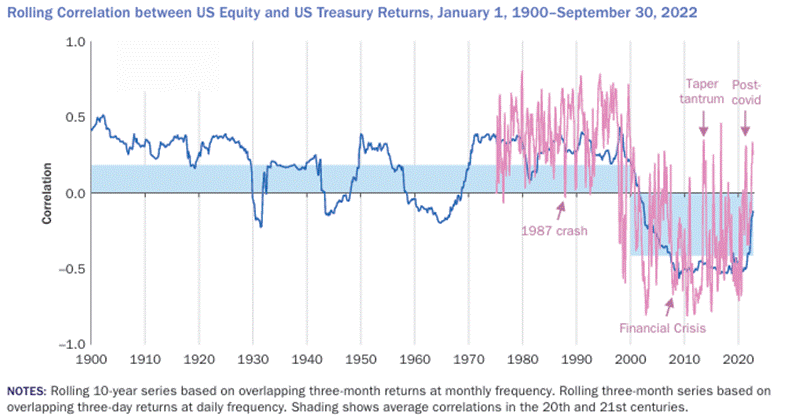
Source: AQR
This matters enormously for how investors should think about the current environment. The question is not simply whether the correlation has changed but whether the conditions that produced the negative correlation regime are likely to return. And here the outlook is sobering.
The structural forces that drove four decades of falling interest rates and bond outperformance have largely reversed or are in the process of doing so. Geopolitical fragmentation, persistently high government debt levels across developed economies, and increased public spending on defence and infrastructure all point toward a structural environment of higher and less predictable inflation. Historically, these conditions have produced positive stock-bond correlations.
A return to the pre-2022 environment of reliably negative correlations would likely require either a significant market dislocation (a severe deflationary shock or financial crisis) or a fundamental reversal of these structural trends. Neither appears likely in the near term.
This is not a reason for despair. But it is a reason to think carefully about portfolio construction in a way that does not simply assume the conditions of 2000–2020 will reassert themselves.
For the avoidance of doubt, bonds remain a critical allocation within a well-diversified portfolio, particularly during periods of economic or market stress when equities can fall sharply. Their value lies not in delivering constant high returns but in reducing drawdowns, providing liquidity, and reducing volatility when risk assets are under pressure.
The real question is not whether bonds still matter but how to size the allocation and what additional diversifiers can be added to a portfolio to strengthen resilience across different economic and market environments.
AQR’s timely new research: what the data says
Against this backdrop, an article published on 8 April 2026 by AQR Capital Management is essential reading for anyone thinking seriously about portfolio construction. The article is titled “A Positive Stock-Bond Correlation Is a Terrible Reason to Add More Equity Risk to Your Portfolio”.
AQR observe that the share-bond correlation turned positive a few years ago, and that this shift has prompted a wave of industry advice about what investors should do in response. The chain of logic being presented to investors runs roughly as follows: bonds are now positively correlated with shares; they can therefore no longer diversify a portfolio; and so investors should sell bonds and replace them with something else. That “something else” has included private credit, buffer funds, and in some cases, even cryptocurrency.
AQR’s response to this reasoning is direct: the proposed alternatives typically carry significantly more shares-like risk than the bonds they are replacing. Far from improving diversification, AQR argue investors following this advice often end up with portfolios more exposed to sharemarket risk than before.
The data AQR present is striking. Over the five years to February 2026, government bonds carried an equity (shares) beta of approximately 0.2 (meaning for every dollar in bonds, investors received roughly 20 cents of equity market exposure). Private credit (proxied by listed Business Development Companies) carried a beta of 0.7,more than three times that of bonds. Buffer funds came in at 0.6. Bitcoin at 2.1. In each case, the proposed “bond replacement” carried substantially more equity risk than the asset it was meant to replace.
AQR also make a broader and equally important point. The 60/40 portfolio has always been dominated by equity risk. A good or bad year for shares has almost always determined whether it was a good or bad year for a diversified portfolio, regardless of what bonds were doing. The current environment has not created a new diversification problem. It has made an existing and longstanding one more visible.
On the future path of the correlation, AQR’s view is consistent with the structural analysis above. Where inflation uncertainty is the dominant macro driver, as both inflation news and growth news can move shares and bonds in the same direction when inflation is the primary concern (see AQR article below), the correlation is likely to remain positive. Only a genuine stabilisation of inflation expectations, or a large market dislocation that reactivates the traditional flight-to-quality dynamic in bond markets, would be expected to restore a reliably negative correlation. AQR note that recent geopolitical developments and the pressures on central bank independence make such a stabilisation uncertain.
What AQR’s research points toward
It is useful to summarise what AQR’s analysis suggests investors and their advisers should be thinking about.
The core conclusion is that the search for genuine diversification is not new, and should not be distorted by the recent correlation shift. The goal has always been to identify return streams that are structurally uncorrelated with equity market risk. AQR point to strategies that have demonstrated this quality in practice during the positive correlation period, including trend-following strategies (managed futures), which have a long track record of performing well during sustained equity drawdowns, and equity market neutral strategies, which seek returns from stock selection while neutralising broad market exposure.
What AQR argue firmly against is the substitution of bonds with assets that are simply equity risk in a different packaging. Private credit, structured products with equity-linked payoffs, and cryptocurrency all carry equity-like risk regardless of how they are labelled or marketed. Calling a strategy “private” or “defined outcome” does not change its underlying economic character.
For deeper reading: what drives the stock-bond correlation?
Readers who want to go further into the mechanics of why the stock-bond correlation changes over time will find an earlier AQR paper particularly valuable. Published in the Journal of Portfolio Management (March 2023), “A Changing Stock–Bond Correlation: Drivers and Implications” by Brixton, Brooks, Hecht, Ilmanen, Maloney, and McQuinn provides a rigorous macroeconomic framework for understanding what determines whether shares and bonds move together or apart.
The paper’s central insight is that the stock-bond correlation is not primarily driven by the level of inflation, but by the relative importance of inflation uncertainty versus growth uncertainty, and the relationship between the two. The key findings are as follows.
Opposite sensitivities to growth, similar sensitivities to inflation. Equities benefit from positive growth news while bonds suffer, so growth shocks push them in opposite directions. Inflation shocks, by contrast, hurt both asset classes, pushing them in the same direction.
What matters is the relative volatility of growth and inflation news. When growth uncertainty dominates, as it did during most of the 2000s and 2010s, the stock-bond correlation tends to be negative, meaning bonds provide genuine diversification. When inflation uncertainty dominates, as it did in the 1970s, 1980s, and 1990s, and again more recently, the correlation tends to be positive.
Alternatives can fill the diversification gap. The paper shows that if sustained inflation uncertainty drives the stock-bond correlation higher, investors can compensate by raising allocations to assets with structurally different return drivers. These assets include commodities (which benefit from inflation shocks rather than being hurt by them), trend-following strategies, and market-neutral approaches. This conclusion is directly consistent with the more recent AQR research discussed above.
The paper is freely available on the AQR website. For those wanting to understand the theoretical underpinnings of the correlation shift we are living through, it remains one of the clearest and most practically grounded treatments of the subject available: A Changing Stock–Bond Correlation: Drivers and Implications (AQR, 2023)
The bottom line
The April 2026 AQR article is a pointed rebuke of an investment industry that, in their view, is using a real and legitimate shift in the correlation regime as cover to sell products that simply add more equity risk under a different name. The core message is that the right response to a world where bonds diversify less effectively is not to add assets that diversify even less. As always, the objective is to find strategies with structurally different return drivers.
That conclusion aligns with the portfolio construction themes this blog has explored over the years, and it will continue to inform the analysis here going forward.
The era of reliably negative stock-bond correlations was the exception, not the rule.
Investors who plan for it to return may be waiting a long time. Those who build portfolios capable of navigating a wider range of market and economic environments are better placed for what lies ahead.
As always, I welcome comments, feedback, and questions from readers.
For further reading on these themes, please see earlier Kiwi Investor Blog posts on the role of alternatives in a robust portfolio, goal-based investing, and the limitations of the traditional balanced fund. The AQR article referenced in this post ‘A Positive Stock-Bond Correlation Is a Terrible Reason to Add More Equity Risk to Your Portfolio’ (April 8, 2026) is freely available at aqr.com. Readers are encouraged to read it in full
Disclosure
Please read the Kiwi Investor Blog Disclosure Statement before relying on any information in this post. This blog is written for information and discussion purposes only. Nothing in this post constitutes financial advice. All investment strategies involve risk, including the loss of principal. Readers should seek independent financial advice before making any investment decisions. The views expressed in this post are my own and do not represent the views of my employer or any organisation with which I am affiliated.

