Welcome Back — and Welcome

This Is What Kiwi Investor Blog Is About.

Ten essential posts. The ideas that define this blog. A guide for new readers and a reminder for those who have been here before.

After five years away, this post reintroduces Kiwi Investor Blog: what it is, what it is trying to do, and where to start if you are new. Rather than simply listing posts, it curates ten of the blog’s most read and enduring pieces and explains, for each one, why the idea matters, what it challenges, and what a thoughtful investor should take away from it. If you have been here before, think of this as a reset. If you are new, think of it as a guided introduction to a set of ideas that most mainstream New Zealand financial commentary does not cover.

What Kiwi Investor Blog is — and what it is trying to do

Kiwi Investor Blog started from a simple observation: there is a gap between how the world’s best institutional investors think about building and managing investment portfolios, and what is available to most New Zealand investors in the way of independent commentary, research, and analysis.

The large global pension funds, endowments, sovereign wealth funds and insurance companies that manage hundreds of billions of dollars collectively have access to world-class research, sophisticated portfolio construction frameworks, and decades of accumulated experience in areas that barely feature in mainstream New Zealand investment conversation.

This blog’s purpose is to close that gap. Not by dumbing ideas down, but by translating concepts, frameworks, and research that institutional investors use routinely and making them accessible, relevant, and practically useful for a wider New Zealand audience.

The topics that most NZ financial commentary doesn’t cover — and why they matter

Mainstream personal finance commentary in New Zealand is overwhelmingly focused on a narrow set of topics: KiwiSaver fund selection, property versus shares, mortgage strategy, and the basics of budgeting. These are all very worthwhile subjects and covered well. But they represent a small fraction of the investment landscape that a thoughtful investor needs to navigate.

Kiwi Investor Blog has, since its inception, focused on topics that are discussed in institutional investment circles but are largely absent from the broader NZ investment conversation:

  • Behavioural finance — the systematic ways in which investor psychology undermines investment outcomes, and how to design against it.
  • True diversification — what it actually means to hold a portfolio whose components behave differently from each other, and why most ‘diversified’ funds are less diversified than they appear.
  • Alternative investments — the role of hedge funds, private equity, real assets, and liquid alternatives in building more robust portfolios, and why New Zealand investors have historically had limited access to them.
  • Liability-driven investing — the framework used by insurance companies and some pension funds to match assets to income needs, applied to the challenges facing individual NZ investors approaching and in retirement.
  • The limitations of the balanced fund — why the standard 60/40 portfolio carries more risk than investors fully appreciate, and what more robust alternatives look like.
  • Fees and their compounding effect — why even small fee differences are large in the long run, and how to read an investment fee disclosure with clear eyes.

None of these topics is especially complex. But none of them gets the sustained, rigorous treatment in NZ financial media that they deserve. That is the gap this blog exists to fill.

Ten essential posts — a guided tour of the blog’s core ideas

The following posts are selected from the blog’s archive based on two criteria: enduring relevance (the ideas are as important today as when they were written) and distinctive value (the content covers ground that is not widely available elsewhere in the NZ investment commentary landscape). They are presented with a summary of the key argument and the single most important insight for a reader to take away.

Post 1  ·  BEHAVIOURAL FINANCE

1. The Benefits of Behavioural Finance in the Investment Planning Process

Why do smart, well-informed investors consistently make the same predictable mistakes? Behavioural finance is the field that answers that question by drawing on psychology and economics to explain why human beings are systematically poor at managing money, even when they know better. This post introduces the key concepts of loss aversion, overconfidence, herding, and recency bias and explains how awareness of these tendencies can be built into the investment planning process itself. It remains the most-read post in the blog’s history for good reason: the insights are universal, timeless, and directly actionable.

Key insight:  Knowing that markets are irrational is useless if your own behaviour is equally irrational. The goal of behavioural finance is not just to understand markets but to also understand yourself as an investor.

→  Read: The Benefits of Behavioural Finance

Post 2  ·  PORTFOLIO CONSTRUCTION

2. A Short History of Portfolio Diversification

Diversification is the only free lunch in investing. That phrase is used so often it has lost its meaning. This post traces the intellectual history of diversification from Harry Markowitz’s 1952 mean-variance framework through to modern multi-asset portfolio construction, explaining not just what diversification means but why it works, when it doesn’t, and what institutional investors have learned about it over seven decades of practice. It is a foundational piece for any serious investor.

Key insight:  True diversification is not about holding many assets. It is about holding assets whose returns are driven by genuinely different economic forces. A portfolio of 20 funds all exposed to the same equity risk premium is not diversified.

→  Read: A Short History of Portfolio Diversification

Post 3  ·  PORTFOLIO CONSTRUCTION

3. Disaggregation of Investment Returns

One of the most practically useful posts on the blog — and one of the most underappreciated. Most investors think of their portfolio return as a single number. This post explains how that return can be decomposed into its component parts: the market beta, the factor exposures, the manager skill (alpha), and the fees extracted at each layer. Understanding which part of your return is coming from where is the foundation of intelligent portfolio evaluation. It is a concept that institutional investors use routinely and that is almost entirely absent from retail investment commentary in New Zealand.

Key insight:  Before you can assess whether your investment manager is adding value, you need to understand what portion of their return you are already paying for through passive exposure and what, if anything, is left over after fees.

→  Read: Disaggregation of Investment Returns

Post 4  ·  PORTFOLIO CONSTRUCTION

4. The Traditional Diversified Fund Is Outdated — Greater Customisation Is Required

The one-size-fits-all balanced fund has been the default vehicle for New Zealand investors for decades. In most cases this suits investors well. This post makes the case for greater portfolio customisation to reflect the investor’s specific risk tolerances, time horizons, liability profiles, and income objectives. The argument draws on how large institutional investors such as pension funds, endowments, and sovereign wealth funds think about portfolio construction, and asks why individual investors are routinely offered something less sophisticated.

Key insight:  The institution managing a $10 billion pension fund does not use a balanced fund. It builds a portfolio around the specific liabilities it needs to meet. Sophisticated individual investors have specific financial goals too, and their portfolios should reflect them.

→  Read: The Traditional Diversified Fund Is Outdated

Post 5  ·  BEHAVIOURAL FINANCE

5. The Psychology of Portfolio Diversification

A companion piece to the behavioural finance post, focused specifically on how psychological biases affect the way investors think about and implement diversification. Home bias, the tendency to overweight familiar domestic assets, familiarity bias, mental accounting, and the illusion of diversification (holding many funds that are all highly correlated) are explored in detail. The post bridges theory and practice in a way that is immediately useful for investors reviewing their own portfolios.

Key insight:  New Zealand represents less than 0.2% of global equity market capitalisation. A portfolio that over-invested in NZ assets is not diversified; it is a concentrated bet on a single small economy.

→  Read: The Psychology of Portfolio Diversification

Post 6  ·  FEES & COSTS

6. Five Myths About Investment Management Fees — Broadening the Fee Debate

Fees are the single most controllable variable in long-term investment outcomes, yet they are consistently misunderstood, underestimated, and obscured by the investment industry. This post takes on five of the most persistent myths about investment management fees, including the idea that higher fees reflect higher quality, that fee differences of less than 1% are immaterial, and that all fees are disclosed in a way that allows meaningful comparison. It is a post that will save most readers money simply by changing how they read a fund disclosure document.

Key insight:  A fee difference of 0.5% per annum appears small. Over 30 years of compounding on a $200,000 portfolio, it is worth approximately $85,000 in foregone wealth. Fees compound in exactly the same way as returns, but in reverse.

→  Read: Five Myths About Investment Management Fees

Post 7  ·  RISK & PORTFOLIO THEORY

7. Understanding the Impact of Volatility on Your Portfolio

Volatility is the most widely cited measure of investment risk and one of the most widely misunderstood. This post explains not just what volatility means statistically, but why the path of returns matters as much as their average level, a concept with profound implications for retirement investors in particular. The mathematics of volatility drag, the asymmetry between gains and losses, and the practical consequences for portfolio construction are all covered in a way that builds genuine intuition rather than just presenting formulas.

Key insight:  A portfolio that falls 50% needs to rise 100% to recover. This asymmetry, not widely appreciated by investors, is why managing downside risk is not the same as being conservative. It is the foundation of intelligent risk management.

→  Read: Understanding the Impact of Volatility on Your Portfolio

Post 8  ·  PORTFOLIO CONSTRUCTION

8. Time to Move Away from the Balanced Portfolio — They Are Riskier Than You Think

Written before the events of 2022 made its argument unavoidable, this post explains why the traditional 60/40 balanced fund carries more risk than investors typically appreciate. The equity risk dominance of the balanced portfolio and the fact that in almost any significant market downturn, the balanced fund falls alongside equities is laid out clearly. The conditions under which bonds genuinely diversify equity risk are examined, along with the circumstances in which that diversification fails. Events since 2022 have provided a live demonstration of precisely the argument this post made.

Key insight:  In 49 of the last 50 years, when the US equity market fell, a 60/40 balanced portfolio also fell. The 40% in bonds has provided partial cushioning, but it has never been a genuine alternative to equity risk management.

→  Read: Time to Move Away from the Balanced Portfolio

Post 9  ·  BEHAVIOURAL FINANCE

9. The Regret-Proof Portfolio

One of the most distinctive posts on the blog and one that addresses a dimension of investing that almost no one in the industry discusses seriously. Regret is a powerful emotion in investment decision-making: the regret of having sold before a rally, of having stayed in a falling market, of having chosen the wrong fund. This post proposes a framework for thinking about portfolio construction that accounts for the investor’s own emotional responses not to indulge them, but to design a portfolio the investor can actually stick with through market cycles. A portfolio that is technically optimal but behaviourally unsustainable is not actually optimal.

Key insight:  The best investment strategy is not the one with the highest expected return. It is the one you will actually implement, hold through downturns, and not abandon at the worst possible moment. Regret minimisation is a legitimate and underused design principle.

→  Read: The Regret-Proof Portfolio

Post 10  ·  RETIREMENT INCOME

10. More on Liability Driven Investing (LDI) for Beginners

Liability-driven investing is the framework that the world’s largest insurance companies and pension funds use to manage the challenge of converting an asset pool into a reliable income stream. In New Zealand, it is almost entirely absent from the mainstream conversation about retirement planning. LDI is directly applicable to the situation facing every KiwiSaver member approaching retirement. This post introduces the core concept in plain English: rather than asking ‘how do I maximise returns?’, LDI asks ‘what income do I need, when do I need it, and how do I build a portfolio that reliably delivers it?’ It is the intellectual foundation for this blog’s approach to retirement income, and remains as relevant today as when it was written.

Key insight:  Every investor approaching retirement has liabilities: the income they will need each year to fund their lifestyle. LDI matches assets to those liabilities explicitly. It is not exotic or complex. It is simply asking the right question first.

→  Read: More on Liability Driven Investing for Beginners

Further posts are planned across the blog’s core topics of behavioural finance, portfolio construction, alternatives, and retirement income.

A note to returning readers

If you subscribed to this blog before 2021 and found your way back: thank you. A lot has happened in markets over the past five years that this blog warned about, and a lot has changed that is worth examining together. The core thesis of this blog has not changed: that institutional-quality thinking, made accessible and applied honestly to the NZ investment landscape, is genuinely valuable to all investors. If anything, the events of 2022–2026 have reinforced rather than undermined that view.

If you are new: welcome. Start anywhere on the list above. The posts are independent of each other and do not require prior knowledge of the blog. What they do require is a willingness to engage with investment ideas, to question conventional wisdom, to think in frameworks rather than rules of thumb, and to accept that good investment thinking is demanding but not inaccessible.

The gap between how institutional investors think about this and what most New Zealanders have access to is real. This blog’s aim is to narrow it, one post at a time.

Kiwi Investor Blog covers portfolio construction, behavioural finance, alternative investments, retirement income, and KiwiSaver from an independent, institutional perspective. It does not constitute financial advice.

Please read the Disclosure Statement on the blog before relying on any content. The views expressed are those of the author personally and do not represent the views of their employer or any organisation with which the author is affiliated.

Disclosure

Please read the Kiwi Investor Blog Disclosure Statement before relying on any information in this post. This blog is written for information and discussion purposes only and does not constitute financial advice. All investment strategies involve risk, including the loss of principal. Readers should seek independent financial advice tailored to their individual circumstances. The views expressed are those of the author personally and do not represent the views of their employer or any organisation with which the author is affiliated.

The 60/40 Portfolio Five Years On and What Has Changed?

Kiwi Investor Blog  ·  kiwiinvestorblog.com  ·  Revisiting the balanced portfolio, rising rates, and the bond-equity correlation regime we are now in.

Introduction

For most of the past two decades, holding both shares and bonds in a balanced portfolio provided a natural cushion: when shares fell, bonds typically rose. That cushion largely disappeared between 2022 and 2024. In this post, I revisit what happened, why it matters, and what a recent AQR article suggests investors should consider when thinking about portfolio positioning in the current environment.

After five years away — a return to the scene

It has been almost five years since my last post on Kiwi Investor Blog. A lot has changed, and, in some respects, a great deal has confirmed what many of us in the investment community were highlighting in 2020 and 2021, after a period of ultra-low interest rates.

Back then, the central argument of this blog was straightforward: the traditional 60/40 balanced portfolio was riskier than many investors appreciated.

The events of the past five years have provided a live test of those concerns.

What happened between 2022 and 2025: a brief recap

The period from early 2022 through to mid-2023 was one of the most challenging in decades for holders of traditional balanced portfolios:

  • Inflation surged globally, reaching multi-decade highs. The Reserve Bank of New Zealand raised the Official Cash Rate from a historic low of 0.25% in late 2021 to a peak of 5.50% by mid-2023.
  • Global bond markets suffered their worst losses in a generation on the back of sharply higher interest rates. As a result, the very asset class investors had long relied upon to cushion sharemarket falls was itself falling hard.
  • Sharemarkets also declined significantly in 2022. This meant both shares and bonds fell simultaneously. Unfortunately, the classic diversification benefit of the 60/40 portfolio simply did not materialise.
  • KiwiSaver balanced funds had a difficult 2022. Many New Zealand investors experienced meaningful negative returns in their retirement savings for the first time in years.
  • Markets recovered strongly in 2023 and 2024, led by a narrow group of US technology stocks. Bond returns remained subdued relative to historical norms.
  • Global sharemarkets performed strongly in 2025, again predominately led higher by a narrow range of large cap technology companies.

In short: the traditional balanced portfolio proved riskier than many investors had assumed, and bonds failed to play their expected defensive role when it mattered most.

A longer view: the negative stock-bond correlation was never the historical norm

Before turning to AQR’s recent research, it is worth pausing on an important piece of historical context that is often overlooked in discussions about portfolio construction.

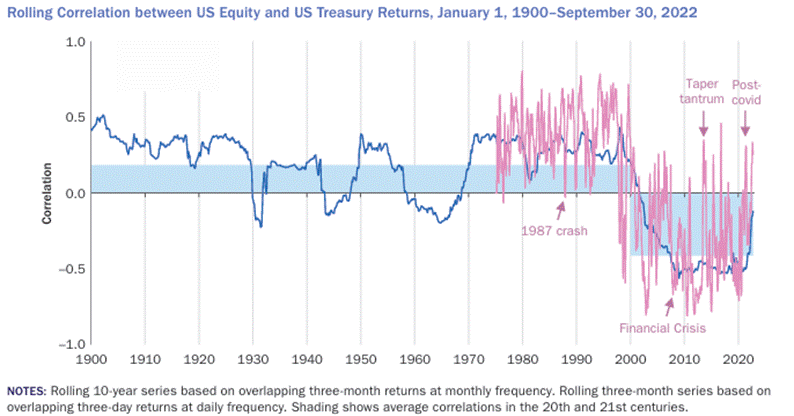
The negative correlation between shares and bonds, the relationship that made the 60/40 portfolio so effective for two decades, has not been a permanent feature of financial markets.

As displayed in the graph below, the correlation between US shares and bonds turned negative following the 2000 dot-com sharemarket crash and has persisted for two decades because of falling interest rates, low and stable inflation, and repeated central bank intervention.

For most of the twentieth century prior to that shares and bonds moved together, not apart. A positive stock-bond correlation was the norm, not the exception.

Source: AQR

This matters enormously for how investors should think about the current environment. The question is not simply whether the correlation has changed but whether the conditions that produced the negative correlation regime are likely to return. And here the outlook is sobering.

The structural forces that drove four decades of falling interest rates and bond outperformance have largely reversed or are in the process of doing so. Geopolitical fragmentation, persistently high government debt levels across developed economies, and increased public spending on defence and infrastructure all point toward a structural environment of higher and less predictable inflation. Historically, these conditions have produced positive stock-bond correlations.

A return to the pre-2022 environment of reliably negative correlations would likely require either a significant market dislocation (a severe deflationary shock or financial crisis) or a fundamental reversal of these structural trends. Neither appears likely in the near term.

This is not a reason for despair. But it is a reason to think carefully about portfolio construction in a way that does not simply assume the conditions of 2000–2020 will reassert themselves.

For the avoidance of doubt, bonds remain a critical allocation within a well-diversified portfolio, particularly during periods of economic or market stress when equities can fall sharply. Their value lies not in delivering constant high returns but in reducing drawdowns, providing liquidity, and reducing volatility when risk assets are under pressure.

The real question is not whether bonds still matter but how to size the allocation and what additional diversifiers can be added to a portfolio to strengthen resilience across different economic and market environments.

AQR’s timely new research: what the data says

Against this backdrop, an article published on 8 April 2026 by AQR Capital Management is essential reading for anyone thinking seriously about portfolio construction. The article is titled “A Positive Stock-Bond Correlation Is a Terrible Reason to Add More Equity Risk to Your Portfolio”.

AQR observe that the share-bond correlation turned positive a few years ago, and that this shift has prompted a wave of industry advice about what investors should do in response. The chain of logic being presented to investors runs roughly as follows: bonds are now positively correlated with shares; they can therefore no longer diversify a portfolio; and so investors should sell bonds and replace them with something else. That “something else” has included private credit, buffer funds, and in some cases, even cryptocurrency.

AQR’s response to this reasoning is direct: the proposed alternatives typically carry significantly more shares-like risk than the bonds they are replacing. Far from improving diversification, AQR argue investors following this advice often end up with portfolios more exposed to sharemarket risk than before.

The data AQR present is striking. Over the five years to February 2026, government bonds carried an equity (shares) beta of approximately 0.2 (meaning for every dollar in bonds, investors received roughly 20 cents of equity market exposure). Private credit (proxied by listed Business Development Companies) carried a beta of 0.7,more than three times that of bonds. Buffer funds came in at 0.6. Bitcoin at 2.1. In each case, the proposed “bond replacement” carried substantially more equity risk than the asset it was meant to replace.

AQR also make a broader and equally important point. The 60/40 portfolio has always been dominated by equity risk. A good or bad year for shares has almost always determined whether it was a good or bad year for a diversified portfolio, regardless of what bonds were doing. The current environment has not created a new diversification problem. It has made an existing and longstanding one more visible.

On the future path of the correlation, AQR’s view is consistent with the structural analysis above. Where inflation uncertainty is the dominant macro driver, as both inflation news and growth news can move shares and bonds in the same direction when inflation is the primary concern (see AQR article below), the correlation is likely to remain positive. Only a genuine stabilisation of inflation expectations, or a large market dislocation that reactivates the traditional flight-to-quality dynamic in bond markets, would be expected to restore a reliably negative correlation. AQR note that recent geopolitical developments and the pressures on central bank independence make such a stabilisation uncertain.

What AQR’s research points toward

It is useful to summarise what AQR’s analysis suggests investors and their advisers should be thinking about.

The core conclusion is that the search for genuine diversification is not new, and should not be distorted by the recent correlation shift. The goal has always been to identify return streams that are structurally uncorrelated with equity market risk. AQR point to strategies that have demonstrated this quality in practice during the positive correlation period, including trend-following strategies (managed futures), which have a long track record of performing well during sustained equity drawdowns, and equity market neutral strategies, which seek returns from stock selection while neutralising broad market exposure.

What AQR argue firmly against is the substitution of bonds with assets that are simply equity risk in a different packaging. Private credit, structured products with equity-linked payoffs, and cryptocurrency all carry equity-like risk regardless of how they are labelled or marketed. Calling a strategy “private” or “defined outcome” does not change its underlying economic character.

For deeper reading: what drives the stock-bond correlation?

Readers who want to go further into the mechanics of why the stock-bond correlation changes over time will find an earlier AQR paper particularly valuable. Published in the Journal of Portfolio Management (March 2023), “A Changing Stock–Bond Correlation: Drivers and Implications” by Brixton, Brooks, Hecht, Ilmanen, Maloney, and McQuinn provides a rigorous macroeconomic framework for understanding what determines whether shares and bonds move together or apart.

The paper’s central insight is that the stock-bond correlation is not primarily driven by the level of inflation, but by the relative importance of inflation uncertainty versus growth uncertainty, and the relationship between the two. The key findings are as follows.

Opposite sensitivities to growth, similar sensitivities to inflation. Equities benefit from positive growth news while bonds suffer, so growth shocks push them in opposite directions. Inflation shocks, by contrast, hurt both asset classes, pushing them in the same direction.

What matters is the relative volatility of growth and inflation news. When growth uncertainty dominates, as it did during most of the 2000s and 2010s, the stock-bond correlation tends to be negative, meaning bonds provide genuine diversification. When inflation uncertainty dominates, as it did in the 1970s, 1980s, and 1990s, and again more recently, the correlation tends to be positive.

Alternatives can fill the diversification gap. The paper shows that if sustained inflation uncertainty drives the stock-bond correlation higher, investors can compensate by raising allocations to assets with structurally different return drivers. These assets include commodities (which benefit from inflation shocks rather than being hurt by them), trend-following strategies, and market-neutral approaches. This conclusion is directly consistent with the more recent AQR research discussed above.

The paper is freely available on the AQR website. For those wanting to understand the theoretical underpinnings of the correlation shift we are living through, it remains one of the clearest and most practically grounded treatments of the subject available: A Changing Stock–Bond Correlation: Drivers and Implications (AQR, 2023)

The bottom line

The April 2026 AQR article is a pointed rebuke of an investment industry that, in their view, is using a real and legitimate shift in the correlation regime as cover to sell products that simply add more equity risk under a different name. The core message is that the right response to a world where bonds diversify less effectively is not to add assets that diversify even less. As always, the objective is to find strategies with structurally different return drivers.

That conclusion aligns with the portfolio construction themes this blog has explored over the years, and it will continue to inform the analysis here going forward.

The era of reliably negative stock-bond correlations was the exception, not the rule.

Investors who plan for it to return may be waiting a long time. Those who build portfolios capable of navigating a wider range of market and economic environments are better placed for what lies ahead.

As always, I welcome comments, feedback, and questions from readers.

For further reading on these themes, please see earlier Kiwi Investor Blog posts on the role of alternatives in a robust portfolio, goal-based investing, and the limitations of the traditional balanced fund. The AQR article referenced in this post ‘A Positive Stock-Bond Correlation Is a Terrible Reason to Add More Equity Risk to Your Portfolio’ (April 8, 2026) is freely available at aqr.com. Readers are encouraged to read it in full

Disclosure

Please read the Kiwi Investor Blog Disclosure Statement before relying on any information in this post. This blog is written for information and discussion purposes only. Nothing in this post constitutes financial advice. All investment strategies involve risk, including the loss of principal. Readers should seek independent financial advice before making any investment decisions. The views expressed in this post are my own and do not represent the views of my employer or any organisation with which I am affiliated.

What too expect, navigating the current Bear Market

After reaching a historical high on 19th February the US sharemarket, as measured by the S&P 500 Index, recorded:

  • Its fastest correction from a peak, a fall of 10% but less than 19%, taking just 6 days; and
  • Its quickest period to fall into a Bear market, a fall of greater than 20%, 21 days.

The S&P 500 entered Bear market territory on March 12th, when the market fell 9.5%, the largest daily drop since Black Monday in October 1987.

The 21 day plunge from 19th February’s historical high was half the time of the previous record set in 1929.

S&P500

Source: ETF.com

This follows the longest Bull market in history, which is a run up in the market without incurring a 20% or more fall in value. The last Bear market occurred in 2008 during the Global Financial Crisis (GFC).

The 11-year bull market grew in tandem with one of the longest economic expansions in US history, this too now looks under threat with a recession in the US now looking likely over the first half of 2020. Certainly, global recession appears most likely.


Global sharemarkets around the world have suffered similar declines, some have suffered greater declines, particularly across Europe.

Markets lost their complacency mid-late February on the spreading of the coronavirus from China to the rest of the world and after Chinese manufacturing data that was not only way below expectations but was also the worst on record.

A crash in the oil price, which slumped more than 30%, added to market anxieties.


Extreme Volatility

The recent period has been one of extreme market volatility, not just in sharemarkets, but currencies, fixed income, and commodity markets.

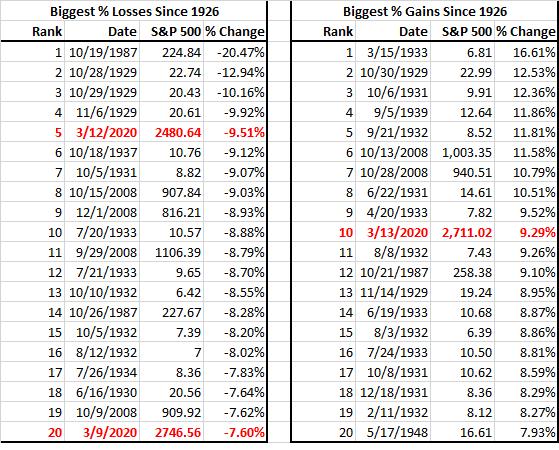
As the Table, courtesy of Bianco Research, below highlights, three of the five days in the week beginning 9th March are amongst the 20 biggest daily gains and losses.

After the 9.5% decline on 12th March, the market rebounded 9.3% the following day. The 7.6% decline on the 9th March was, to date, the 20th largest decline recorded by the S&P 500.

2020 is joining an infamous group of years, which include 1929, 1987, and 2008.

Extreme volatility

Where do we go from here?

Great question, and I wish I knew.

For guidance, this research paper by Goldman Sachs (GS) is helpful: Bear Essentials: a guide to navigating a bear market

To get a sense as to how much markets are likely to fall, and for how long, they look at the long-term history of the US sharemarket. They also categories Bear markets into three types, reflecting that Bear markets have different triggers and characteristics.

The three types as defined by GS are:

  • Structural bear market – triggered by structural imbalances and financial bubbles. Very often there is a ‘price’ shock such as deflation that follows.
  • Cyclical bear markets – typically a function of rising interest rates, impending recessions and falls in profits. They are a function of the economic cycle.
  • Event-driven bear markets – triggered by a one-off ‘shock’ that does not lead to a domestic recession (such as a war, oil price shock, EM crisis or technical market dislocation).

They then plot US Bear Markets and Recoveries since the 1800s, as outlined in the following Table:

Historical US Bear markets

Source: Goldman Sachs

From this they can characterise the historical averages of the three types of Bear markets, as outlined at the bottom of the Table:

GS summarise:

  • Structural bear markets on average see falls of 57%, last 42 months and take 111 months to get back to starting point in nominal terms (134 months in real terms (after inflation)).
  • Cyclical bear markets on average see falls of 31%, last 27 months and take 50 months to get back to starting point in nominal terms (73 months in real terms).
  • Event-driven bear markets on average see falls of 29%, last 9 months and recover within 15 months in nominal terms (71 months in real terms).


In their opinion GS currently think we are in an Event-driven Bear market. Generally these Bear markets are less severe, but the speed of the fall in markets is quicker, as is the recover. However, as they note none of the previous Event-Driven Bear markets were triggered by the outbreak of a Virus, nor were interest rates so low at the start of the market decline.

Therefore, they conclude, a fall of between 20-25% can be expected, and the rebound will be swift.

This makes for an interest couple of quarters, in which the economic data and company profit announcements are sure to get worse, yet equity markets will likely look through this for evidence of a recovery in economic activity over the second half of this year.


Happy investing.


Please read my Disclosure Statement


Global Investment Ideas from New Zealand. Building more Robust Investment Portfolios.


Equity Market declines in Perspective

Far from Unprecedented: Nine Selloffs Like this, and Nine Rebounds.

The Bloomberg article has much prettier graphs than I can do, but I can provide the view from a wonderful ski field in New Zealand, in the spirit of the Winter Olympics, Treble Cone near Wanaka.

150


So, since the beginning of the bull equity market run in 2009 there have been nine significant declines in global equities. On each occasion global equity markets have come back.

The nine episodes are outlined in the Table below. They make for interesting reading and are distant memories.

Now of course we maybe only partway through the decline of the current “correction” and it could be different this time i.e. no bounce


Market movements are in relation to the US S&P 500 Index.

Date Level of Decline Trigger
January 2016 -11% of three weeks Concerns over economic slowdown and mounting Chinese debt
August 2015 -11% over six sessions China’s shock devaluation of the Yuan
October 2014 -5.0% over week Spread of Ebola virus, concern over end of US Quantitative Easing and tensions in the Middle East
January 2014 -3.6% over the month Emerging markets equities and currencies sold down
October – November 2012 -7.2% US Election uncertainty between Obama and Romney
March – June 2012 ~-10.0% US Federal Reserve indicating it will likely hold back on further monetary Policy easing e.g. Quantitative Easing
July – August 2011 -17% US Credit downgrade and weaker than expected jobs report, Greece
January 2010 -8% Market correction uncertainty as to global growth outlook, particularly Europe
April – July 2010 -16% Similar reasons and the infamous flash crash
January 2018 -10.1% Rising longer dated interest rates, inflation concerns, Fed tightening, negative feedback loop of short volatility Products


Please see my Disclosure Statement