Future’s Hedge Funds

A really interesting article by the Chief Investment Officer: A New Generation of Hedge Funds Can Provide Stability, Australia’s sovereign wealth fund CIO is betting hedge funds can help reduce risk.

The article covered a number of themes from my earlier Blog Post Perspective of the Hedge Fund Industry

The hedge fund industry, and the “hedge fund”, have changed dramatically over the last few years.  This is captured in the recently published AIMA paper (Alternative Investment Management Association), Perspectives, Industry leaders on the future of the Hedge Fund Industry.  The AIMA paper is covered in the Post above.

The following Quotations from the Chief Investment Office article by Raphael Arndt, CIO of Australia’s A$166 billion sovereign wealth fund, the Future Fund, are consistent with the AIMA Paper:

  • “Hedge funds have an important portfolio role to play in generating returns that are uncorrelated to equity markets,” Arndt said last week in a speech before the Insurance Investment Forum in Torquay, Australia.
  • “For the Future Fund, hedge funds have a very specific purpose in our portfolio.  This is to reduce risk—and in particular to provide returns during market environments involving prolonged periods of losses in equity markets.”


From Kiwi Investor’s perspective a well designed and implemented Hedge Fund solution is particularly attractive for an insurance company.


Arndt, continues:

  • “I recognize that hedge funds have historically had a public relations problem, being associated with high fees, a lack of transparency, and perceptions of poor ethics and customer focus,” said Arndt.
  • But Arndt said this perception of hedge funds is a dated stereotype that he refers to as “hedge funds 1.0,” which has given way to what he calls “hedge funds 2.0”—a newly evolved generation of hedge funds.


This sentiment very much comes out in the AIMA paper As Arndt emphasised, many hedge funds run institutional-quality investment process.  If they don’t, they don’t receive institutional money.  This not only relates to the investment management process, it includes issues such as management of counter party risk, operational risk management, regulatory risk management, and transparency of portfolio risk exposures.

Lastly, after outlining the type of hedge fund solution the Future Fund runs, Arndt comments:

  • “I encourage industry participants to consider such a program in their portfolio to protect against the risks associated with a repeat of a GFC type event in equity markets,” said Arndt. “The fees paid, while unquestionably high, are worth paying for skilled managers who collectively can add significant value to the portfolio overall.
  • “It’s time to re-examine what hedge funds offer,” he added. “The industry has evolved and improved, and features a new breed of managers that are different from their predecessors.”


These comments are also consistent with points made in my earlier post on Investment Fees and Investing like an Endowment – Part 2 and Disaggregation of Investment Returns.


In effect, the Future Fund uses Hedge Funds to provide return diversification, they use Hedge Funds so they can invest into riskier assets like equities and illiquid asset such as infrastructure, property, and private equity.

We all know a robust portfolio is broadly diversified across different risks and returns.

Combined the Future Fund has a more robust portfolio.


It has worked well for them, the article states: “As of the end of March, the Future Fund reported a return of 8.5% per year over the last 10 years, compared to a target benchmark return of 6.7% per year during that same time period.”

This is a very good result, successfully managing into their stated investment objectives.


Happy investing.


Please see my Disclosure Statement


Global Investment Ideas from New Zealand. Building more Robust Investment Portfolios.

cropped-title-picture-enhanced.jpg

Investment Fees and Investing like an Endowment – Part 2

We all know a robust portfolio is broadly diversified across different risks and returns.

Increasingly institutional investors are accepting that portfolio diversification does not come from investing in more and more asset classes.  This has diminishing diversification benefits e.g. adding global listed property or infrastructure to a multi-asset portfolio that includes global equities.

Why? True portfolio diversification is achieved by investing in different risk factors that drive the asset classes e.g. duration, inflation, economic growth, low volatility, value, and growth.

Investors are compensated for being exposed to a range of different risks. For example, those risks may include market beta, smart beta, alternative and hedge fund risk premia.  And of course, true alpha from active management, returns that cannot be explained by the risk exposures outlined above.  There has been a disaggregation of returns.

Not all of these risk exposures can be accessed cheaply.


The US Endowment Funds and Sovereign Wealth Funds have led the charge on true portfolio diversification, along with the heavy investment into alternative investments and factor exposures.  They are a model of world best investment management practice.

Unlisted infrastructure, unlisted real estate, hedged funds, and private equity are amongst the favoured alternatives by Endowments, Sovereign Wealth Funds, and Superannuation Funds.

As reported by the New York Times recently “Yale continues to diversify its holdings into hedge funds, where it has 25 percent of its assets, and venture capital, with a 17 percent stake, in addition to foreign equity, leveraged buyouts and real estate, as well as some bonds and cash. That diversification strategy, which Mr. Swensen pioneered, is widely followed by larger institutions.”

Yale has approximately 20% allocated to listed equities, domestic and foreign combined, and seeks to allocate approximately one-half of the portfolio to the illiquid asset classes of leveraged buyouts, venture capital, real estate, and natural resources.


The Yale Endowment recently released its annual report which gained some publicity.

The following quote received a lot of press:  “In advocating the adoption of a passive indexing strategy, Buffett provides sound investment advice for the vast majority of individuals and institutions that are unable (or unwilling) to commit the resources (human and financial) necessary for active management success. Yet, Buffett’s advice is not appropriate for the cohort of endowments that possess the capabilities to pursue successful active management programs.”

The Yale report was published not long after the Buffet Bet concluded.

Buffet’s investment advice was highlighted further this week surrounding publicity of the Berkshire Hathaway Annual meeting.


At the centre of this exchange is investment management fees.

Don’t get me wrong, fees are important.  Yet smart investors are managing fees as part of a multi-dimensional investment puzzle that needs to be solved in meeting client investment objectives.  Other parts of the puzzle may include for example liquidity risk, risk appetite, risk tolerance, cashflow requirements, investing responsibly, and client future liabilities, to name a few.

This is more pressing currently, these issues need to be considered in light of the current market conditions of an aging US equity bull market and historically low interest rates and the growing array of different investment solutions that could potential play a part in a robust investment portfolio.

The debate on fees often misses the growing complexities faced in meeting specific investment objectives.  The debate becomes commoditised.  The true risk of investing, failure to meet your investment objectives, often gets pushed into the background.


The importance of this? EDHEC recently highlighted many of the current retirement products do not adequately address the true retirement savings goal – replacement income in retirement.

This is not addressed by many of the target date / life cycle funds, nor is it the role of the accumulation 60/40 (equities/bonds) Fund of your standard superannuation fund.  Life cycle funds predominately manage market risk, there are other risks that need to be managed, some of which are outlined above, replacement income in retirement should also be added.

As EDHEC further highlighted, this is a serious issue for the industry, and more so considering the world’s pension systems are under enormous stress due to underfunding and a rising demographic imbalance with an aging population.  Furthermore, globally, there has been a shift of managing retirement risk to the individual i.e. the move away from Defined Benefit to Defined Contribution.


As a result, a greater focus is needed on investment solutions in replacing income needs in retirement.  This requires a greater awareness and matching of people’s retirement liabilities, a Goal Based Investment solution (Liability Driven Investing).

The management of client liabilities, and the design of the customised investment solutions needs to be implemented prior to retirement.  As many are currently discovering, a portfolio of cash and fixed interest securities, no matter how cheaply it is provided, is not meeting retirement income needs.

The debate needs to move on from fees to the appropriateness of the investment solutions in meeting an individual’s retirement needs.

The advice model is critical.

This is a big challenge, and I’ll blog more on this over time.


I’ll say it again, fees paid are important.  Nevertheless, the race to be the lowest cost provider may not be in the best interest of clients from the perspective of meeting client investment objectives.  The focus and design of “products” is primarily on accumulated value, a greater focus is required on replacement income in retirement.

Sophisticated investors such as endowments, insurance companies, pension funds, and Sovereign Wealth Funds, are taking a different perspective to the commoditised retail market.  Albeit, their approach is not inconsistent with fees being an important “consideration” that should be managed, and managed appropriately.  They likely manage to a fee “budget”, as they manage to a risk budget.


It is very critical that the Endowments get it right.  Endowments are a crucial component of university budgets. During the global financial crisis of 2008 many endowments had to significantly cut back their spending due to the falling value of their Endowment Funds.  It is estimated that distributions from the Yale endowment to the operating budget of the University have increased at an annualized rate of 9.2 percent over the past 20 years.  The Endowment Fund is the university’s largest source of revenue.  The Fund is expected to contribute $1.3 billion to the University this year, this is equal to approximately 34% of the Yale’s operating budget.

Much can be learned from how endowments construct portfolios, take a long term view, and seek to match their client’s liability profile.  An overriding focus on fees will lead away from investing successfully in a similar fashion.


The endowment approach can be applied to an individual’s circumstances, particularly high net worth individuals.  The more complex the situation, the better, and the more value that can be added.

There will be a growing demand for more tailored investment solutions.

EDHEC argue an industrial revolution is about to take place in money management, this will involve a shift from investment products to investment solutions “While mass production has happened a long time ago in investment management through the introduction of mutual funds and more recently exchange traded funds, a new industrial revolution is currently under way, which involves mass customization, a production and distribution technique that will allow individual investors to gain access to scalable and cost-efficient forms of goal-based investing solutions.”


For the record, as reported by the Institutional Investor: For the 20-year period ending June 30, Yale’s endowment earned a 12.1 percent annualized return, beating its benchmark Wilshire 5000 stock index, which gained 7.5 percent. A passive portfolio with a 60 percent stock allocation and 40 percent in bonds, meanwhile, had a 20-year return of 6.9 percent.


Lastly, I am a very big fan of Buffet, and one should read the two books by the two key people who have reportedly had a big influence on him, number one is obvious, Benjamin Graham’s The Intelligence Investor, and the other Philip A Fisher, Common Stocks and Uncommon Profits.  I preferred the later to the former.

It is also well worth reading David Swensen’s book: Pioneering Portfolio Management. Yale has generated the highest returns among its peers over the last 20 years.


Build robust investment portfolios.  As Warren Buffet has said: “Predicting rain doesn’t count.  Building arks does.”

Invest for the long-term.

Happy investing.


Please see my Disclosure Statement


My favourite part of New Zealand

150

Perspectives of the Hedge Fund Industry

The hedge fund industry, and the “hedge fund”, have changed dramatically over the last few years.

This is capture in the recently published AIMA paper (Alternative Investment Management Association), Perspectives – Industry Leaders on the Future of the Hedge Fund Industry

From the report: “Most people today look to hedge funds for diversification, i.e., an alternate return stream, with low beta and correlation to traditional investments. In the past, the driver of hedge fund interest was high expected returns and growth of capital.”

Hedge fund’s largest clients are Pension Funds, University Endowments, and Sovereign Wealth Funds.

Access to hedge fund strategies is becoming increasingly available to retail investors.  Hedge Funds, and hedge fund strategies, are no longer the exclusive domain of High Net Wealth Worth individuals.


Summary of the Report’s Executive Summary

  1. Paradigm shift. The industry is experiencing significant transformation as investors seek new investment solutions to more cheaply access different return streams. This has witnessed an innovation of investment solutions that fit between the traditional hedge fund and the traditional actively managed listed market funds.  These new investment solutions are providing the benefits of increased portfolio diversification for lower fees and increased transparency relative to the traditional hedge fund.  These cheaper return streams are the factor betas and alternative hedge fund betas. There has been a disaggregation of investment returns as a result of recent investment solution innovation.
  1. Hedge Funds can still produce alpha (risk adjusted excess returns) but it is getting harder due to increased competition and the greater ease of access to financial data and computing power.
  1. Therefore, an increasing employment of artificial intelligence and advanced cutting-edge quantitative techniques will likely grow across the hedge fund industry.
  1. The integration of Responsible Investing will likely rise across the hedge fund industry.
  1. The hedged fund firm is likely to change from its current traditional model, employing outside of the traditional business school graduate, employing a greater diversity of talent, flatten organisational structures, and encourage more collaborative environments.
  1. Hedge Fund firms will likely look to partner more with investors and co-invest.
  1. This will see a different focus on distribution and ownership models.


Points One and Two are of the most relevant to the focus of Kiwiinvestorblog.

The changing dynamics of the hedge fund industry has implications for the wider funds management industry e.g. downward pressure on fees, the blurring of the lines between traditional fund managers and hedge fund managers investment solutions, and the increased weight on traditional active equity managers to deliver genuine alpha – the closest index fund is on the endangered extinction list!

Importantly, the change taking place is making it easier, cheaper, and more transparent to implement truly diversified and robust multi-asset portfolios.  This is evident in the thoughts expressed in the quotes provided below and throughout the Report.

Section One of the Report formed the basis of an earlier blog on the Disaggregation of Investment Returns between market beta, factor and hedge fund beta, and alpha (linked aboved).

Pages 37 – 43 of the Report has a good discussion on whether hedged funds can still generate alpha (risk adjusted excess returns).

Understanding these sources of returns will help in building truly diversified portfolios.  It will also make the quotes more meaningful.  A greater appreciation of where the industry is moving will also be gained.


The following quotes from the Report help bring this all together.

Happy investing


Key quotes from within the Report:

“The past years have brought significant changes to the hedge fund industry. What was once a boutique industry serving high-net-worth individuals now serves some of the world’s largest investors. The products offered by hedge fund firms are changing to meet the needs of this wider and more diverse investor universe. The alpha-beta returns dichotomy of yesteryear is being replaced with a new range of investment solutions tailored to the needs of a wider range of investors.”


“A majority of investable assets in the total hedge fund pot will go to some form of risk premium investment strategy or a low-to-average correlation type of investment product, because investors have become increasingly more technical and have caught on to the fact that some investment strategies can be replicated for lower fees. Going forward, I expect more than half of the hedge fund investable universe will comprise of the top ten largest investment strategies being commoditised into more low-cost investment products—the so-called liquid alternatives. The remainder of the universe will comprise of high-end niche investment strategies that are capacity constrained, and are able to deliver true alpha.”


“Changing investor expectations are forcing hedge fund firms to rethink the investment solutions that they offer. The pace of technological change and the rise of artificial intelligence is leading some to question whether the hedge fund proposition will even exist in a few years. Responsible investment, meanwhile, is becoming more of a priority for hedge fund firms, as they gradually overcome their reluctance to constrain themselves. All of these changes are in turn forcing hedge fund firms to re-evaluate their own inner workings, from how they service investors through to how they build a business that outlasts its founders.”


Please see my Disclosure Statement

Disaggregation of Investment Returns

Understanding the disaggregation of investment returns can assist in building a truly diversified and robust investment portfolio.

It can also help determine the appropriateness of fees being paid and if a manager is adding value.


Many institutional investors understand that true portfolio diversification does not come from investing in many different asset classes but comes from investing in different risk factors. More Asset Classes Does not Equal More Diversification.

The objective is to implement a portfolio with exposures to a broad set of different return and risk outcomes.  The increasing allocation to alternative investment strategies by institutional investors globally, such as hedge fund strategies, to complement more traditional investments is evidence of this.  Alternative strategies are added so as to reduce overall portfolio volatility, resulting in a more attractive portfolio risk return profile.

The inclusion of alternative strategies can assist in providing greater probability in meeting investment objectives.


An understanding of the different return and risk outcomes can be gained by disaggregating investment returns.

Essentially, and from a broad view, investment returns can be disaggregated in to the following three parts:

  1. Market beta. Think equity market exposures to the NZX50 or S&P 500 indices (New Zealand and America equity market exposures respectively).  Market Index funds provide market beta returns i.e. they track the returns of the market e.g. S&P 500 and NZX50
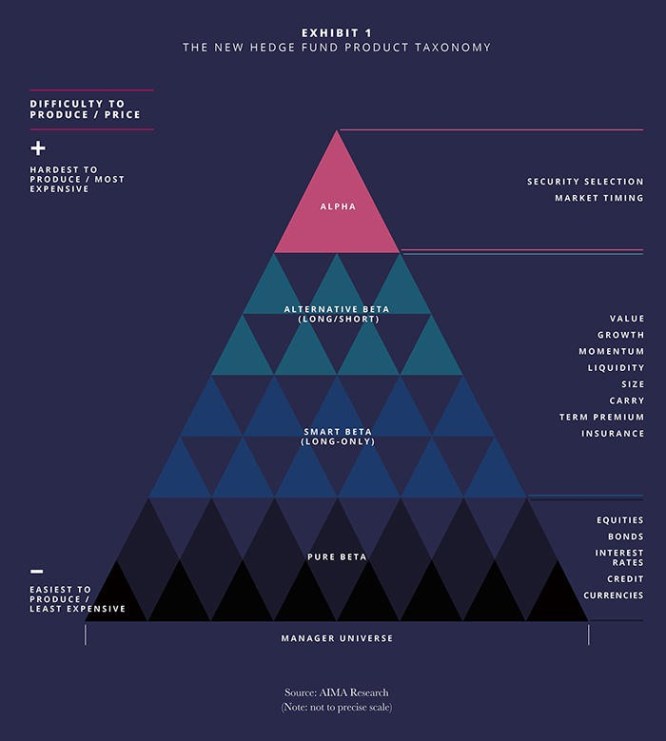
  2. Factor betas and Alternative hedge fund beta exposures.  Of the sources of investment returns these are a little more ambiguous and contentious than the others.  This mainly arises from use of terminology and number of investable factors that are rewarding.  My take is as follows, these betas fit between market betas and alpha.
    1. Factor Beta exposures.  These are the factor exposures for which I think there are a limited number.  The common factors include value, momentum, low volatility, size, quality/profitability, carry.  These were outlined in this blog and are often referred to as Smart beta – see diagram below.
    2. Alternative hedge fund betas.  Many hedge fund returns are sourced from well understood investment strategies.  Therefore, a large proportion of hedge fund returns can be explained by common hedge fund risk exposures, also known as hedge fund beta or alternative risk premia or risk premia.  Systematic, or rule based, investment strategies can be developed to capture a large portion of hedge fund returns that can be attributed to a hedge fund strategy (risk premia) e.g. long/short equity, managed futures, global macro, and arbitrage hedge fund strategies.  The alternative hedge fund betas do not capture the full hedge fund returns as a portion can be attributed to manager skill, which is not beta and more easily accessible, it is alpha.


Lastly, and number three, there is Alpha.  Alpha is what is left after beta.  It is manager skill.  Alpha is a risk adjusted measure. In this regard, a manager outperforming an index is not necessarily alpha.  The manager may have taken more risk than the index to generate the excess returns, they may have an exposure to one of the factor betas or hedge fund betas which could have been captured more cheaply to generate the excess return.  In short, what is often claimed as alpha is often explained by the factor and alternative hedge fund betas outlined above.  Albeit, there are some managers than can deliver true alpha.  Nevertheless, it is rare.


These broad sources of return are captured in the diagram below, provided in a recent hedge fund industry study produced by the AIMA (Alternative Investment Management Association).

Another key distinction, in the most beta and factor betas are captured by investing long (i.e. buying securities and holding) while alternative hedge fund betas are captured by going both long and short and generally being market neutral i.e. having a limited exposure to market betas e.g. equity market risk.

The framework above is also useful for a couple of other important investment considerations.  We can use this framework to determine:

  1. Appropriateness of the fees paid. Obviously for market beta low fees are paid e.g. index fund fees.  Fees increase for the factor betas and then again for the alternative hedge fund betas.  Lastly, higher fees are paid to obtain alpha, which is the hardest to produce.
  1. If a manager is adding value – this was touched on above. Can a manager’s outperformance, “alpha”, be explained by “beta” exposures, or it truly unique and can be put down to manager skill.


Lastly, and most importantly, to obtain a truly diversified portfolio, a robust portfolio should have exposures to the different return and risk sources outlined above.

Accessing the disaggregation of investment returns has come increasingly available due to advancements in technologies and the lowering of transaction costs.  It is also having a fundamental impact on the global funds management industry, including hedge funds.

Furthermore, the determination of institutional investors to pay appropriate fees for return sources has witnessed the development of investment strategies that appropriately match fees for sources of return and risk.

Happy investing.


Return aggregation


Please see my Disclosure Statement


Factor Investing Portfolio Construction

Following on from my last post on Factor Investing this article provides some good insights into the implementation of a factor portfolio.

The article makes a few key points:

  1. The best way to capture the different factors is through diversification i.e. diversify across the different factors: value, momentum, size, minimum volatility and quality. Avoid having a single factor exposure.
  1. Although factors work, their performance vary greatly given different underlying financial and economic environments (macro environment).
  1. It is difficult to pick when the macro environment will change to the benefit or otherwise of an individual factor. Therefore, successfully under or over weighting a factor to expected changes in the macro environment offers little value add.  It is nevertheless likely to be more fruitful than making country and sector allocations shifts based on anticipated changes in the macro environment.
  1. There are a number of approaches to constructing a factor portfolio. Most often implemented are equally weighted approach (i.e. equal allocation to each factor) and risk weighted approach.  Risk weighted, in simple terms, starts with an equally weighted portfolio, then reduces the portfolio allocation to the higher risk factors e.g. more volatile factors, and increases the portfolio allocation to the less risky factors (in practice this is a more sophisticated and technically advanced approach).  Whichever approach is implemented, it needs to be consistent with Investor’s risk appetite and investment objectives.

The implementation of a robust factor portfolio is more complicated than outlined above.  There are a number of nuances that need to be considered e.g. level of portfolio turnover and redundancy of portfolio holdings i.e. a portfolio holding could enhance one factor but dilute another factor exposure.


Finally, the article makes a key point, this applies in any portfolio, robust portfolio construction is the key to success in Factor Investing.

True portfolio diversification isn’t easy.  Many portfolios have lots of asset classes, this does not mean they have more diversification.  See More Asset Classes Does not Equal More Diversification, the failings of diversification.

A more robust portfolio is achieved through factor allocation than say sector allocations, so long as there is a broad set of factors to invest in.


Please see my Disclosure Statement

Factor Investing

Factoring Investing, along with Alternative Investment Strategies, true portfolio diversification, Goal Based Investing (Liability Driven Investing), building robust investment portfolios, behavioural economics, and Responsible Investing, will be key themes of future blogs.

I thought this was a good article to cover as the first blog on Factor Investing:  The Case For Adding Factors To Your Portfolio.

This is a good article for those new to Factor Investing or at the beginning of considering the addition of factor exposures into a portfolio.  There are many articles like this from other provides.


A few of key points from the article:

  1. A factor can be thought as any characteristic relating a group of securities that is important in explaining their return and risk.
  1. Factor Investing is not new. It has been around for sometime within the industry, Value and Growth in the old days.  The drivers of value and momentum have been recognised by academics and professionals for decades.

What has changed, particularly over the last 5 years, is the technology that makes it easier and cheaper to capture market factors.

  1. There are not that many rewarding factors, Value, Quality, Momentum, Size and Minimum volatility are the most robust, Carry is another (I’ll blog separately on what each of these are).

Most of these factors can be found across most “asset classes” e.g. equities, fixed interest, commodities and currencies.

  1. Factors exposures can be used to determine if an active manager is adding true excess returns (alpha – risk adjusted excess returns), or just providing a market factor exposure which can be gained cheaply. It is a tough environment for active investors, they are being squeezed by passive index funds and cheaper factor funds (sometime referred to as smart beta strategies).  Albeit, a high level of sophistication is required in developing an effective factor investment strategy.
  1. Factor investing can deliver more efficient portfolios. This means better reward for risk taken.  Well-constructed factor investment strategies eliminate or reduce the exposure to unwanted and un-reward market risks. The article uses an America’s Cup analogy of reducing frictions to make the boat go faster– note New Zealand is the current holder of the America’s Cup.

Therefore, factor investment strategies can provide a more efficient portfolio outcome than selecting Industry Sectors or active management by way of example.

  1. Not all factors will perform equally well at every moment. Factors can underperform the wider and broader equity market and the other factors for long periods of time e.g. the Value factor has underperformed the broader global equity index for about 10 years currently!

Therefore, diversification across the factors is often recommended.


From a more advanced perspective, a portfolio that invests across multiply factors across multiply asset classes, and that can invest both long and short, e.g. go long stocks with favourable rewarding factors and sell short those stocks that do not display the rewarding factors, is likely the most efficient means of factor investing.  Such a strategy could well make up an allocation within a Liquid Alternatives Investment Strategy.


As an aside and not to confuse:

The above factors e.g. value, momentum and carry are factors that can be used to explain the drivers of securities within an asset classes e.g. equities fixed interest, and currencies

There are also macro factors, these explain at a higher level what drives a multi-asset portfolio.  Macro factors can explain more than 90% of returns across a multi-asset portfolio.  These macro factors can be used to determine an appropriate allocation to the different asset classes e.g. equities versus fixed interest exposures given preferred risk tolerance and investment objectives.

Macro factors include, economic growth, real interest rates, inflation, credit, emerging markets, and liquidity.  This is a topic for a future blog.


Please see my Disclosure Statement

Shortcomings of Target Date and Life Cycle Funds

Target Date Funds, also referred to as Glide Path Funds or Life Cycle Funds, reduce the equity allocation in favour of more conservative investments, fixed interest and cash, as the investor gets closer to retirement.

They do this on the premise that as we get older we cannot recover from financial disaster because we are unable to rebuild savings through human capital (salary and wages).  These Funds follow a rule of thumb that as you get closer to retirement an investor should be moved into a more conservative investment strategy.  This is a generalisation that does not take into consideration the individual circumstances of the investor nor market conditions.

Target Funds are becoming increasingly popular.  Particularly in situations where the Investor does not want or can afford investment advice.  The “Product” adjusts the investor’s investment strategy throughout the Life Cycle for them, no advice provided.


All good in theory, nevertheless, these “products” have some limitations in their design which are increasingly being highlighted.

No, it is not that they are moving investors into cash and fixed interest at a time of record low cash returns and over-valued fixed interest markets.  This is an issue, but a topic for another Blog.  Albeit this is touched on below from a slightly different angle.


Essentially, Target Date Funds have too main short comings:

  1. They are not customised to an individual’s consumption liability, human capital or risk preference e.g. they do not take into consideration future income requirements or likely endowments, level of income generated up retirement, or the investors risk profile, appetite for risk, or risk tolerance.
  • They are prescribed asset allocations which are the same for all investors who have the same number of years to retirement, this is the trade-off for scale over customisation.
  1. Additionally, the glide path does not take into account current market conditions.
  • Risky assets have historically shown mean reversion (i.e. asset returns eventually return back toward the mean or average return, prices display volatility to the upside and downside.
  • Therefore, linear glide paths, most target date funds, do not exploit mean reversion in assets prices which may require:
    • Delays in the pace of transitioning from risky assets to safer assets
    • May require step off the glide path given extreme market risk environments


Therefore, there is the risk that some Target Date Funds will fall short of providing satisfactory outcomes and meeting the key requirement in retirement of sufficient income.


Target Date Funds, Life Cycle Funds, focus on the investment horizon without protecting investors’ retirement needs, they focus on one risk, market risk.

The focus is not on producing retirement income or hedging risks in relation to investment risk, inflation risk, interest rate risk, and longevity risk.

As noted above, most target date funds don’t make revisions to asset allocations due to market conditions.  This is inconsistent with academic prescriptions, and also common sense, both of which suggest that the optimal investment strategy should also display an element of dependence on the current state of the economy.


The optimal target date or life cycle fund asset allocation should be goal based and multi-period:

  • It requires customisation by goals, of human capital, and risk preferences
  • Some mechanism to exploit the possibility of mean reversion within markets


All up, this requirements a more Liability Driven Investment approach, Goal Based Investing.

My first blog outlines the revolution required within the industry to Mass Customisations.


Please see my Disclosure Statement

More Asset Classes Does Not Equal More Diversification

The Failings of Diversification.

Diversification has been the central tenant of portfolio construction since the early 1950s.

Diversification simply explained, you don’t put all your eggs in one basket.

Nevertheless, technically we want to invest in a combination of lowly correlated asset classes. This will lower portfolio volatility.  (Lowly correlated means returns from assets are largely independent of each other – they have largely different risk and return drivers.)

The article highlights that more asset classes does not equal more diversification.

“This is because the investment returns of a range of asset classes are driven by many of the same factors. These can include: economic growth; valuation; inflation; liquidity; credit; political risk; momentum; manager skill; option premium; and demographic shifts.

So while investors have added a range of asset classes to their portfolio (such as property, infrastructure, distressed debt, and commodities) their portfolio risk remains similar at the expense of adding greater complexity and management cost.”


These are key messages from earlier blogs, focus on true portfolio diversification so as to ride out the volatility and on Liquid Alternative investment strategies.


From the Article

Key Points

  • Diversification is just one risk management tool, not a comprehensive risk management solution.
  • Multiple asset classes won’t lower portfolio risk when the same factors drive each asset classes’ investment returns.
  • Diversification cannot provide protection against systematic risk, such as a global recession, when all major asset classes tend to fall in unison.

Risk comes in many forms but investors are acutely aware of two: the impact of capital losses and extreme bouts of volatility.

Both can have a devastating impact on a portfolio.

Capital losses, such as we saw during the global financial crisis, may never be recouped by some unlucky investors. Meanwhile, volatility can prompt investors to withdraw their money at just the wrong time or quickly erode a lifetime’s savings when an investor is drawing down their capital.

Liquid Alternatives

This is a great article on the benefits of Liquid Alternatives (“Liquid Alternatives Coming of Age”)

One of the big lessons from the Global Financial Crisis (GFC) ten years ago was for investors to seek true portfolio diversification.  Specifically, increase the diversification within portfolios so as to reduce the level of equity risk within them.  Thus reducing the level of portfolio volatility.  This will likely lead to better outcomes for investors in meeting their investment objectives over time.

For investors, increasing the level of true portfolio diversification comes with the added challenge of reducing costs, maintaining high levels of liquidity, and having transparency of the underlying investment strategies.

For these reasons Liquid Alternative strategies have gained increasing acceptance around the world.

The article covers the benefits of Liquid Alternative strategies and a variety of implementation approaches undertaken by a number of Australian Institutional Investors.

Liquid Alternative Investment strategies are a growing allocations across many investment portfolios globally and are an effective means of increasing the true diversification of a multi-asset class (diversified) portfolio.


I have written previous Posts on adding Alternatives to Investment Portfolios.


Please see my Disclosure Statement

The Buffet Bet

Receiving much attention from the 2017 Berkshire Hathaway shareholder letter has been “The Bet”.

To recap, “The Bet” was with Protégé Partners, who picked five “funds of fund” hedge funds they expected would outperform the S&P 500 over the 10 year period ending December 2017.

The bet was made in December 2007, when the market was reasonably expensive and the Global Financial Crisis (GFC) was just around the corner.

Needless to say, Buffet won.  The S&P 500 easily outperformed the Hedge Fund selection over the 10 year period.


I have some sympathy with this well written article.


Firstly I’d like to make three points:

  1. I’d never bet against Buffet!
  1. I would also not expect a Funds of Fund hedge Fund to consistently outperform the S&P 500, let alone a combination of five Funds of Fund.

This is not to say Hedged Funds should not form part of a “truly” diversified investment portfolio.  They should.

Nevertheless, I am unconvinced their role is to provide equity plus returns.

  1. Most, if not all, investor’s investment objective(s) is not to beat the S&P 500. Investment Objectives are personal and targeted e.g. Goal Based Investing to meet future retirement income or endowments


Albeit, as the article points out (A Rhetorical Oracle?), key investment points are missed by the media’s focus on the drag race over a 10 year period.

Now, I have no barrel to push here, except advocating for the building of robust investment portfolios consistent with meeting your investment objectives. The level of fees also needs to be managed across a portfolio.


In this regard and consistent with the points in the article:

  1. Having a well-diversified multi-asset portfolio is paramount.

Being diversified across non-correlated or low correlated investments is important.  Adding low correlated investments to an equities portfolio, combined with a disciplined rebalancing policy, will add value above equities over time.

The investment focus should be on reducing portfolio volatility through true portfolio diversification so that wealth can be accumulate overtime.  If you like, minimising loses results in higher returns over time.  A portfolio that falls 50%, needs to gain 100% to get back to the starting capital.  This means as equity markets take off, as they have over the last 24 months, a well-diversified multi-asset portfolio will not keep up.  Nevertheless, the well diversified portfolio won’t fall as much when the inevitable crash comes along.

It is true that equities are less risky over the longer term.  Nevertheless, not many people can maintain a fully invested equities portfolio, given the wild swings in value (as highlighted by Buffett in his recent Shareholder Letter, Berkshire can fall 50% in value).

100% in equities is often not consistent with meeting ones investment objectives.  Buffet himself has recommended the 60/40 equities/bond allocation, with allocations adjusted around this target based on market valuations.

In fact, I’d never suggest someone to be 100% invested in equities for the very reason of the second point in the article.


  1. Investment Behavioural aspects.

How many clients would have held on to a 100% equity position during the high level of volatility experienced over the last 10 years, particularly in the 2008 – 2014 period.  Not many I suspect.


A well-diversified portfolio, that lowers portfolio volatility, will assist an investor in staying the course in meeting their investment objectives.

An allocation to alternative strategies, including a well-chosen selection of Hedge Funds, will result in a truly diversified Portfolio, lowering portfolio volatility.  See earlier Post

Staying the course is the biggest battle for most investors.  Therefore, take a longer term view, focus on customised investment objectives, and maintain a truly diversified portfolio.

This will help the psychological battle as much as anything else!


I like this analogy of using standard deviation of returns as a measure of risk, average volatility:

“A stream may have an average depth of five feet, but a traveler wading through it will not make it to the other side if its mid-point is 10 feet deep. Similarly, an overly volatile investing strategy may sink an investor before she gets to reap its anticipated rewards.”


Please see my Disclosure Statement