The monkey paw of Target Date Funds (be careful what you wish for)

I have written previously about the short comings of Target Date Funds (TDF). They would certainly benefit from the inclusion of Alternative investment strategies.

Nevertheless, this is not to dismiss them. TDF have some notable advantages e.g. they have an inbuilt advice model. TDF automatically de-risk the portfolio with the age of the investor by down weighting the equity allocation and increasing the allocation to cash and fixed interest. This is attractive to those who are unable to afford investment advice or are not interested in seeking investment advice.

Nevertheless, it is important to understand their short comings given their growing dominance international. (According to the FT “Assets held in US target date mutual funds now stand at $1.1tn, compared with $70bn in 2005, according to first-quarter data compiled by the Investment Company Institute, a trade body.”

Locally, TDF have also been raised as a possible addition to the KiwiSaver landscape as a Default Fund option. They are very much part of the investment landscape in Australia.


In my mind TDF don’t address the inherit weaknesses of current investment products that overly simplify the retirement investment solution by focusing on:

  • Accumulated wealth as the primary goal; and a
  • Formulaic (prescribed) approach of adjusting allocations to equities over the period up to retirement based on age.


TDF may not be the investment solution that addresses key retirement issues, just as Annuities are also not the solution.   Arguably, TDF don’t have an investment objective.

A more goal orientated investment approach is required.

Improvements in the investment solution and a more robust portfolio can be developed by engaging in a more goal orientated investment approach that:

  • Has a focus on the generation of retirement income as an investment goal; and
  • Employs a more sophisticated cash and fixed interest solution that generates a more stable level of retirement income (much like insurance companies employ to meet future liabilities (insurance claims).


The investment knowledge is available now to implement these investment solution enhancements.

This new approach will bring more rigor to the investment strategy and a move away from rules of thumbs such as the 4% Rule and adjusting the equity allocation based on age alone.


At the centre of a more robust approach is the focussing on the generation of retirement income.

Accumulated wealth is important, you can say you are rich with a million-dollar investment portfolio.

However, this million-dollars does not tell you the standard of living you may be able to support in retirement. Some may well say a very good one! And that may well depend on whether you live in Auckland or Gore.

How about the volatility of income in retirement?

By way of example, prior to the Global Financial Crisis (GFC) a New Zealand investor could get 7-8% on cash at the bank, lets say $70k in income on your million dollar investment.

Current term deposit rates are around 3.5%, that’s a 50% fall in income!! And interest rates have been at these levels for some time and if the Reserve Bank of New Zealand is right they will continue to remain at these levels for some time.


Of course, these issues are not the concern of the ultra-wealthy. They are nevertheless vitally important for the less wealthy. They could have a detrimental impact on the standard of living in retirement for many people.

Furthermore, with an income focus, as interest rates rise (they will some day!) more informed investment decisions can be made and importantly investment strategies can be undertaken to help minimise the volatility of income in retirement.


Therefore, we should not just focus on the generation of retirement income as the investment goal but also consider how we can manage the volatility of income in retirement. As I say, the knowledge to do this is already available.


I have recently written a Post on why focus on Income and one on why focus on the volatility of Income.


This FT article on the short comings of TDF may be of interest.


The article highlights the risk to the industry.


The following section of the FT article is most relevant to the discussion above:

…….. “This underscores the importance of crafting investment products that generate sustained income for retirees, says Lionel Martellini, a professor at Edhec currently seconded to Princeton.

Prof Martellini says the key shortcoming with target date funds the group has identified is the fact that the bond allocation, intended to be the safe portion of the portfolio, is often risky. This risk hinges on the fact that bond portfolios offer — but do not guarantee — income, according to the researchers.

The fixed income allocation should look more like an annuity, Prof Martellini says, a financial product that pays a steady stream of income to the holder. But it must avoid the pitfalls of annuities, namely a lack of flexibility that means they cannot be passed on to a next of kin, for example.

“That’s what we’re talking about — a bond portfolio that is a good proxy for the cash flow that people need. Such a simple move will add a large benefit to how much replacement income you can generate,” Prof Martellini says. Critics say target date funds fail to achieve this because their fixed income portfolios are composed of short-term bonds that are beholden to market risks and do not take into account retirees’ different income expectations.” ………………..


The final comments are consistent with the point made above with having a more sophisticated cash and fixed interest investment solution.


Happy investing.


Global Investment Ideas from New Zealand. Building more Robust Investment Portfolios.

Please see my Disclosure Statement

Alternatives Investments will improve the investment outcomes of Target-Date Funds

Including alternative investments in Target-Date Funds (TDF) will improve their investment outcomes.

This is the conclusion of a recently published research report by the Center for Retirement Initiatives at Georgetown University’s McCourt School of Public Policy, developed in conjunction with Willis Tower Watson.   The Evolution of Target Date Funds: Using Alternatives to Improve Retirement Plan Outcomes

The study concludes the use of alternative investment strategies “can improve expected retirement income and mitigate loss in downside scenarios.”


Many TDF are over exposed to equity risk, they are not truly diversified.

The above study notes that TDF need to increase their diversification away from equities and fixed interest that dominate their portfolios.  In short, TDF need to broaden their diversification to allow access to alternative return drivers.

This is seen as very important, “even more important step is improving the performance of the underlying investments. The use of alternatives in DB (Define Benefit) plans is an investment practice that should be considered in today’s DC (Define Contribution) plans, specifically in TDFs”

The article outlines the growing popularity of TDF and therefore the opportunity that is available to build better portfolios and improve investment outcomes for clients.


The study compared TDF’s comprising of only equities, bonds, and cash.  To this traditional portfolio they added individual allocations to Private Equity, Unlisted Property, and Hedge Funds separately.

The study first looked at outcomes of adding these alternative strategies in isolation to the Traditional Portfolio, and then when all are added to the Portfolio all together.

When adding the alternatives in isolation to a traditional equities and fixed interest portfolio they concluded that investment outcomes for TDF were improved by:

  • Increasing the amount of income that can be generated in retirement from the portfolio;
  • Increase the probability of maintaining positive assets after 30 years of retirement spending;
  • Delivering higher expected returns; and
  • Reducing downside risk, particularly reduce the negative impact of a negative market at time of retirement (reducing sequencing risk)


Therefore, investment outcomes for Target-Date Funds can be improved with greater levels of diversification (as can any portfolio which only invests in equities, bonds, and cash).

Investment outcomes were improved with any one of the alternative strategies implemented in isolation.


The study then looked at TDF when all the alternative strategies were added to the Traditional Portfolio.

As they note “previous examples look attractive in isolation, we now turn to considering how these strategies contribute to a diversified implementation that includes allocations to all these assets. Not only do these alternative asset classes provide diversification or differentiated return drivers relative to equities and fixed income, but they also provide attractive cross-correlation benefits when viewed in combination with each other (meaning they outperform and underperform at different times from one another).”


Importantly, portfolios were constructed to be of similar risk along the glide path, the increased diversification of adding alternative provides risk benefits over time.

A higher allocation to return seeking assets is able to be maintained over time given the diversification benefits of adding alternatives to the TDF.

Again investment outcome were improved upon compared to a Traditional Portfolio of Equities and Fixed Interest, higher retirement income (+17%) and improved downside risk outcomes (+11%)


Importantly, they noted:  “One straightforward way to mitigate downside risk is to shift more equities into fixed income, though that approach would materially lower expected returns and adversely impact participants who intended to utilize the funds as a source for income throughout retirement.  Additionally, shifting from equities to core fixed income lessens equity risk but increases other risks such as interest rate and inflation. Instead, participants may be better off by further diversifying their portfolios.”


Notably they comment that this is part of an overall plan to improve retirement income outcomes:

“In order to improve retirement income outcomes, plan sponsors must pull all of the levers at their disposal across their organizations. While a number of enhancements have been made with investment vehicles …., plan design…….., and communications, DC plans still lag behind other large investment pools in the use of alternative asset classes. There is a reason why alternative assets are used more often in other investment pools: They can improve investment efficiency and the net-of-fee value proposition.”


Implementation Considerations

The paper covers a number of implementation issues, such as Governance, liquidity, and fees.

Their comments of fees hits the mark:

“To include the potential benefits of alternatives in TDFs, plan sponsors need to be comfortable increasing total fund fees, which can be accomplished through a prudent process focused on enhancing potential outcomes for participants. The fee compression in TDFs has come at the expense of the potential increased returns, lower volatility and portfolio efficiency alternatives could provide.”

Think about after fee outcomes.


Concluding remarks

Overall the outcomes from this Study are hardly surprising.  The use of alternatives has been shown to improve the investment outcomes of other investment portfolios and are widely used e.g. endowments, Insurance Companies, Super (Pension) Funds, and as mentioned Defined Benefit Funds.

The Study notes “As of 2016, the largest corporate pension plans in the Fortune 1000 (assets greater than $2.1 billion) held average allocations of 4.2 percent to hedge funds, 3.4 percent to private equity, 3.0 percent to real estate and 3.6 percent to “other” asset classes.” And “public pensions allocate even more to alternative investments (approximately 25 percent), according to the National Association of State Retirement Administrators.”

This is not to take anything away from the Study, it is great analysis, enhances our understanding of TDF, and is well worth reading.


Lastly, investment outcomes for Target-Date Funds can also be enhanced with the more active management of the glide path strategy.  This may include delaying the pace of transitioning from risky assets (which would include alternatives!) to safer assets or stepping off the glide path given extreme risk environments.

Investment outcomes for clients can also be improved if more client information is used over and above age to determine an investment glide paths e.g. changes in salary leading to a higher expected standard of living.  This is where technology can have a massive impact on the industry.

Many TDF have their limitations, particularly they have no goal and the glide path is based solely on age.

The experience in retirement is changing, we are living longer, more robust retirement solutions are needed.


Happy investing.


Global Investment Ideas from New Zealand. Building more Robust Investment Portfolios.


Please see my Disclosure Statement
Is All-Passive Really the Best Thing for Target-Date Funds?

A recent AB article highlights the limitation of some Target-Date Funds (Life Cycle Funds).

AB propose:

“With market returns expected to be lower going forward, target-date funds that invest in passively managed underlying components are at risk of underdelivering. We think diversifying beyond traditional asset classes and tapping alpha opportunities with a multi-manager structure can increase the chances of success. “


I would argue more broadly, despite the market outlook, any passive portfolio that only invests into the traditional markets of equities, bonds, and cash are not well diversified for a range of possible economic and market outcomes. They are further at risk if they take a set and forget approach to the overarching strategic asset class positioning of the fund i.e. these short-comings are not limited to passively managed Target-Date Funds.


In short, AB argue that the outlook for traditional markets (beta) is challenging. As a result, this environment pose:

“major headwinds to target-date funds as they work to provide the growth participants need. Target-date funds that invest only in traditional asset classes, such as large-cap equities and core bonds through indices, face limitations in their glide path designs. This can make it a struggle for target-date funds to meet participants’ needs in anything but a high-return, low-risk market environment. And in terms of environments, that ship has likely sailed for now.”

Further: “A lower-beta landscape challenges a popular line of thinking that says investing in funds with the lowest fees will ensure compliance with plan sponsors’ fiduciary responsibilities. Low fees aren’t the end all and be all. For one thing, focusing too much on fees could cause sponsors to overlook other factors in retirement investing that also have fiduciary implications.”

The bold is mine.


My Opinion and solution

Increase the diversification of the Target-Date Fund and more actively manage the glide path of the strategy.

There could well be a blend of active and passive strategies.

Quite obviously increasing true portfolio diversification is paramount to building robust portfolios and increasing the likelihood of achieving investment objectives.

The prospect of a low returning environment only reinforces this position.

As mentioned in my last post, Reports of the death of Diversification are greatly exaggerated, also see my post Invest more like an Endowment, which also touches on the fee debate, investors should seek true portfolio diversification. The portfolio should be constructed to meet an investor’s objectives “through a range of potential outcomes”. There would appear to be a diverse range of likely economic and market outcomes currently.

Robust portfolios are positioned for a range of outcomes and are “forecast-free as possible”.

We all know a robust portfolio is broadly diversified across different risks and returns.   Increasingly institutional investors are accepting that portfolio diversification does not come from investing in more and more asset classes. True portfolio diversification is achieved by investing in different risk factors that drive the asset classes e.g. duration, economic growth, low volatility, value, and growth.


Limitations of Target Date Funds

The AB article touches on the limitations of most Target-Date Funds, weather the underlying asset classes are actively or Index (passively) managed.

Essentially, most Target-Date Funds have two main short comings:

  • They are not customised to an individual’s consumption liability, human capital or risk preference e.g. they do not take into consideration by way of example future income requirements or likely endowments, level of income earned to retirement, or investor’s risk profile.

They are prescribed asset allocations which are the same for all investors who have the same number of years to retirement, this is the trade-off for scale over customisation.

  • The glide path does not take into account current market conditions.

Therefore, linear glide paths, most target date funds, do not exploit mean reversion in assets prices which may require:

      • Delays in pace of transitioning from risky assets to safer assets
      • May require step off the glide path given extreme risk environments

Most Target-Date funds don’t make revisions to asset allocations due to market conditions. This is inconsistent with academic prescriptions, and also common sense, which both suggest that the optimal strategy should also display an element of dependence on the current state of the economy.


Therefore, there is the risk that some Target-Date Funds will fall short of providing satisfactory outcomes and meeting the key requirement in retirement of sufficient income. See A more Robust Retirement Income Solution is needed.

Target-Date Funds (Life Cycle Funds) focus on the investment horizon without protecting investors’ retirement needs, they focus on one risk, market risk.   The focus is not on producing retirement income or hedging risks in relation to investment risk, inflation risk, interest rate risk, and longevity risk. A better solution is required.


The optimal Target-Date fund asset allocation should be goal based and multi-period:

  • It requires customisation by goals, of human capital, and risk preferences
  • Some mechanism to exploit the possibility of mean reversion within market


Happy investing.


Global Investment Ideas from New Zealand. Building more Robust Investment Portfolios.


Please see my Disclosure Statement

Reports of the death of Diversification are greatly exaggerated.

Is Portfolio Diversification dead?

One could think so given the extraordinary performance of equities over the last five to six years and the absence of a significant market correction.

The US equity market is likely to record its longest running bull market in August of this year, which is the longest period of time without a 20% or more fall in value.  The equity market correction in February/March of this year ended a record period of historically low volatility for US equities, having experienced their longest period in history without a 5% or greater fall in value.


This is a theme picked up by Joe Wiggins in a recent post on his Blog site, Behavioural Investment, titled “The Death of Diversification”.

Wiggins proposes that the success of equities over the last few years could be used by some to argue as evidence of the failure of portfolio diversification.  Furthermore, such has been the superior performance of equities that some could argue “prudent diversification” is no longer important.

The benign environment could well lead some to believe this, reflecting there has been “scant reward” for holding other assets.  Diversification has come at a “cost”.

Of course such a worldly view, if held, is rubbish.

Wiggins does not hold these views.  He does however indicate it is hard in this environment to argue for the benefits of diversification.

Nevertheless the benefits of portfolio diversification still exist.

It is not a time to become complacent, nor suffer from FOMO (Fare of missing out).


Building robust and truly diversified portfolios will never go out of fashion.

This is well summed up in Wiggins’s post:

“The idea of diversification is to create a portfolio that is designed to meet the requirements of an investor through a range of potential outcomes – it should be as forecast-free as possible. It is also founded on the concept of owning assets that not only provide diversification in a quantitative sense (through low historic correlations) but also sound economic reasons as to why their return stream is likely to differ from other candidate asset classes. Crucially, in a genuinely diversified portfolio not all of the assets or holdings will be delivering strong results at any given time, indeed, if all of the positions in a portfolio are ‘working’ in unison – it will feel like a success but actually represent a shortcoming.


Well said.

I like the turn of phrase: as forecast-free as possible.

In my opinion, a portfolio still needs to be dynamically managed and tilted to reflect extreme valuations and a shifting economic environment, the focus should be on factors rather than asset classes.

Invest like an Endowment, seek true diversification and always remember the long-term benefits of diversification.  The portfolio should be constructed to meet an investor’s objectives “through a range of potential outcomes”.

There would appear to be a diverse range of likely economic and market outcomes currently.

Robust portfolios are positioned for a range of outcomes and “forecast-free as possible”.

We all know a robust portfolio is broadly diversified across different risks and returns.   Increasingly institutional investors are accepting that portfolio diversification does not come from investing in more and more asset classes.  True portfolio diversification is achieved by investing in different risk factors that drive the asset classes e.g. duration, economic growth, low volatility, value, and growth.


I’ll leave the final comment from a great post from Wiggins:

“At this point in the cycle the temptation to abandon the concept of prudent portfolio diversification is likely to prove particularly strong; but unless a new paradigm is upon us, investors will be well-served remaining faithful to sound and proven investment principles.  Take the long-term view and remain diversified”


Happy investing.


Global Investment Ideas from New Zealand. Building more Robust Investment Portfolios.


Please see my Disclosure Statement

Future’s Hedge Funds

A really interesting article by the Chief Investment Officer: A New Generation of Hedge Funds Can Provide Stability, Australia’s sovereign wealth fund CIO is betting hedge funds can help reduce risk.

The article covered a number of themes from my earlier Blog Post Perspective of the Hedge Fund Industry

The hedge fund industry, and the “hedge fund”, have changed dramatically over the last few years.  This is captured in the recently published AIMA paper (Alternative Investment Management Association), Perspectives, Industry leaders on the future of the Hedge Fund Industry.  The AIMA paper is covered in the Post above.

The following Quotations from the Chief Investment Office article by Raphael Arndt, CIO of Australia’s A$166 billion sovereign wealth fund, the Future Fund, are consistent with the AIMA Paper:

  • “Hedge funds have an important portfolio role to play in generating returns that are uncorrelated to equity markets,” Arndt said last week in a speech before the Insurance Investment Forum in Torquay, Australia.
  • “For the Future Fund, hedge funds have a very specific purpose in our portfolio.  This is to reduce risk—and in particular to provide returns during market environments involving prolonged periods of losses in equity markets.”


From Kiwi Investor’s perspective a well designed and implemented Hedge Fund solution is particularly attractive for an insurance company.


Arndt, continues:

  • “I recognize that hedge funds have historically had a public relations problem, being associated with high fees, a lack of transparency, and perceptions of poor ethics and customer focus,” said Arndt.
  • But Arndt said this perception of hedge funds is a dated stereotype that he refers to as “hedge funds 1.0,” which has given way to what he calls “hedge funds 2.0”—a newly evolved generation of hedge funds.


This sentiment very much comes out in the AIMA paper As Arndt emphasised, many hedge funds run institutional-quality investment process.  If they don’t, they don’t receive institutional money.  This not only relates to the investment management process, it includes issues such as management of counter party risk, operational risk management, regulatory risk management, and transparency of portfolio risk exposures.

Lastly, after outlining the type of hedge fund solution the Future Fund runs, Arndt comments:

  • “I encourage industry participants to consider such a program in their portfolio to protect against the risks associated with a repeat of a GFC type event in equity markets,” said Arndt. “The fees paid, while unquestionably high, are worth paying for skilled managers who collectively can add significant value to the portfolio overall.
  • “It’s time to re-examine what hedge funds offer,” he added. “The industry has evolved and improved, and features a new breed of managers that are different from their predecessors.”


These comments are also consistent with points made in my earlier post on Investment Fees and Investing like an Endowment – Part 2 and Disaggregation of Investment Returns.


In effect, the Future Fund uses Hedge Funds to provide return diversification, they use Hedge Funds so they can invest into riskier assets like equities and illiquid asset such as infrastructure, property, and private equity.

We all know a robust portfolio is broadly diversified across different risks and returns.

Combined the Future Fund has a more robust portfolio.


It has worked well for them, the article states: “As of the end of March, the Future Fund reported a return of 8.5% per year over the last 10 years, compared to a target benchmark return of 6.7% per year during that same time period.”

This is a very good result, successfully managing into their stated investment objectives.


Happy investing.


Please see my Disclosure Statement


Global Investment Ideas from New Zealand. Building more Robust Investment Portfolios.

cropped-title-picture-enhanced.jpg

Perspectives of the Hedge Fund Industry

The hedge fund industry, and the “hedge fund”, have changed dramatically over the last few years.

This is capture in the recently published AIMA paper (Alternative Investment Management Association), Perspectives – Industry Leaders on the Future of the Hedge Fund Industry

From the report: “Most people today look to hedge funds for diversification, i.e., an alternate return stream, with low beta and correlation to traditional investments. In the past, the driver of hedge fund interest was high expected returns and growth of capital.”

Hedge fund’s largest clients are Pension Funds, University Endowments, and Sovereign Wealth Funds.

Access to hedge fund strategies is becoming increasingly available to retail investors.  Hedge Funds, and hedge fund strategies, are no longer the exclusive domain of High Net Wealth Worth individuals.


Summary of the Report’s Executive Summary

  1. Paradigm shift. The industry is experiencing significant transformation as investors seek new investment solutions to more cheaply access different return streams. This has witnessed an innovation of investment solutions that fit between the traditional hedge fund and the traditional actively managed listed market funds.  These new investment solutions are providing the benefits of increased portfolio diversification for lower fees and increased transparency relative to the traditional hedge fund.  These cheaper return streams are the factor betas and alternative hedge fund betas. There has been a disaggregation of investment returns as a result of recent investment solution innovation.
  1. Hedge Funds can still produce alpha (risk adjusted excess returns) but it is getting harder due to increased competition and the greater ease of access to financial data and computing power.
  1. Therefore, an increasing employment of artificial intelligence and advanced cutting-edge quantitative techniques will likely grow across the hedge fund industry.
  1. The integration of Responsible Investing will likely rise across the hedge fund industry.
  1. The hedged fund firm is likely to change from its current traditional model, employing outside of the traditional business school graduate, employing a greater diversity of talent, flatten organisational structures, and encourage more collaborative environments.
  1. Hedge Fund firms will likely look to partner more with investors and co-invest.
  1. This will see a different focus on distribution and ownership models.


Points One and Two are of the most relevant to the focus of Kiwiinvestorblog.

The changing dynamics of the hedge fund industry has implications for the wider funds management industry e.g. downward pressure on fees, the blurring of the lines between traditional fund managers and hedge fund managers investment solutions, and the increased weight on traditional active equity managers to deliver genuine alpha – the closest index fund is on the endangered extinction list!

Importantly, the change taking place is making it easier, cheaper, and more transparent to implement truly diversified and robust multi-asset portfolios.  This is evident in the thoughts expressed in the quotes provided below and throughout the Report.

Section One of the Report formed the basis of an earlier blog on the Disaggregation of Investment Returns between market beta, factor and hedge fund beta, and alpha (linked aboved).

Pages 37 – 43 of the Report has a good discussion on whether hedged funds can still generate alpha (risk adjusted excess returns).

Understanding these sources of returns will help in building truly diversified portfolios.  It will also make the quotes more meaningful.  A greater appreciation of where the industry is moving will also be gained.


The following quotes from the Report help bring this all together.

Happy investing


Key quotes from within the Report:

“The past years have brought significant changes to the hedge fund industry. What was once a boutique industry serving high-net-worth individuals now serves some of the world’s largest investors. The products offered by hedge fund firms are changing to meet the needs of this wider and more diverse investor universe. The alpha-beta returns dichotomy of yesteryear is being replaced with a new range of investment solutions tailored to the needs of a wider range of investors.”


“A majority of investable assets in the total hedge fund pot will go to some form of risk premium investment strategy or a low-to-average correlation type of investment product, because investors have become increasingly more technical and have caught on to the fact that some investment strategies can be replicated for lower fees. Going forward, I expect more than half of the hedge fund investable universe will comprise of the top ten largest investment strategies being commoditised into more low-cost investment products—the so-called liquid alternatives. The remainder of the universe will comprise of high-end niche investment strategies that are capacity constrained, and are able to deliver true alpha.”


“Changing investor expectations are forcing hedge fund firms to rethink the investment solutions that they offer. The pace of technological change and the rise of artificial intelligence is leading some to question whether the hedge fund proposition will even exist in a few years. Responsible investment, meanwhile, is becoming more of a priority for hedge fund firms, as they gradually overcome their reluctance to constrain themselves. All of these changes are in turn forcing hedge fund firms to re-evaluate their own inner workings, from how they service investors through to how they build a business that outlasts its founders.”


Please see my Disclosure Statement

Disaggregation of Investment Returns

Understanding the disaggregation of investment returns can assist in building a truly diversified and robust investment portfolio.

It can also help determine the appropriateness of fees being paid and if a manager is adding value.


Many institutional investors understand that true portfolio diversification does not come from investing in many different asset classes but comes from investing in different risk factors. More Asset Classes Does not Equal More Diversification.

The objective is to implement a portfolio with exposures to a broad set of different return and risk outcomes.  The increasing allocation to alternative investment strategies by institutional investors globally, such as hedge fund strategies, to complement more traditional investments is evidence of this.  Alternative strategies are added so as to reduce overall portfolio volatility, resulting in a more attractive portfolio risk return profile.

The inclusion of alternative strategies can assist in providing greater probability in meeting investment objectives.


An understanding of the different return and risk outcomes can be gained by disaggregating investment returns.

Essentially, and from a broad view, investment returns can be disaggregated in to the following three parts:

  1. Market beta. Think equity market exposures to the NZX50 or S&P 500 indices (New Zealand and America equity market exposures respectively).  Market Index funds provide market beta returns i.e. they track the returns of the market e.g. S&P 500 and NZX50
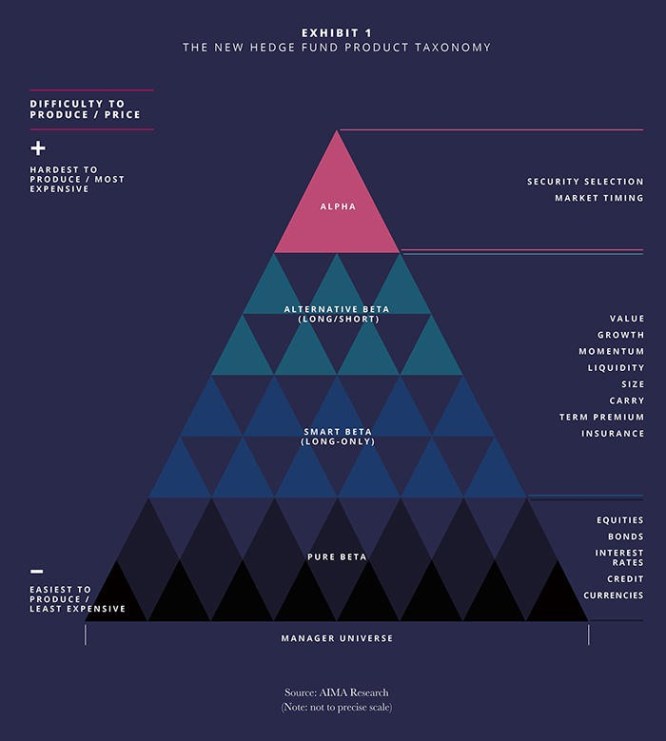
  2. Factor betas and Alternative hedge fund beta exposures.  Of the sources of investment returns these are a little more ambiguous and contentious than the others.  This mainly arises from use of terminology and number of investable factors that are rewarding.  My take is as follows, these betas fit between market betas and alpha.
    1. Factor Beta exposures.  These are the factor exposures for which I think there are a limited number.  The common factors include value, momentum, low volatility, size, quality/profitability, carry.  These were outlined in this blog and are often referred to as Smart beta – see diagram below.
    2. Alternative hedge fund betas.  Many hedge fund returns are sourced from well understood investment strategies.  Therefore, a large proportion of hedge fund returns can be explained by common hedge fund risk exposures, also known as hedge fund beta or alternative risk premia or risk premia.  Systematic, or rule based, investment strategies can be developed to capture a large portion of hedge fund returns that can be attributed to a hedge fund strategy (risk premia) e.g. long/short equity, managed futures, global macro, and arbitrage hedge fund strategies.  The alternative hedge fund betas do not capture the full hedge fund returns as a portion can be attributed to manager skill, which is not beta and more easily accessible, it is alpha.


Lastly, and number three, there is Alpha.  Alpha is what is left after beta.  It is manager skill.  Alpha is a risk adjusted measure. In this regard, a manager outperforming an index is not necessarily alpha.  The manager may have taken more risk than the index to generate the excess returns, they may have an exposure to one of the factor betas or hedge fund betas which could have been captured more cheaply to generate the excess return.  In short, what is often claimed as alpha is often explained by the factor and alternative hedge fund betas outlined above.  Albeit, there are some managers than can deliver true alpha.  Nevertheless, it is rare.


These broad sources of return are captured in the diagram below, provided in a recent hedge fund industry study produced by the AIMA (Alternative Investment Management Association).

Another key distinction, in the most beta and factor betas are captured by investing long (i.e. buying securities and holding) while alternative hedge fund betas are captured by going both long and short and generally being market neutral i.e. having a limited exposure to market betas e.g. equity market risk.

The framework above is also useful for a couple of other important investment considerations.  We can use this framework to determine:

  1. Appropriateness of the fees paid. Obviously for market beta low fees are paid e.g. index fund fees.  Fees increase for the factor betas and then again for the alternative hedge fund betas.  Lastly, higher fees are paid to obtain alpha, which is the hardest to produce.
  1. If a manager is adding value – this was touched on above. Can a manager’s outperformance, “alpha”, be explained by “beta” exposures, or it truly unique and can be put down to manager skill.


Lastly, and most importantly, to obtain a truly diversified portfolio, a robust portfolio should have exposures to the different return and risk sources outlined above.

Accessing the disaggregation of investment returns has come increasingly available due to advancements in technologies and the lowering of transaction costs.  It is also having a fundamental impact on the global funds management industry, including hedge funds.

Furthermore, the determination of institutional investors to pay appropriate fees for return sources has witnessed the development of investment strategies that appropriately match fees for sources of return and risk.

Happy investing.


Return aggregation


Please see my Disclosure Statement


Liquid Alternatives

This is a great article on the benefits of Liquid Alternatives (“Liquid Alternatives Coming of Age”)

One of the big lessons from the Global Financial Crisis (GFC) ten years ago was for investors to seek true portfolio diversification.  Specifically, increase the diversification within portfolios so as to reduce the level of equity risk within them.  Thus reducing the level of portfolio volatility.  This will likely lead to better outcomes for investors in meeting their investment objectives over time.

For investors, increasing the level of true portfolio diversification comes with the added challenge of reducing costs, maintaining high levels of liquidity, and having transparency of the underlying investment strategies.

For these reasons Liquid Alternative strategies have gained increasing acceptance around the world.

The article covers the benefits of Liquid Alternative strategies and a variety of implementation approaches undertaken by a number of Australian Institutional Investors.

Liquid Alternative Investment strategies are a growing allocations across many investment portfolios globally and are an effective means of increasing the true diversification of a multi-asset class (diversified) portfolio.


I have written previous Posts on adding Alternatives to Investment Portfolios.


Please see my Disclosure Statement

The Buffet Bet

Receiving much attention from the 2017 Berkshire Hathaway shareholder letter has been “The Bet”.

To recap, “The Bet” was with Protégé Partners, who picked five “funds of fund” hedge funds they expected would outperform the S&P 500 over the 10 year period ending December 2017.

The bet was made in December 2007, when the market was reasonably expensive and the Global Financial Crisis (GFC) was just around the corner.

Needless to say, Buffet won.  The S&P 500 easily outperformed the Hedge Fund selection over the 10 year period.


I have some sympathy with this well written article.


Firstly I’d like to make three points:

  1. I’d never bet against Buffet!
  1. I would also not expect a Funds of Fund hedge Fund to consistently outperform the S&P 500, let alone a combination of five Funds of Fund.

This is not to say Hedged Funds should not form part of a “truly” diversified investment portfolio.  They should.

Nevertheless, I am unconvinced their role is to provide equity plus returns.

  1. Most, if not all, investor’s investment objective(s) is not to beat the S&P 500. Investment Objectives are personal and targeted e.g. Goal Based Investing to meet future retirement income or endowments


Albeit, as the article points out (A Rhetorical Oracle?), key investment points are missed by the media’s focus on the drag race over a 10 year period.

Now, I have no barrel to push here, except advocating for the building of robust investment portfolios consistent with meeting your investment objectives. The level of fees also needs to be managed across a portfolio.


In this regard and consistent with the points in the article:

  1. Having a well-diversified multi-asset portfolio is paramount.

Being diversified across non-correlated or low correlated investments is important.  Adding low correlated investments to an equities portfolio, combined with a disciplined rebalancing policy, will add value above equities over time.

The investment focus should be on reducing portfolio volatility through true portfolio diversification so that wealth can be accumulate overtime.  If you like, minimising loses results in higher returns over time.  A portfolio that falls 50%, needs to gain 100% to get back to the starting capital.  This means as equity markets take off, as they have over the last 24 months, a well-diversified multi-asset portfolio will not keep up.  Nevertheless, the well diversified portfolio won’t fall as much when the inevitable crash comes along.

It is true that equities are less risky over the longer term.  Nevertheless, not many people can maintain a fully invested equities portfolio, given the wild swings in value (as highlighted by Buffett in his recent Shareholder Letter, Berkshire can fall 50% in value).

100% in equities is often not consistent with meeting ones investment objectives.  Buffet himself has recommended the 60/40 equities/bond allocation, with allocations adjusted around this target based on market valuations.

In fact, I’d never suggest someone to be 100% invested in equities for the very reason of the second point in the article.


  1. Investment Behavioural aspects.

How many clients would have held on to a 100% equity position during the high level of volatility experienced over the last 10 years, particularly in the 2008 – 2014 period.  Not many I suspect.


A well-diversified portfolio, that lowers portfolio volatility, will assist an investor in staying the course in meeting their investment objectives.

An allocation to alternative strategies, including a well-chosen selection of Hedge Funds, will result in a truly diversified Portfolio, lowering portfolio volatility.  See earlier Post

Staying the course is the biggest battle for most investors.  Therefore, take a longer term view, focus on customised investment objectives, and maintain a truly diversified portfolio.

This will help the psychological battle as much as anything else!


I like this analogy of using standard deviation of returns as a measure of risk, average volatility:

“A stream may have an average depth of five feet, but a traveler wading through it will not make it to the other side if its mid-point is 10 feet deep. Similarly, an overly volatile investing strategy may sink an investor before she gets to reap its anticipated rewards.”


Please see my Disclosure Statement

Are we in a Bubble?

A developing consensus view is that the US sharemarket is overvalued, certainly by measures such as the Shiller PE (Price to earnings ratio).  Future low returns can be expected based on this measure.

Of course there is some debate about whether this is a bubble. Time will tell.

An earlier Post did touch on this. Another Post put the recent level of sharemarket volatility into a historical context.


Furthermore, the consensus view is that although overvalued the risk of a US recession is low. Generally a recession is needed to trigger a large drop in the value of sharemarkets.

None of the following forward indicators are flashing the risk of a recession: Leading Economic Indicators, ISM Manufacturing New Orders, Initial Unemployment Insurance claims, Durable Goods Order, shape of the yield curve (e.g. are longer dated interest rates lower than short dated interest rates, which is often a precursor to recession) and level of High Yield Credit Spreads.

The consensus view is that the US economy will continue to expand in 2018, now into its third longest period of economic expansion. Over time capacity constraints within the economy will grow further (e.g. falling unemployment) and the US Central Bank, US Federal Reserve (Fed), will continue to raise interest rates as the threat of or higher inflation emerge.

This will result in a “classical” ending to the economic cycle where higher interest rates will result in a slowing of economic activity, resulting in a pick-up in unemployment, followed closely by recession, say late 2019 early 2020. Unfortunately the recession will be felt more heavily on Wall Street (e.g. large share price declines) than Main Street.

This article outlines a paper written by James Montier of GMO. He outlines 4 different types of bubbles:

  1. Fad or mania e.g. dot-com bubble, Roaring 20s, and US Housing market
  2. Intrinsic Bubble e.g. Financials prior to the GFC had inflated earnings
  3. Near Rational bubble – the greater fool market, cynical, and they can keep going as long as the music is playing.
  4. Information Bubble


Montier argues we are in a cynical bubble (3 above), noting many professional investors acknowledge the US market is expensive yet remain fully invested even overweight, based on a BofA Merrill Lynch survey.

He agrees with Jeremy Grantham, many of the psychological hallmarks of a Fad and Mania are absent. Grantham has raised the prospect the US sharemarket may be entering a two year “melt-up” period as the next phase of the current “bubble”.

Time will indeed tell.  Nevertheless, the cynical bubble appears consistent with the consensus view above.


Mortimer’s article also has some great quotes from John Maynard Keynes, a great investor in his own right.


 Please see my Disclosure Statement