Limitations of Passive Index Investing

The short comings of investing into market index benchmarks are not widely discussed, nor understood.

Market indices suffer from two key short comings:

  1. They have exposures to unrewarded risks, they are therefore suboptimal e.g. think concentration risk, the best example of which is the Finnish Market Index which at one point Nokia made up over 50% of the Index. In New Zealand Telecom once made up over 30% of the Market Index.
  1. Poor Diversification of rewarding risk exposures e.g. they are not efficient. See discussion below.


The first short coming is well understood and often highlighted.  This is an issue with the current US market with the growing dominance of the Technology stocks which now make up 25% of the market.  Apple currently makes up around 4% of the S&P 500, this compares to IBM’s 7% weighting in the late 1970s.  Transport stocks dominated the S&P 500 for over 60 years in the mid-1880s to early 1900s.  Therefore unrewarded risks, such as concentration risks, have been a common feature of market indices and benchmarks.


The second short coming is less well understood.  In effect, market indices are poorly allocated to known risk premia from which excess returns can be generated from.

For example, and to the point, given their construction market indices are underweight the value and size premia.  These are known systematics risks for which investors are rewarded e.g. the value and size premia


Of course we are talking about the rise of Factor Investing, which I covered in an earlier post.


We are also not talking about a “factor zoo”, there are a number of limited rewarding risk premia, which are likely to include the likes of value and size (small cap), momentum, and low volatility.  Profitability, quality, and carry are potentially others to consider as well.  Implementation of Factor strategies is key.


Fama and French, the fathers of Finance, developed the 3 Factor model in the 1990s.  The 3 factor model includes market risk, value, and size.  It has now become a 5 factor model.  Their pioneering work forms the basis of a very successful global Funds Management business.

This stuff is not new, yet large amounts of money flow into the inefficient and sub-optimal market index funds.  Bond indices are more suboptimal than equity market indices.


Therefore, factor exposures provide a more efficient exposure for investors.

The go to analogy on understanding Factors comes from Professor Andrew Ang, factors in markets are like nutrients in food:

“Factors are to assets what nutrients are to food. Just like ‘eating right’ requires you to look through food labels to understand the nutrient content, ‘investing right’ means looking through asset class labels for the underlying factor risks. It’s the nutrients in the food that matter. And similarly, the factors matter, not the asset labels.”


Factor investing is part of a strong movement by institutional investors away from investing into “asset classes” but thinking more about looking through asset class labels and investing into the underlying factors.


Many institutional investors understand that true portfolio diversification does not come from investing in many different asset classes but comes from investing in different risk factors.

The objective is to implement a portfolio with exposures to a broad set of different return and risk outcomes.

True portfolio diversification is achieved by investing in different risk factors that drive the asset classes e.g. duration, economic growth, low volatility, value, and momentum.


This is part of a wider shift within the global Wealth and Funds Management industry.  The industrial revolution that EDHEC Risk discusses.  There are better ways of doing things, such as Goal Based Investing.


Remember, Modern Portfolio Theory (MPT) is over 65 years old, it is hardly modern anymore.  Although the fundamentals of the benefits of diversification remain, greater insights have been gained over the years and more efficient approaches to building robust portfolios have been developed.


Happy investing.


Please see my Disclosure Statement


Global Investment Ideas from New Zealand. Building more Robust Investment Portfolios.


 cropped-title-picture-enhanced.jpg

Asness on Hedge Fund Returns and Buffet Bet Revisited

Earlier in the year I wrote a post about the Buffett Bet.

To recap, “The Bet” was with Protégé Partners, who picked five “funds of funds” hedge funds they expected would outperform the S&P 500 over the 10 year period ending December 2017.

The bet was made in December 2007, when the market was reasonably expensive and the Global Financial Crisis (GFC) was just around the corner.

Needless to say, Buffet won.  The S&P 500 easily outperformed the Hedge Fund selection over the 10 year period.

I made three points earlier in the year:

  1. I’d never bet against Buffet!
  1. I would also not expect a Funds of Funds hedge Fund to consistently outperform the S&P 500, let alone a combination of five Funds of Fund.

This is not to say Hedged Funds should not form part of a “truly” diversified investment portfolio.  They should.  Nevertheless, I am unconvinced their role is to provide equity plus returns.

  1. Most, if not all, investor’s investment objective(s) is not to beat the S&P 500. Investment Objectives are personal and targeted e.g. Goal Based Investing to meet future retirement income or endowments

Finally, someone from the Hedge Fund Industry has come out a said it: Hedge Funds should not be compared to the performance of investing in equities.

Cliff Asness from AQR has, and not for the first time, recently written an article about why Hedge Fund returns should not be compared to equity market returns such as the S&P 500 Index, see The Hedgie in Winter.

The key point Asness makes is that Hedge Funds are not 100% invested in equities.  He estimates that they are in effect 50% invested in equities.  If we use beta terms, where a beta of 1.0 =  100% equities, Hedge Funds have a beta of 0.5.  (For those who are wondering what Beta is, Beta is a measure of how sensitivity an investment is to a market index e.g. S&P 500.  Put another way, how much of the returns from the market index can explain the returns of the investment.  Therefore, with a beta of 0.5 we would expect hedge funds to be less volatile than equities and equity markets performance would only explain some of the returns from hedge funds.)

Asness expresses it more succinctly:

“Comparing hedge funds to 100% equities is flat-out silly. Hedge funds have historically, rather consistently, delivered equity exposure (beta to my fellow geeks) just under 50%. In fact much of their point is, supposedly, to be different from equities. I mean that they are at least partly hedged investments. Put more bluntly, it is in the freaking name!”

That’s right, Hedge Funds look to reduce their equity market exposure, hedge it out.  Therefore they will not capture all of an equities market upside.  Similarly, when equity markets fall significantly, they are not capturing all of this downside as well! i.e. Hedge Funds tend to outperform equity markets in equity bear markets.

Certainly, hedge funds are not going to outperform equities in a strong bull market, as we have recently experienced, as they are not 100% invested in equities.  They are not equities.

Well, you probably would expect a hedge fund manager to say this.  Yip, but I would say he is right on the money.

Furthermore, it is not as if Asness lets Hedge Funds off the hook.  From further analysis in the paper Asness notes that Hedge Fund performance has been “petering out” since the Global Financial Crisis (GFC).  This means they have not added or subtracted much value since the GFC.

I take this to mean they have struggled to meet their investment objectives and historical rate of returns, albeit they may well have delivered mildly positive returns.  Which is not as disastrous as often reported.

The “petering out” of Hedge Fund performance is highlighted by Asness as an area of concern.  The data he presents provides no proofs as to why.  He concludes that Hedge Funds may be less special than before.

That is certainly something to dwell upon.  Hedge Funds can play an important role in a robust portfolio and achieving true portfolio diversification.  The observation by Asness should be considered in the selection of Hedge Fund managers and strategies.

Lastly, there is change occurring across the Hedge Funds industry.  This expected change is captured in the recently published AIMA paper (Alternative Investment Management Association), Perspectives, Industry leaders on the future of the Hedge Fund IndustryAIMA paper (Alternative Investment Management Association), Perspectives, Industry leaders on the future of the Hedge Fund Industry. This includes more transparency and lower fee structures.

From the report: “Most people today look to hedge funds for diversification, i.e., an alternate return stream, with low beta and correlation to traditional investments. In the past, the driver of hedge fund interest was high expected returns and growth of capital.”

This is consistent with Hedge Funds playing a valuable role in a truly diversified portfolio.

Happy investing.

Please see my Disclosure Statement


Global Investment Ideas from New Zealand. Building more Robust Investment Portfolios.

cropped-title-picture-enhanced.jpg

Unintended Portfolio Risks – Fixed Interest example

A lot of investment professionals understand the issue outlined in this post.

Not so the investment public, for example KiwiSaver Investors.  Are they aware that their “Conservative” Kiwisaver Default Funds have become more risky over recent years?

And how are Investment Committees addressing the limitations of market indices?  Particularly those who blindly follow them.

It worries me with the high concentration of international fixed interest in the KiwiSaver Default Funds.  There is a lot of room for disappointment.


Many institutional investors understand that true portfolio diversification does not come from investing in many different asset classes but comes from investing in different risk factors.  See earlier post More Asset Classes Does not Equal More Diversification.

The objective is to implement a portfolio with exposures to a broad set of different return and risk outcomes

True portfolio diversification is achieved by investing in different risk factors that drive the asset classes e.g. duration, economic growth, low volatility, value, and growth.


An example of the benefits of this approach is very evident in fixed interest.

As we know, duration is a key risk factor that drives fixed interest securities. (Duration is a measure of a fixed interest securities price/value sensitivity to changes in interest rates.  The longer the duration e.g. 10 years, the great the securities price sensitivity and change in value from movements in interest rates i.e. a 90 day cash security has very little duration risk and value sensitivity to changes in interest rates.  Lastly, as interest rates increase the price/value of a fixed interest security falls.  Conversely if interest rates fall the price rises.)


Fixed interest indices have become more risky over the last 10 years.  Not because interest rates have reached historical lows.  Many have predicted we witnessed the end of a 35 year bull market in fixed interest markets last year.

The duration of most international fixed interest indices has increased over the last 10 years.  Duration being the measure of risk.

Therefore, fixed interest indices have become more risky from an interest rate perspective given an increase in duration.


By way of example, the duration of most international fixed interest indices have increased by 1.5 – 2 years over the last 8-10 years.

In a recent piece by Blackstone they noted the duration of the Bloomberg Barclays Agg Bond Index moved from 4.4 years in 2016 to 6.3 years (as of 5/2018).

Blackstone also noted that the biggest risk to investors is not recognizing that the data changed. History proves bond yields do move higher.


What does this mean for a number of the Kiwisaver Default Funds that have around 30% of their portfolio invested in international fixed interest?

In 2008, a 30% allocation to international fixed interest meant a duration contribution to a multi-asset portfolio of 1.65 years, assuming an index duration of 5.5 years.

In 2018, the 30% allocation to international fixed interest means a duration contribution to a multi-asset portfolio of 2.1 years, assuming an index duration of 7.0 years.

Therefore, the duration risk of the portfolio has increased by around half a year, an increase of almost a third.

As a result the multi-asset portfolio has become more volatile to movements in interest rates.


So what can be done?

  1. A new index with a lower duration could be used. It would need to be 5.5 years to bring the multi-asset portfolio’s risk back to levels displayed in 2008, all else equal.
  1. The portfolio allocation to global fixed interest could be reduced. The multi-asset portfolio weighting would need to be reduced to 24% from 30%, a reduction of 6%, to bring the portfolio’s duration risk back to the levels displayed in 2008, all else equal.
  1. A combination of the above.


However, on all occasions, Portfolio risk has been brought back to levels of 10 years ago.  Further action would be required if one had a negative view on the outlook for interest rates and wanted to de-risk the portfolio further.  Noting we are probably at the end of 35 year bull market in fixed interest.


This issue is often exasperated further by increasing the multi-assets portfolio’s allocation to Listed Property and Infrastructure as a means to increase yield, given a reduction in interest rates.  Listed property and infrastructure are interest rate sensitive sectors of the equity markets.

Therefore, increasing allocations to these sectors often only increases portfolio duration risk and equity risk at the same time.  Not great if interest rates increase sharply, as they have over the last year internationally.

Portfolio risk has not been reduced if a factor focused approach is taken.  A new asset class does not necessarily reduce portfolio risk, despite what a portfolio optimisation model may say!


In conclusion, and the key point, it is not how much international and NZ Fixed Interest to allocate to within a portfolio that is important.  What is importnat is how much duration risk should the portfolio have in meeting its investment objectives.

Investment committees should not be debating the level of allocation to international or NZ fixed interest without first considering what is the most appropriate level of portfolio duration risk to target.  This is a different conversation and focus.

Implementation of the duration target can then be made in relation to the international and NZ fixed interest allocation split.  An issue in this consideration is that NZ investors have NZ liabilities e.g. NZ inflation risk

This is a subtle but an important shift in thinking to build more robust portfolios.


Happy investing.


Please see my Disclosure Statement

Global Investment Ideas from New Zealand. Building more Robust Investment Portfolios.

The Market Fox interviews a Wise Owl of the Australian Investment Industry

This is worth sharing, a Podcast interview by Daniel Griolio with Jack Gray, an Australian investment industry veteran.

This is a great interview for those new and old to the industry.


Although Jack is wise, he is not silent like an owl.  Jack is well known to many within the industry for his forthright views, okay strong opinions.  Which is great, we need more of this to challenge the status quo and to have intellectually honest debates.  Not to make things more complicated but to challenge some of the industry practices.  Jack touches on the downside of holding strong beliefs and being willing to share them in the Podcast, it comes with a cost.  It is who he is, he calls out if he believes things are wrong.

Jack joined the investment industry later in life after a career in Academia, he talks about how he had to learn things from scratch, there are some great insights here e.g. what advice would you give to a young Jack Gray starting out?

The interview is wide ranging and Daniel does a great job keeping it flowing, with lots of good discussion, stories, and introspection.

Topics include:

  • thinking about probabilities;
  • heuristics;
  • you don’t need a lot of maths to be comfortable investing;
  • IQ vs temperament in investing successfully;
  • the short term focus of the industry;
  • industry agency issues;
  • investment firms learning to play to their strengths and being different;
  • IA; and
  • Robo Advice.


Happy investing.

Please see my Disclosure Statement


Global Investment Ideas from New Zealand. Building more Robust Investment Portfolios.


Dick Quax – a Kiwi that could fly

This is one of the non-investment posts I will do from time to time.

For off-shore readers, a Kiwi, is a flightless native New Zealand bird and a national symbol of New Zealand.  New Zealanders are known affectionately as Kiwis, as is our currency (dollar), the Kiwi.


Kiwi’s Can Fly is a great book by Ivan Agnew.  It is a book about Rod Dixon, Dick Quax, and John Walker, a trio of great New Zealand runners that dominated the world of middle distance running in the 1970’s.

It is sad to hear of the passing of Dick Quax, a leader of this Group by all accounts.

I Posted about Dick Quax earlier in the year.  He was a hero of mine.

It is great to see the many articles paying tribute to Dick Quax, I liked Phil Gifford’s article,  comments by Rod Dixon, and these about being a rock star and also.


In a country where rugby and cricket tended to dominate in the 70’s and 80’s, and if not now, Dick Quax was under-appreciated by the New Zealand public for what he achieved.  He was world class, including being a world record holder over 5000m.


For those who are interested New Zealand has a strong tradition in middle distance running and great success at the Olympics:

New Zealand’s over 1500m at the Olympics:

1936 – Jack Lovelock won Gold

1964 – Peter Snell Gold, and John Davis Bronze

1972 – Rod Dixon, bronze

1976 – John Walker Gold

2008 – Nick Willis, silver

2016 – Nick Willis, bronze (becoming the oldest man to win an Olympic medal in the 1500m)

Over 5000m, Murray Halberg won Olympic gold in 1960 and Quax silver 1976.

Snell also has two Olympic golds over 800m, 1960 and 1964.


Happy investing.


Please see my Disclosure Statement


Global Investment Ideas from New Zealand. Building more Robust Investment Portfolios.

Are Kiwi-saver investors too conservative?

Fisher Funds recently released research suggesting those nearing retirement, and in retirement, should reduce their growth assets allocation more slowly than currently implemented in New Zealand (NZ) and that the NZ Funds Management industry should do more to help shake Kiwis out of their too conservative approach to investing.  As reported on Good Returns.

This is an interesting piece of research.  At the very least, credit where credit is due.

The NZ industry should be discussing these issues more broadly.

It is disappointing to see these discussions transcend into a debate over fees.  Fees are important.  So too is the appropriateness of the investment strategy being implemented.  And arguably, investment strategy is more important.  Investment strategy and fees can be debated independently.  Perhaps the comment by Fisher Funds, as reported by Good Returns, “too-conservative investment was a bigger concern than fees, which gets more attention”, was too much for some.


I’d imagine in some circumstances Fisher’s comment would be true, subject to the level of fees being paid and mismatch of investment strategy relative to a Client’s investment objectives.

And that is where I would like to jump in.  The focus on the growth / income split and rule of thumb of reducing the growth allocations with age is potentially misleading.

The investment strategy is obviously subject to the individual’s circumstances, including age, level of current income, other assets, risk appetite, risk tolerance, planned retirement age to name a few, but most important is required level of replacement income in retirement and any aspirational goals e.g. legacies.

Therefore, the investment strategy should focus not only on wealth accumulation but also the level of replacement income in retirement.

Many of the Life Cycle Funds based on cohorts of age and only managing market risk (through the reductions in growth assets) have a number of shortcomings.  e.g. many are not managing inflation risk and longevity risk.  Lastly, most Life Cycle Funds don’t make revisions to asset allocations due to market conditions, it is a naïve glide path.

More importantly, the vast majority of the Life Cycle Funds, particularly in Australasia, are not focusing on generating or hedging replacement income in retirement.

The New Zealand industry is behind global developments in this area, more robust approaches are being developed.

Globally the retirement income challenge is leading to new Goal Based Investing solutions.  Goal-based investing is the counterpart to Liability Driven Investing (LDI), which is used by pensions and insurance companies where their investment objectives are reflected in the terms of their future liabilities.  See my post A more Robust Retirement Income Solution


Arguably the main challenge facing retirees is to have a sufficient and stable stream of replacement income.

A good advice model recognises this issue.


The underlying investment solutions need to be more targeted in relations to investment objectives.  For example the “conservative” allocation (described by EDHEC-Risk as the Goal-hedging portfolio, see post above) is a fixed interest portfolio of duration risk (interest rate risk), high quality credit, and inflation linked securities.  Nevertheless, investment decisions are not made relative to market indices nor necessarily a view on the outlook for interest rates and credit.  Investment decisions are made with the view to match future income replacement requirements, matching of future cashflows and client liabilities.  This is akin to what Insurance companies do to match their future liabilities.

The investment strategy required to generate a stable stream of replacement income is much more sophisticated that a fixed interest laddered approach or investments into term deposits.  Particularly with retirement lasting for 20 – 25 years.  NZer’s are lucky, as they have had, at least historically, high real interest rates.

From this perspective, the Good Returns article noted that a Kiwi Fund providers Life Cycle Fund was invested 100% in Cash for those over 65, if this is true, this is a very risky investment solution for someone in retirement.  Let’s hope they are getting the appropriate level of  investment advice.


Of course this leads into the fee debate.  We all know a robust portfolio is broadly diversified across different risks and returns.   Increasingly institutional investors are accepting that portfolio diversification does not come from investing in more and more asset classes.  True portfolio diversification is achieved by investing in different risk factors that drive the asset classes e.g. duration, economic growth, low volatility, value, and growth.

Investors are compensated for being exposed to a range of different risks. For example, those risks may include market beta, smart beta, alternative and hedge fund risk premia.  And of course, true alpha from active management, returns that cannot be explained by the return sources outlined above.  There has been a disaggregation of returns.

Not all of these risk exposures can be accessed cheaply.


I’ll say it again, fees paid are important.  Nevertheless, the race to be the lowest cost provider may not be in the best interest of clients from the perspective of meeting their unique investment objectives.  Sophisticated investors such as endowments, insurance companies, pension funds, and Sovereign Wealth Funds, are taking a different perspective.  Albeit, their approach is not inconsistent with fees being an important “consideration” that should be managed, and managed appropriately.  They likely manage to a fee “budget”, as they manage to a risk budget.


A balanced and appropriate approach is required, with the focus always on achieving the investment objective.


So are Kiwi Saver investors invested too conservatively?  Quite likely.  Is the solution to have higher equity allocations? Not necessarily.

The answer is to have more goal orientated investment solutions with a focus on managing the biggest investment risk, failure to meet your investment objectives.  To achieve this, may require a higher level of fees than the lowest cost “products” in the market.  Lastly, the goal is not about beating markets, it’s about meeting investment objectives.  Risk is not solely measured by the level of equities you have in a portfolio.  Risk is the probability of meeting your investment objectives.


Happy investing.

Please see my Disclosure Statement


Global Investment Ideas from New Zealand. Building more Robust Investment Portfolios.


cropped-title-picture-enhanced.jpg

A Robust Framework for generating Retirement Income

How much Income do you need in Retirement?

The focus is often on accumulated wealth e.g. how much do you need to save to retire on?

This could potentially result in the wrong focus.  For example if a New Zealander retired in 2008 with a million dollars, their annual income would have been around $80k by investing in retail term deposits, furthermore their income would have dramatically dropped in 2009.  Current income on a million dollars would be approximately $35k.  That’s a big drop in income!  This also does not take into account the erosion of buying power from inflation. [Note: this Post was written in 2018, the current income on $1m in February 2021 is less than $10k.]

Of course, retirees can draw down capital, the rules of thumb are, ………… well, ………..less than robust.

The wrong focus on wealth accumulation can potentially lead to yield chasing in retirement which leads to unintended risks within investment portfolios.

More robust approaches are being developed

The global retirement challenge is leading to new Goal Based Investing solutions.  Goal-based investing is the counterpart to Liability Driven Investing (LDI), which is used by pensions and insurance companies where their investment objectives are reflected in the terms of their future liabilities.

Arguably the main challenge facing retirees is to have a sufficient and stable stream of replacement income.

An innovative, rigorous, and robust investment framework for solving the retirement challenge is being developed by EDHEC, along with the Operations Research and Financial Engineering Department at Princeton University, and supported by Merrill Lynch.

The framework being developed has some practical applications.  The EDHEC-Princeton Framework:

Defines the Retirement goal

The goal for retirement can be split between wealth and replacement income.

Those planning for retirement seek to secure essential (sufficient income) and aspirational goals (additional wealth accumulation) with high probabilities.

Different Risk Focus

The retirement framework results in a different focus on risk.

Instead of worrying about fluctuations in capital, investors investing for retirement should worry about fluctuations in potential income in retirement.

With regards to capital specifically, the focus should be on avoiding permanent loss of capital, rather than fluctuations in capital.

Therefore, the real risk is about not achieving the investment goal.  Risk is not fluctuations of returns or underperforming a market index, but instead the true investment risk is failure to achieve investment goals.  This is how investment outcomes should be measured and reported against.

Investment Management Attributes

With the EDHEC-Princeton framework the following portfolio management processes can be adjusted to increase the probability of meeting the investment goals:

  1. Hedging – this is the least risky portfolio that matches future income requirements
  2. Diversification – this is the most efficient way to achieve returns relative to goals
  3. Insurance – this is a dynamic interplay between hedging and return seeking portfolio in the context of what is the worst case scenario in pursuing the investment goals. The trade-off is between downside protection and upside participation.  The measure of risk is underachieving the investment goals.

From this framework, EDHEC argue investors should maintain two portfolios:

  1. Goal-hedging portfolio – this replicates future replacement income goals
  2. Performance-seeking portfolio – this portfolio seeks returns and is efficiently diversified across the different risk premia – disaggregation of investment returns

Over time the manager dynamically allocates to the hedging portfolio and performance seeking portfolio to ensure there is a high probability of meeting replacement income levels.

The Goal-hedging portfolio is a sophisticated fixed interest portfolio of duration risk (interest rate risk), high quality credit, and inflation linked securities.  Nevertheless, investment decisions are not made relative to market indices nor necessarily a view on the outlook for interest rates and credit, they are made with the view to match future replacement income requirements, matching of future cashflows.  This is akin to what Insurance companies do to match their future liabilities.

EDHEC-Princeton Retirement Goal-Based Investing Indices

To reflect this retirement investment solution framework EDHEC and Princeton University have developed the EDHEC-Princeton Retirement Goal-Based Investing Indices.

The EDHEC-Princeton Retirement Goal-Based Investing Indices represents the value of a dynamic strategy that aims to offer high probabilities of reaching attractive levels of replacement income for 20 years in retirement while securing, on an annual basis, 80% of the purchasing power in terms of retirement income of each dollar invested.

This is the strategy of investing into a goal-hedging portfolio, that delivers stable replacement income in retirement, and the performance-seeking portfolio, which offer the upside potential needed to reach higher income levels with high probabilities, as outlined above

It will be really interesting to follow how these indices perform.

The investment framework developed by EDHEC has intuitive appeal and is robust in the context of developing an investment solution for the retirement challenge.  There are a some investment solutions currently available in the Target Date/Life Cycle options that are aligned with the above investment approach, as there are many that don’t.

These solutions are better than many of the Target Date Funds that have a number of short comings.

The EDHEC framework is a more efficient framework than the rule of thumbs that reduce the growth allocations towards defensive/income and where the income component is invested into market replicating cash and fixed income portfolios.

Nevertheless, and most importantly, the Goal Based Investment framework outlined by EDHEC focuses on the right goal, replacement income in retirement.

In summary, the retirement investment solution needs to focus on generating a sufficient and stable stream of replacement income.  This goal needs to be considered over the accumulation phase, such that hedging of future income requirements is undertaken prior to retirement (LDI), much like an insurance company does in undertaking a liability driven investing approach.  Focusing purely on an accumulated capital value and management of market risk alone may lead to insufficient replacement income in retirement, or inefficient trade-offs are made prior to and in retirement.

Importantly the investment management focus is not on beating a market index, arguing about fees (albeit they are important), the focus is on how the Investment Solution is tracking relative to the retirement goals.

Happy investing.

Please see my Disclosure Statement

Global Investment Ideas from New Zealand. Building more Robust Investment Portfolios.

Future’s Hedge Funds

A really interesting article by the Chief Investment Officer: A New Generation of Hedge Funds Can Provide Stability, Australia’s sovereign wealth fund CIO is betting hedge funds can help reduce risk.

The article covered a number of themes from my earlier Blog Post Perspective of the Hedge Fund Industry

The hedge fund industry, and the “hedge fund”, have changed dramatically over the last few years.  This is captured in the recently published AIMA paper (Alternative Investment Management Association), Perspectives, Industry leaders on the future of the Hedge Fund Industry.  The AIMA paper is covered in the Post above.

The following Quotations from the Chief Investment Office article by Raphael Arndt, CIO of Australia’s A$166 billion sovereign wealth fund, the Future Fund, are consistent with the AIMA Paper:

  • “Hedge funds have an important portfolio role to play in generating returns that are uncorrelated to equity markets,” Arndt said last week in a speech before the Insurance Investment Forum in Torquay, Australia.
  • “For the Future Fund, hedge funds have a very specific purpose in our portfolio.  This is to reduce risk—and in particular to provide returns during market environments involving prolonged periods of losses in equity markets.”


From Kiwi Investor’s perspective a well designed and implemented Hedge Fund solution is particularly attractive for an insurance company.


Arndt, continues:

  • “I recognize that hedge funds have historically had a public relations problem, being associated with high fees, a lack of transparency, and perceptions of poor ethics and customer focus,” said Arndt.
  • But Arndt said this perception of hedge funds is a dated stereotype that he refers to as “hedge funds 1.0,” which has given way to what he calls “hedge funds 2.0”—a newly evolved generation of hedge funds.


This sentiment very much comes out in the AIMA paper As Arndt emphasised, many hedge funds run institutional-quality investment process.  If they don’t, they don’t receive institutional money.  This not only relates to the investment management process, it includes issues such as management of counter party risk, operational risk management, regulatory risk management, and transparency of portfolio risk exposures.

Lastly, after outlining the type of hedge fund solution the Future Fund runs, Arndt comments:

  • “I encourage industry participants to consider such a program in their portfolio to protect against the risks associated with a repeat of a GFC type event in equity markets,” said Arndt. “The fees paid, while unquestionably high, are worth paying for skilled managers who collectively can add significant value to the portfolio overall.
  • “It’s time to re-examine what hedge funds offer,” he added. “The industry has evolved and improved, and features a new breed of managers that are different from their predecessors.”


These comments are also consistent with points made in my earlier post on Investment Fees and Investing like an Endowment – Part 2 and Disaggregation of Investment Returns.


In effect, the Future Fund uses Hedge Funds to provide return diversification, they use Hedge Funds so they can invest into riskier assets like equities and illiquid asset such as infrastructure, property, and private equity.

We all know a robust portfolio is broadly diversified across different risks and returns.

Combined the Future Fund has a more robust portfolio.


It has worked well for them, the article states: “As of the end of March, the Future Fund reported a return of 8.5% per year over the last 10 years, compared to a target benchmark return of 6.7% per year during that same time period.”

This is a very good result, successfully managing into their stated investment objectives.


Happy investing.


Please see my Disclosure Statement


Global Investment Ideas from New Zealand. Building more Robust Investment Portfolios.

cropped-title-picture-enhanced.jpg

Investment Fees and Investing like an Endowment – Part 2

We all know a robust portfolio is broadly diversified across different risks and returns.

Increasingly institutional investors are accepting that portfolio diversification does not come from investing in more and more asset classes.  This has diminishing diversification benefits e.g. adding global listed property or infrastructure to a multi-asset portfolio that includes global equities.

Why? True portfolio diversification is achieved by investing in different risk factors that drive the asset classes e.g. duration, inflation, economic growth, low volatility, value, and growth.

Investors are compensated for being exposed to a range of different risks. For example, those risks may include market beta, smart beta, alternative and hedge fund risk premia.  And of course, true alpha from active management, returns that cannot be explained by the risk exposures outlined above.  There has been a disaggregation of returns.

Not all of these risk exposures can be accessed cheaply.


The US Endowment Funds and Sovereign Wealth Funds have led the charge on true portfolio diversification, along with the heavy investment into alternative investments and factor exposures.  They are a model of world best investment management practice.

Unlisted infrastructure, unlisted real estate, hedged funds, and private equity are amongst the favoured alternatives by Endowments, Sovereign Wealth Funds, and Superannuation Funds.

As reported by the New York Times recently “Yale continues to diversify its holdings into hedge funds, where it has 25 percent of its assets, and venture capital, with a 17 percent stake, in addition to foreign equity, leveraged buyouts and real estate, as well as some bonds and cash. That diversification strategy, which Mr. Swensen pioneered, is widely followed by larger institutions.”

Yale has approximately 20% allocated to listed equities, domestic and foreign combined, and seeks to allocate approximately one-half of the portfolio to the illiquid asset classes of leveraged buyouts, venture capital, real estate, and natural resources.


The Yale Endowment recently released its annual report which gained some publicity.

The following quote received a lot of press:  “In advocating the adoption of a passive indexing strategy, Buffett provides sound investment advice for the vast majority of individuals and institutions that are unable (or unwilling) to commit the resources (human and financial) necessary for active management success. Yet, Buffett’s advice is not appropriate for the cohort of endowments that possess the capabilities to pursue successful active management programs.”

The Yale report was published not long after the Buffet Bet concluded.

Buffet’s investment advice was highlighted further this week surrounding publicity of the Berkshire Hathaway Annual meeting.


At the centre of this exchange is investment management fees.

Don’t get me wrong, fees are important.  Yet smart investors are managing fees as part of a multi-dimensional investment puzzle that needs to be solved in meeting client investment objectives.  Other parts of the puzzle may include for example liquidity risk, risk appetite, risk tolerance, cashflow requirements, investing responsibly, and client future liabilities, to name a few.

This is more pressing currently, these issues need to be considered in light of the current market conditions of an aging US equity bull market and historically low interest rates and the growing array of different investment solutions that could potential play a part in a robust investment portfolio.

The debate on fees often misses the growing complexities faced in meeting specific investment objectives.  The debate becomes commoditised.  The true risk of investing, failure to meet your investment objectives, often gets pushed into the background.


The importance of this? EDHEC recently highlighted many of the current retirement products do not adequately address the true retirement savings goal – replacement income in retirement.

This is not addressed by many of the target date / life cycle funds, nor is it the role of the accumulation 60/40 (equities/bonds) Fund of your standard superannuation fund.  Life cycle funds predominately manage market risk, there are other risks that need to be managed, some of which are outlined above, replacement income in retirement should also be added.

As EDHEC further highlighted, this is a serious issue for the industry, and more so considering the world’s pension systems are under enormous stress due to underfunding and a rising demographic imbalance with an aging population.  Furthermore, globally, there has been a shift of managing retirement risk to the individual i.e. the move away from Defined Benefit to Defined Contribution.


As a result, a greater focus is needed on investment solutions in replacing income needs in retirement.  This requires a greater awareness and matching of people’s retirement liabilities, a Goal Based Investment solution (Liability Driven Investing).

The management of client liabilities, and the design of the customised investment solutions needs to be implemented prior to retirement.  As many are currently discovering, a portfolio of cash and fixed interest securities, no matter how cheaply it is provided, is not meeting retirement income needs.

The debate needs to move on from fees to the appropriateness of the investment solutions in meeting an individual’s retirement needs.

The advice model is critical.

This is a big challenge, and I’ll blog more on this over time.


I’ll say it again, fees paid are important.  Nevertheless, the race to be the lowest cost provider may not be in the best interest of clients from the perspective of meeting client investment objectives.  The focus and design of “products” is primarily on accumulated value, a greater focus is required on replacement income in retirement.

Sophisticated investors such as endowments, insurance companies, pension funds, and Sovereign Wealth Funds, are taking a different perspective to the commoditised retail market.  Albeit, their approach is not inconsistent with fees being an important “consideration” that should be managed, and managed appropriately.  They likely manage to a fee “budget”, as they manage to a risk budget.


It is very critical that the Endowments get it right.  Endowments are a crucial component of university budgets. During the global financial crisis of 2008 many endowments had to significantly cut back their spending due to the falling value of their Endowment Funds.  It is estimated that distributions from the Yale endowment to the operating budget of the University have increased at an annualized rate of 9.2 percent over the past 20 years.  The Endowment Fund is the university’s largest source of revenue.  The Fund is expected to contribute $1.3 billion to the University this year, this is equal to approximately 34% of the Yale’s operating budget.

Much can be learned from how endowments construct portfolios, take a long term view, and seek to match their client’s liability profile.  An overriding focus on fees will lead away from investing successfully in a similar fashion.


The endowment approach can be applied to an individual’s circumstances, particularly high net worth individuals.  The more complex the situation, the better, and the more value that can be added.

There will be a growing demand for more tailored investment solutions.

EDHEC argue an industrial revolution is about to take place in money management, this will involve a shift from investment products to investment solutions “While mass production has happened a long time ago in investment management through the introduction of mutual funds and more recently exchange traded funds, a new industrial revolution is currently under way, which involves mass customization, a production and distribution technique that will allow individual investors to gain access to scalable and cost-efficient forms of goal-based investing solutions.”


For the record, as reported by the Institutional Investor: For the 20-year period ending June 30, Yale’s endowment earned a 12.1 percent annualized return, beating its benchmark Wilshire 5000 stock index, which gained 7.5 percent. A passive portfolio with a 60 percent stock allocation and 40 percent in bonds, meanwhile, had a 20-year return of 6.9 percent.


Lastly, I am a very big fan of Buffet, and one should read the two books by the two key people who have reportedly had a big influence on him, number one is obvious, Benjamin Graham’s The Intelligence Investor, and the other Philip A Fisher, Common Stocks and Uncommon Profits.  I preferred the later to the former.

It is also well worth reading David Swensen’s book: Pioneering Portfolio Management. Yale has generated the highest returns among its peers over the last 20 years.


Build robust investment portfolios.  As Warren Buffet has said: “Predicting rain doesn’t count.  Building arks does.”

Invest for the long-term.

Happy investing.


Please see my Disclosure Statement


My favourite part of New Zealand

150

Risk of Economic Recession and an Inverted Yield Curve

There has been a lot of discussion recently about the prospect of an inverted US yield curve.  (An inverted yield curve is when longer-term interest rates (e.g. 10 years) are lower than shorter-term interest rates (e.g. 2 years or 3 months).  A normal yield curve is when longer-term-interest rates are higher than shorter-term-interest rates.

Historically an inverted yield curve is a powerful recession sign.  John Williams, who will take over the helm of the New York Federal Reserve Bank of New York in June, said earlier in the year a truly inverted yield curve “is a powerful signal of recessions” that has historically occurred (italics is mine).

The US yield curve spread (difference in yield) between the 2 year and 10 year US Treasury interest rates has recently reached its narrowest in over a decade.  Thus the heightened discussion.

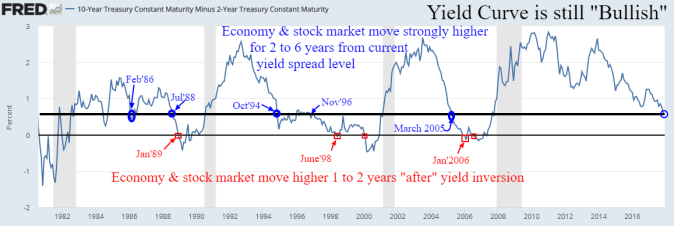
As can be seen in the graph below the US Treasury yield curve inverted before the recessions of 2008, 2000, 1991, and 1981.

It should be noted that the US yield curve has not yet inverted and there is a lag between inversion and recession, on average of 1 to 2 years.  See graph below.  I am not sure I’d call the Yield Curve still “Bullish” all the same.

At the same time, the risk of recession does not currently appear to be a clear and present danger.

Much of the flattening of the current yield curve (i.e. shorter-term interest rates are close to longer-term interest rates) reflects that the US Federal Reserve has increased shorter-term interest rates by over 150 bpts over the last 2 years and longer-term interest rates remain depressed largely due to technical factors.  Albeit, the US 10 year Treasury bond recently trade above 3%, the first time since the start of 2014.  Therefore, the current shape of the US yield curve does make some sense.

Inverted yield curve.png


The picking of recession is obviously critical in determining the likely future performance of the sharemarket.

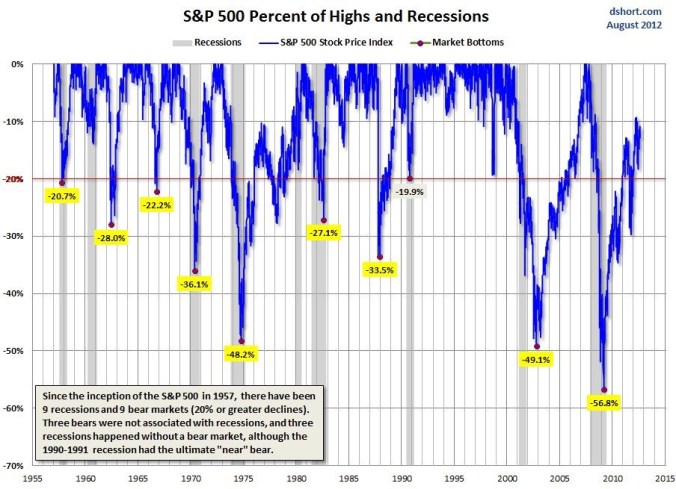
As a rule, sharemarkets generally enter bear markets, falls of greater than 20%, in the event of a recession.

Nevertheless, while a recession is necessary, it is not sufficient for a sharemarket to enter a bear market.

See the graph below, as it notes, since 1957, the S&P 500, a measure of the US sharemarket:

  • three bear markets where “not” associated with a recession; and
  • three recessions happened without a bear market.

bear market recessions.jpg


Statistically:

  1. The average Bull Market period has lasted 8.8 years with an average cumulated total return of 461%.
  2. The average Bear Market period lasted 1.3 years with an average loss of -41%
  3. Historically, and on average, equity markets tend not to peak until six months before the start of a recession.

The current US sharemarket bull market passed its 9 year anniversary in March 2018.  The accumulated return is over 300%.


Mind you, we have to be careful with averages, I like this quote:

“A stream may have an average depth of five feet, but a traveler wading through it will not make it to the other side if its mid-point is 10 feet deep. Similarly, an overly volatile investing strategy may sink an investor before she gets to reap its anticipated rewards.”


Assessing Recession Risk

Importantly, investors should not use the shape of the yield curve as a sole guide as to the likelihood of a recession.

The key forward looking indicators to monitor include an inverted yield curve, but also a significant widening of high yield credit spreads, rising unemployment, and falling future manufacturing orders.

Tightening of financial conditions is also a key indicator, particularly central banks raising interest rates (or reducing the size of their balance sheet as in the current environment) e.g. US Federal Reserve, but also tightening of lending conditions by the large lenders such as the commercial banks to consumers and more particularly businesses.

Lastly, equity market valuation is important.

Happy investing.


Please see my Disclosure Statement