The balancing act of the least liked investment activity

A recent Research Affiliates article on rebalancing noted: “Regularly rebalancing a portfolio to its target asset mix is necessary to maintain desired risk exposure over the portfolio’s lifetime. But getting investors to do it is another matter entirely—many would rather sit in rush-hour traffic! “

“A systematic rebalancing approach can be effective in keeping investors on the road of timely rebalancing, headed toward their destination of achieving their financial goals and improving long-term risk-adjusted returns.”

Research Affiliates are referencing a Wells Fargo/ Gallup Survey, based on this survey “31% of investors would opt to spend an hour stuck in traffic rather than spend that time rebalancing their portfolios. Why would we subject ourselves to gridlock instead of performing a simple task such as rebalancing a portfolio?


I can’t understand why rebalancing of an investment portfolio is one of least liked investment activity, it adds value to a portfolio overtime, is a simple risk management exercise, and is easy to implement.

It is important to regularly rebalance a Portfolio so that it continues to be invested as intended to be.


A recent article in Plansponsor highlighted the importance of rebalancing. This article also noted the reluctance of investors to rebalance their portfolio.

As the article noted, once an appropriate asset allocation (investment strategy) has been determined, based on achieving certain investment goals, the portfolio needs to be regularly rebalanced to remain aligned with these goals.

By not rebalancing, risks within the Portfolio will develop that may not be consistent with achieving desired investment goals. As expressed in the article “Participants need to make sure the risk they want to take is actually the risk they are taking,” …………..“Certain asset classes can become over- or under-weight over time.”

Based on research undertaken by BCA Research and presented in the article “Rebalancing is definitely recommended for all investors, perhaps more so for retirement plan participants than others, as they are more likely to be concerned with capital preservation than capital appreciation.”

The following observation is also made “While a portfolio that is not rebalanced will have a greater allocation to equities during a bull market and, therefore, outperform a rebalanced portfolio, all rebalanced portfolios outperformed an unbalanced portfolio during periods leading up to market corrections and recessions,” Hanafy says, citing a BCA Research study which looked at three main rebalancing scenarios of a simple 60/40 portfolio since 1973.

The potential risks outlined above is very relevant for New Zealand and USA investors currently given the great run in the respective sharemarkets over the last 10 years.

When was last time your investment fiduciary rebalanced your investment portfolio?


Rebalancing becomes more important as you get closer to retirement and once in retirement:

“There are two main components to retirement plans: returns and the risk you take,” …… “When you do not rebalance your portfolio, a participant could inadvertently take on too much risk, which would expose them to a market correction. This is important because, statistically, as participants reach age 40 to 45, how much risk they take on is far more important than how much they save. When you are young, the most important thing is how much you save.”

Rebalancing Policy

As the article notes, you can systematically set up a Portfolio rebalancing approach based on time e.g. rebalance the portfolio every Quarter, six-months or yearly intervals.

It is not difficult!

Alternatively, investment ranges could be set up which trigger a rebalancing of the portfolio e.g. +/- 3% of a target portfolio allocation.

Higher level issues to consider when developing a rebalancing policy include:

  • Cost, the more regularly the portfolio is rebalanced the higher the cost on the portfolio and the drag on performance. This especially needs to be considered where less liquid markets are involved;
  • Tax may also be a consideration;
  • The volatility of the asset involved;
  • Rebalancing Policy allows for market momentum. This is about letting the winners run and not buying into falling markets too soon. To be clear this is not about market timing. For example, it could include a mechanism such as not rebalancing all the way back to target when trimming market exposures.


My preference is to use rebalancing ranges and develop an approach that takes into consideration the above higher level issues. As with many activities in investing, trade-offs will need to be made, this requires judgement.


As noted above, it appears that rebalancing is an un-liked investment activity, if not an over looked and underappreciated investment activity. This seems crazy to me as there is plenty of evidence that a rebalancing policy can add value to a naïve monitoring and “wait and see” approach.

I think the key point is to have a documented Rebalancing Policy and be disciplined in implementing the Policy.


This also means that those implementing the Rebalancing Policy have the correct systems in place to efficiently carry out the Portfolio rebalancing so as to minimise transaction costs involved.

Be sure, that those responsible for your investment portfolio can efficiently and easily rebalance your portfolio. Importantly, make sure the rebalancing process is not a big expense on your portfolio e.g. trading commissions and the crossing of market spreads (e.g. difference between buy and sell price), and how close to the “market price” are the trades being undertaken?

These are all hidden costs to the unsuspecting.


A couple of last points:

  • It was noted in the recent Kiwi Investor Blog on Behaviour Finance that rebalancing of the portfolio was an import tool in the kit in helping to reduce the negative impact on our decision making from behavioural bias. It is difficult to implement a rebalancing policy when markets are behaving badly, discipline is required.
  • The automatic rebalancing nature of Target Date Funds is an attractive feature of these investment solutions.


To conclude, as Research Affiliates sums up:

  1. Systemic rebalancing raises the likelihood of improving longer-term risk-adjusted investment returns
  2. The benefits of rebalancing result from opportunistically capitalising on human behavioural tendencies and long-horizon mean reversion in asset class prices.
  3. Investors who “institutionalise contrarian investment behaviour” by relying on a systematic rebalancing approach increase their odds of reaping the rewards of rebalancing.


It is not hard to do.


Happy investing.

Please see my Disclosure Statement


Global Investment Ideas from New Zealand. Building more Robust Investment Portfolios.


Recessions, inverted yield curves, and Sharemarket returns

Fears of economic recession, particularly in the US, peaked over the final three months of 2018.

Nevertheless, talk of economic recession has now faded into the background after the US Federal Reserve hit the pause button to further interest rate increases in January of 2019. The Fed is not expected to raise interest rates again in 2019.

This is not to say that a recession will not occur, it will at some stage, just as night follows day. The economic/business cycle has not been conquered.

Nevertheless, the timing of the next recession is unknown. Take Australia for example, their last recession was over 28 years ago. New Zealand is over 9 years since their last recession.

With regards to the US, in July of this year the US economy will enter its longest period in history without incurring a recession. Their economy remains on a sound footing: interest rates remain low, the US consumer is confident, businesses are investing, the Government is increasing spending, and forward looking indicators of economic activity remain positive. Lastly, housing activity is likely to pick up over the second half of 2019.


What is a Recession?

A recession is defined as at least two consecutive quarters of declining economic growth. The US National Bureau of Economic Research (NBER) defines a recession as “a significant decline in economic activity spread across the economy, lasting more than a few months, normally visible in real gross domestic product (GDP), real income, employment, industrial production and wholesale-retail sales.”


A recent article by the Capital Group: Preparing for the next recession: 9 things you need to know provides a good overview of the ins-and-outs of economic recession.


The good news, as Capital highlight, recessions generally aren’t very long.

Capital undertook analysis of 10 US economic cycles since 1950. This analysis showed that recessions have lasted between eight and 18 months, with the average spanning about 11 months. Unfortunately New Zealand’s history is a little more chequered than the US.

Investors with a long-term investment horizon, should expect to experience a number recession over their investment horizon and therefore look through the full economic cycle. Fortunately, for most of us, we spend more time in economic expansion than in recession.

Capital note, “over the last 65 years, the U.S. has been in an official recession less than 15% of all months.”

The following graph highlights the average length, total growth, and returns from the average stock market return over the average recession and economic expansion.

Notably, “equity returns can even be positive over the full length of a contraction, since some of the strongest stock rallies have occurred during the late stages of a recession.”

The human cost of economic recession is provided in the form of jobs lost and this should not be forgotten.


Economic cycles Capital.jpg


From a sharemarket perspective, a bear market, defined as a 20% or more fall in value, usually overlaps with recessions.

Share markets tend to lead the economic cycle, given they are forward looking. Sharemarkets on average peak six months prior to the onset of a recession. They continue to fall during the early stages of a recession.

The recovery in sharemarkets often takes hold while the economy is still in recession (economic growth is still contracting).

The initial bounce in sharemarkets is often a period of strong performance and occurs before there is any hard evidence of a pickup in economic activity.

The following graph presents the above sequencing and overlapping nature of sharemarket returns and recessions.

Sharemarket returns and recession cycles.png


Having said all that, stock markets are not good predictors of economic recession i.e. a sharp fall in global sharemarket does not mean there will be an onset of global economic recession.

This is captured by the well know quote from Paul Samuelson: “The stock market has predicted nine of the last five recessions.”


Sharemarket Returns and Inverted Yield Curves

There has been a lot of discussion over the last twelve months about the implications of an inverted US yield curve. (An inverted yield curve is when longer-term interest rates (e.g. 10 years) are lower than shorter-term interest rates (e.g. 2 years or 3 months). A normal yield curve is when longer-term-interest rates are higher than shorter-term-interest rates.

Parts of the US yield curve are currently inverted, and this inversion has increased over recent days.

The significance of this is that prior to the last 7 US recessions the yield curve has inverted prior each time. An inverted yield curve has by and large been a good predictor of recession.

Nevertheless, not every time the yield curve inverts does a recession follow and on average the inversion of the yield curve occurs 12 months prior to a recession.


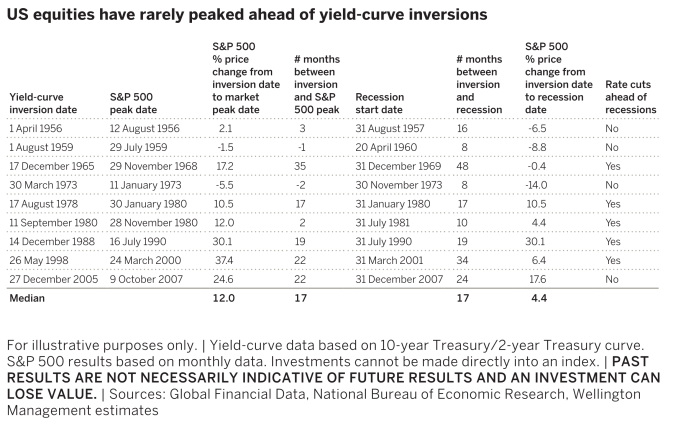
The following analysis undertaken by Wellington Management looks at the performance of the US sharemarket in relation to yield curves inversions.

The period of analysis is from the 1950s at which time the US Federal Reserve gained full, independent control over interest rates from the US Treasury. As Wellington note, “it was after this transition that the yield curve became an effective tool for gauging the impact of monetary policy on the economy and the prospect of a recession.”

Wellington present the following analysis and the Table below:

  • “As shown in the third column (of Table below), the S&P 500 peaked ahead of a yield-curve inversion only twice (1959 and 1973).
  • “The median time between inversion and peak equity returns was 17 months, and in several cases the market peaked almost two years or more after inversion.”
  • “Aggregate equity returns post-inversion have been partly dependent on the length of time between the initial inversion and the start of the recession.”
  • “Since returns tend to be negative right around the time a recession begins, the instances in which there was a shorter period between the initial inversion and the start of the recession were more likely to have a negative return.”


Just like there is a period of time between economic recession and an inverted yield curve, the sharemarket often peaks after the yield curves inverts.

Sharemarket returns and inverted yield curves.png


Back to the Capital article, for it also runs through a number of other recession related questions.

Of interest are:

What economic indicators can warn of a recession?

  • Capital outline some generally reliable signals worth watching closely, such as an inverted yield curve, corporate profits, unemployment, and leading economic indices.
  • Importantly it is appropriate to look at and consider several different economic indicators.


What Causes Recessions?

  • There are many reasons for a recession, chief amongst them are rising interest rates, particularly by Central Banks such as the US Federal Reserve and Reserve Bank of New Zealand, imbalances within an economy e.g. excess housing prices, high debt levels
  • Every economic cycle is unique, but anything that impacts on corporate profits or consumer spending, such as rising unemployment, are factors to consider.


Just remember is it notoriously difficult to predict economic recession and they are normally the result of a number of factors that have a cascading effect leading to an economic downturn.


The following Kiwi Investor Blog Posts maybe of interest to those wanting a better understanding of inverted yield curves, leading economic indicators, and historical performance of equity market corrections.

Recession predictability of inverted yield curves and other economic indicators to considered:


Analysis of Sharemarket corrections and market declines


Lastly the Capital article provides some suggestions as to how to position your portfolio for a recession. I think it is exceedingly difficult to finesse a portfolio in the expectations of a recession.

From my perspective, the following is most critical:

  • Maintain a long-term perspective;
  • Implement a balanced and broadly diversified portfolio. Portfolio diversification does not come from investing in more and more asset classes. This has diminishing diversification benefits. True portfolio diversification is achieved by investing in different risk factors that drive the asset classes e.g. duration (movements in interest rate), economic growth, low volatility, value, and growth. Investors are compensated for being exposed to a range of different risks;
  • Know you risk tolerance: what level of volatility in capital are you prepared to handle without changing your mind;
  • Understand your risk capacity: the amount of risk you need to take in order to reach your financial goals;
  • Implement a goals-based investment approach, where success is measured on how you are tracking relative to your investment goals, rather than market index performances; and
  • Always maintain a high quality portfolio, with plenty of liquidity, and limit the level of turnover across the portfolio e.g. amount of trading (buying and selling)


A good advisor should be able to help you with the above and see you through bouts of sharemarket volatility, including a recession environment.


Happy investing.


Please see my Disclosure Statement


Global Investment Ideas from New Zealand. Building more Robust Investment Portfolios.

cropped-title-picture-enhanced.jpg

Are Kiwisaver Funds, NZ Endowments, and Family Offices missing out on the benefits of Private Investment?

“Private investments, particularly private equity (PE) and venture capital (VC), have provided the strongest relative returns for decades, and top-performing institutions have been long-time allocators to private investment strategies, reaping the benefits of the outperformance.”

“Cambridge Associates’ past analysis indicates that endowments and foundations in the top quartile of performance had one thing in common: a minimum allocation of 15% to private investments”

These are the key findings of a recently published Cambridge Associates (CA) report.

Private investments include non-venture private equity, venture capital, distressed securities (private equity structure), private real estate, private oil & gas/natural resources, timber, and other private investments.


The Cambridge Report suggests a weighting of higher than 15% to private investment may be prudent: their analysis highlighted that top decile performers have higher allocations to private investments and that this allocation has grown over time to a mean allocation of 40%.


CA emphasis with proper diversification the risks within private investments can be appropriately managed. Nevertheless, they highlight there is a wide dispersion of returns in this space, as there are across Alternative strategies in general.


A critical issue, as highlighted by CA, was liquidity calculations, “investors should determine their true liquidity needs as part of any investment strategy”.

Liquidity should be seen as a “budget”.  An investment strategy should be subject to a liquidity budget.  Along with a fee and risk budgets.

CA emphasis that in relation to Family Offices “the portion of the portfolio needed for liquidity may be much lower than their allocation to illiquid investments would suggest.”

As CA notes, many of the top-performing Funds have figured out their liquidity requirements, allowing for higher allocations to illiquid investments.

CA conclude “Those willing to adopt a long-term outlook might be able to withstand more illiquidity and potentially achieve more attractive long-term returns.”


The Institutional Real Estate Inc article covered the CA report and had the following quotes from CA which helps to provide some context.

“Multi-generational families of significant wealth are often well-aligned for considerable private investment allocations,” said Maureen Austin, managing director in the private client practice at Cambridge Associates and co-author of the report. “The precise balance between the need for wealth accumulation for future generations and typically minimal liquidity requirements puts these investors in a unique position where a well-executed private investment allocation can significantly support and extend their legacy. Higher returns, compounded over time in a more tax-advantaged manner, make a sizable allocation to private investments quite compelling.”

  “The long-term time horizon that comes with private investing aligns well with the time horizon for multi-generational families and is often central to our investment strategy with each family……”


Although the CA analysis does not look at the New Zealand market, it does highlight that those Funds underweight private investments are missing out.

With regards to New Zealand, Kiwisaver Funds are underweight private investments and Alternatives more generally.

Given the overall lack of investment to private investments and alternatives by Kiwisaver Funds, do they overestimate their liquidity needs to the detriment of investment performance? Yes, quite likely.

It is also quite likely that a number of New Zealand Endowments and Family Offices do as well.


There is no doubt that Alternatives are, and will continue to be, a large allocation within more sophisticated investment portfolios globally.

As Prequin note in their recent report, investor’s motivation for investing in alternatives are quite distinctive:

    • Private equity and venture capital = high absolute and risk-adjusted returns
    • Infrastructure and real estate = an inflation hedge and reliable income stream
    • Private debt = high risk-adjusted returns and an income stream
    • Hedge Funds = diversification and low correlation with other asset classes
    • Natural Resources = diversification and low correlation with other asset classes


For those wanting a discussion on fees and alternatives, please see my previous post Investment Fees and Investing like an Endowment – Part 2.

As this blog post notes, a robust portfolio is broadly diversified across different risks and returns.

Increasingly institutional investors are accepting that portfolio diversification does not come from investing in more and more asset classes. This has diminishing diversification benefits.

True portfolio diversification is achieved by investing in different risk factors that drive the asset classes e.g. duration, economic growth, low volatility, value, and growth.

Investors are compensated for being exposed to a range of different risks. For example, those risks may include market beta, smart beta, alternative, and hedge fund risk premia. And of course, true alpha from active management, returns that cannot be explained by the risk exposures outlined above. There has been a disaggregation of investment returns.

Not all of these risk exposures can be accessed cheaply.

The US Endowment Funds and Sovereign Wealth Funds have led the charge on true portfolio diversification with the heavy investment into alternative investments and factor exposures.

They are a model of world best investment management practice.  Much like New Zealand’s own Sovereign Wealth Fund, the New Zealand Super Fund.


Happy investing.


Global Investment Ideas from New Zealand. Building more Robust Investment Portfolios.


Please see my Disclosure Statement


Growing importance of ESG within the Alternatives sector

The growing importance of ESG within the Alternatives sector is one of the key themes from the JP Morgan Alts Survey March 2019.  This survey provides some fascinating detail on the state of the Global Alternatives industry, including Private Equity, Real Estate, Infrastructure and Hedge Funds.

Some of the other highlights from the survey include:

  • Diversified benefits – correlation matrix
  • Strategy and manager selection is vitally important – dispersion of manager returns
  • Detailed analysis of the varying Alternative categories e.g. hedge funds and real estate, including drivers of returns


As noted in previous Posts, Kiwisaver Funds are underweight Alternatives relative to the rest of the world, an alternatives allocation would be beneficial for Target Date Funds, and US Endowment have provided superior long term returns after fees due their successful allocations to Alternatives.


The benefits of Alternatives have been well documented and they are set to continue to become a larger part of Client portfolios over time as outlined by the recently published Prequin Global Alternatives Report.


Therefore, not surprisingly, according to JP Morgan, “Institutional investors are flocking to hedge funds this year, even after a turbulent 2018 marked by poor performance and market volatility.”

The demand for hedged funds is driven by the search for market-beating returns and diversification.

They found that about a third of respondents plan to boost allocations, up from 15 percent in 2018. Just 13 percent expect a decrease while 55 percent said they plan to maintain current allocations.

As a recent Bloomberg article highlighted, the hedge fund industry took its biggest annual loss last year since 2011, declining 4.8 percent on a fund-weighted basis, according to Hedge Fund Research Inc. Managers were hurt by volatility that trampled markets, and hedge funds saw $33.5 billion in outflows.

JPMorgan polled 227 investors with about $706 billion in hedge fund assets for its annual Institutional Investor Survey.


For those new to Alternatives, a recent Investment News article provides some wonderful insights into the benefits of Alternatives and implementation challenges with clients.

With regards to the benefits of Alternatives, comments by Dick Pfister, founder and president of AlphaCore Capital, a firm that allocates between 15% and 30% of client assets to alternative investments, are worth highlighting.

“We look at some alternatives as diversifiers,” he said. “But we will also look at other alternatives as ways to capture chunks of up markets.”

The article notes the “message that investors, advisers and allocators like Mr. Pfister understand is that the big picture perspective rarely looks good for alternative investments, which is why those who dwell on broad category averages often get stopped at the gate.”

The article continues “Making the case for alternatives, which are generally designed to neutralize market beta and enhance alternative alpha, is never easy when market beta is robust in the form of a bullish stock market.”

“That is the reality of allocating to alternative investments. To benefit from the diversifying factors, investors and advisers must appreciate that losing less than the market can often mean gaining less than the market.”

“There’s always something to complain about when you have a diversified portfolio,” said Hans-Christian Winkler, a financial planner at Claraphi Advisory Network, where client portfolios have between 20% and 30% allocated to alternatives.

“A diversified portfolio will never outperform the market, but in times like the last quarter of 2018, when we saw the market down 20% from the high, our portfolios with alternatives were down 5%,” he added. “By using alternatives, you are spreading out your risk and making your investment portfolio a lot less bond-market- and stock-market-dependent.”


These are key points, they highlight the benefits but also the challenges when it comes to positioning Alternatives with clients and stakeholders e.g. Trustees, Investment Committees.

Alternatives “underperform” on a relative basis when equity and bond markets perform strongly.  This can have some challenges with Clients, the article is well worth reading from this perspective, as it provides insights into how a number of Advisors are positioning Alternatives with their Clients.


Happy investing.


Global Investment Ideas from New Zealand. Building more Robust Investment Portfolios.


Please see my Disclosure Statement

Risk Measure of Wealth Management

Risk is not the volatility of your investment portfolio, or volatility of returns, risk is determined by your investment goals.

This is the view of Nobel laureate Professor Robert Merton. Such an assessment of risk also underpins many Goals-Based wealth management solutions.

More robust investment solutions are developed when the focus on risk moves beyond variations of returns and volatility of capital. The key risk is failure to meet your investment objectives.


The finance industry, many financial advisors and academics express risk as the variation in returns and capital, as measured by the standard deviation of returns, or variance.

Nevertheless, clients often see risk as the likelihood of not attaining their investment goals.

The traditional financial planning approach is to understand client’s goals, then ask questions to determine risk tolerance, which then leads to advising a client to adopt a portfolio that has a mean expected return and standard deviation corresponding to the Client’s risk appetite.  Standard deviation of returns, variation in capital, becomes the measure of risk.


Nevertheless, a different discussion with clients on their goals will likely result in a different investment solution. It will also improve the relationship between the Client and the Advisor.

Such a discussion will lead to more individualised advice and a better understanding of the choices being made. Clients will be in a better place to understand the impacts of their choices and the probability of achieving their goals. It will be more explicit to them in making trade-offs between playing it safe and taking risks to achieve their investment goals.

A goals based approach provides a more intuitive, transparent, and understandable planning approach.

Ultimately it leads to a more robust portfolio for the Client where information from the goals-based discussion can be mapped to a specific range of portfolios.

It is also a dynamic process, where portfolios can be updated and changed on new discussions and information. The process can adapt for multiple-goals over multiple time periods.

This is in stark contrast to the single period single objective, static portfolio traditionally implemented based on risk appetite.

There is also a strong foundation in Behaviour Economics supporting the Goals-Based investment approach.


I have covered Merton’s view in previous Posts, so please don’t accuse me of confirmation bias!

Merton’s views on risk is also well presented in a 2016 i3 Invest article in Australia, Risk is determined by Investment goal.

“Risk is not simply expressed as the volatility of your invested assets, but is determined by your ultimate goal, according to Nobel laureate Robert Merton.”


The i3 article provides an example on how your goal determines to a large degree what your risk-free asset is.

The goal provides a starting point for determining:

  • how far removed you are from achieving your objectives; and
  • importantly, how much risk you need to take to have a chance of meeting these objectives.


“If you had as your goal to pay your (Australian dollar) tax bill in a year from now, then what is the safe asset for you?”

“It would be an Australian dollar, one year, zero coupon, Australian Treasury Bill that matures in one year. That would be the sure thing.”


As the i3 article mentions Merton has criticised the idea that superannuation is a pot of money, instead of a basis for generating an income stream.

Merton argues that there should be greater focus on generating replacement income in retirement and we need to stop looking at account balances and variations in account balances. Instead, we should focus on the income that can potentially be generated in retirement from the investment portfolio, pot of money.


This is not a radical idea, this is looking at the system in the same way as Defined Benefit Funds did, the “old” style funds before the now “modern” defined contributions fund (where the individual takes on all the investment risk).  Defined contributions funds focus on the size of the pot.  The size of the superannuation pot (Kiwisaver account balance) does not necessarily tell you the standard of living that can be supported in retirement.  This is Merton’s critical point.


A greater focus on income is aligned with goals-based investment approach.

As Merton’s explains, if we accept we should focus on income, targeting sufficient replacement income in retirement, the development of a comprehensive income product in retirement is not difficult. He concludes, “This doesn’t require the smartest scientist in Australia to solve this problem. We know how to do it, we just need to go out and do it,”.


As noted above I have previously Posted on Merton’s retirement income views. The material from these Posts comes from a Podcast between Steve Chen, of NewRetirement, and Professor Merton. The Podcast is 90 minutes in length and full of great conversation about retirement income. Well worth listening to.


For those wanting a greater understanding of Merton’s views and rationale please see:

  1. What matters for retirement is income not the value of Accumulated Wealth
  2. Is variability of retirement income a better measure of risk rather than variability of capital? – What matters for retirement is income not the value of Accumulated Wealth


Happy investing.


Please see my Disclosure Statement

Global Investment Ideas from New Zealand. Building more Robust Investment Portfolios.
 

Behavioural Drivers of Wealth Management

Underpinning The Regret Proof Portfolio and Best Portfolio Does not Mean Optimal Portfolio is, amongst a number of things, Behavioural Economics.


A recent paper A New Approach to Goals-Based Wealth Management published in the Journal of Investment Management (JOIM), provides a very comprehensive framework for a Goals-Based Wealth Management approach.


Behavioural Economics forms the foundations of Goals-Based Wealth Management.


As the JOIM Paper notes “Traditionally, the financial industry, financial advisors, and academics in finance have associated the notion of “risk” with the standard deviation of an investor’s portfolio. Investors, on the other hand, typically associate “risk” with the likelihood of not attaining their goals.”

This is important from the perspective of client communications: “In traditional financial planning, advisors look to understand what an investor’s goals are, then they ask questions designed to determine the investor’s tolerance for portfolio standard deviation, which leads to advising the investor to adopt a portfolio that has a mean and standard deviation corresponding to the investor’s risk appetite”

Goals-Based Wealth Management is defined “as a process that focuses on helping investors realize their goals, both short-term and long-term,..”

Behavioural Economics comes into play by “using language and ideas that are more natural for investors” in determining appropriate investment goals.


Behavioural Economics Foundations

The JOIM Paper provides a very good overview of the behavioural economics that forms the foundations of their Goals-Based Wealth Management Investment solution.

Inputs comes from the:

  1. pioneering and very influential academic literature on Behavioural Economics
  2. growing practitioner literature on goals-based wealth management


Richard Thaler’s work, who is a 2017 Nobel prize winner for his contribution to Behavioural Economics, provides a central pillar to the Goals-Based Wealth Management solution outlined in the JOIM Paper.

Thaler’s worked on the “endowment effect”, which is the asymmetric valuation of assets by individuals.  Namely, individuals value items more when they own them as opposed to when they do not.

This is related to loss aversion in Prospect Theory. Loss aversion refers to people’s tendency to prefer avoiding losses to acquiring equivalent gains.  Some studies have suggested that losses are twice as powerful, psychologically, as gains.  Loss aversion was first identified by Amos Tversky and Daniel Kahneman.


Mental accounting theory is also a significant contribution from Thaler and it is also an essential foundation for Goals-Based Wealth Management.

Mental accounting is where people treat money with different risk-return preference, depending on what use the money is to be put to. It is a way of keeping track of our money related transactions.

From a practical perspective, mental accounting helps elicit investors goals, and is “facilitated by breaking down overall portfolio goals into sub-portfolio goals using the ideas of mental accounts, where different goals are managed in different accounts, each aggregating into the overall portfolio.”


Lastly the JOIM Paper notes the work undertaken that developed Behavioural Portfolio Theory.  This theory postulates that investors behave as if they have multiple mental accounts. “Each mental account portfolio has varying levels of aspiration, depending on the goals for the mental account.  These ideas naturally lead to portfolio optimization where investors are goal-seeking (aspirational), while remaining concerned about downside risk in the light of their goals. Rather than trade-off risk versus return, investors trade off goals versus safety…”.


Practitioner’s Perspective

The JOIM Paper also notes the growing practitioner literature on goals-based wealth management.

Specifically, they reference three major contributions:

Nevins advocates a goal-orientated approach to help investors deal with biases such as overconfidence, hindsight bias, and overreaction.   Nevins’ work extended the mental accounting approach. He also argues that traditional investment planning fails to recognize investor’s behavioural preferences and biases.

Contributions by Zwecher, complements Nevins, he argues that risk management can be “done more actively and efficiently by demonstrating how a retirement portfolio that provides income, generates growth, and protects assets from disasters, can be created by adopting a bucketing (mental accounting) approach.”

Research undertaken by Brunel discussed the equal importance of two goals for an investor: being able to avoid nightmares while realizing dreams. “Brunel’s work focussed on demonstrating how goals-based wealth management can be achieved across multiple time horizons for multiple life goals. He also suggested how to map the language customers use in describing the importance of dreams or the severity of nightmares into acceptable probabilities that the investor will realize such dreams or avoid such nightmares.”


In short, Practitioners have recognized the need for a goals-based approach.

The premise is, if customers can better articulate and discuss their goals, including safety, then they are able to work with Practitioners to build more robust investment solutions that are better designed to meet their aspirations and investment objectives.


Happy investing.


Please see my Disclosure Statement

Global Investment Ideas from New Zealand. Building more Robust Investment Portfolios.

One Year Anniversary

Kiwi Investor Blog is one year old.

My top three articles for the year would be:

Investment Fees and Investing like an Endowment – Part 2

Endowments and Sovereign wealth Funds lead the way in building robust investment portfolios in meeting a wide range of challenging investment objectives.   This Post covers this and amongst other things, what true diversification is, it is not having more and more asset classes, a robust portfolio is broadly diversified across different risks and returns. A lot can be learnt from how Endowments construct portfolios, take a long term view, and seek to match their client’s liability profile. Although fees are important, an overriding focus on fees may be detrimental to building a robust portfolio and in meeting client investment objectives.


A Robust Framework for generating Retirement Income

This Post builds on the Post above and looks at an investment framework for individuals, developed by EDHEC-Risk Institute and their Partners. It is a Goal Based Investment framework with a focus on capital value but also delivering a secure and stable level of replacement income in retirement.


The monkey paw of Target Date Funds (be careful what you wish for)

This Post emphasises the need to focus on generating a stable and secure level of replacement income in retirement as an investment goal and highlights the approach that is required to achieve this. Such an approach would greatly enhance the outcomes of Target Date Funds. This Post also references the thoughts of Professor Robert Merton around having a greater focus on generating replacement income in retirement as an investment objective and that volatility of replacement income is a better measure of investment risk, as it is more aligned with investment objectives, unlike the volatility of capital or standard deviation of returns.


Kiwi Investor blog has covered many topics over the year, including the value of active management, the shocking state of the investment management industry globally, Responsible Investing, the high cost of index funds and being out of the market.

Of these, recent research into the failure of the 4% rule in almost all markets worldwide is well worth highlighting.


Kiwi Investor Blog has a primary focus on topics associated with building more robust portfolios and investment solutions.

The Blog has highlighted the research of EDHEC-Risk Institute throughout the year. EDHEC draw on the concept of Flexicurity. This is the concept that individuals need both security and flexibility when approaching investment decisions. This is surely a desirable goal and the hallmark of a robust investment portfolio. The knowledge is available to achieve this and the framework and rationale is covered in the Posts above.

Flexicure is my word of 2018.


I don’t think the Uber moment has been reached in the investment management industry yet. Technology will be very important, but so too will be the underlying investment solution. The investment solution needs to be more tailored to an individual’s investment objectives.

As outlined in the Posts highlighted above, the framework for the investment solution has emerging and is developing.

It is a goal based investment solution, more closely tailored to an individual’s investment aspirations, so as to provide a more secure and stable level of replacement income in retirement.


Happy investing.


Please see my Disclosure Statement

Global Investment Ideas from New Zealand. Building more Robust Investment Portfolios.


The Regret Proof Portfolio

Based on analysis involving the input of Daniel Kahneman, Nobel Memorial Prize-winning behavioural economist, a “regret-proof” investment solution would involve having two portfolios: a risky portfolio and a safer portfolio.

Insurance companies regularly implement a two-portfolio approach as part of their Liability Driven Investment (LDI) program: a liability matching portfolio and a return seeking portfolio.

It is also consistent with a Goal Based Investing approach for an individual: Goal-hedging portfolio and a performance seeking portfolio. #EDHEC

Although there is much more to it than outlined by the article below, I find it interesting the solution of two portfolios came from the angle of behavioural economics.

I also think it is an interesting concept given recent market volatility, but also for the longer-term.


Background Discussion

Kahneman, discussed the idea of a “regret-proof policy” at a recent Morningstar Investment Conference in Chicago.

“The idea that we had was to develop what we called a ‘regret-proof policy,’” Kahneman explained. “Even when things go badly, they are not going to rush to change their mind or change and to start over,”.

According to Kahneman, the optimal allocation for someone that is prone to regret and the optimal allocation for somebody that is not prone to regret are “really not the same.”

In developing a “regret-proof policy” or “regret minimization” Portfolio allows advisors to bring up “things that people may not be thinking of, including the possibility of regret, including the possibility of them wanting to change their mind, which is a bad idea generally.”


In developing a regret proof portfolio, they asked people to imagine various scenarios, generally bad scenarios, and asked at what point do you want to bail out or change your mind.

Kahneman, noted that most people — even the very wealthy people — are extremely loss averse.

“There is a limit to how much money they’re willing to put at risk,” Kahneman said. “You ask, ‘How much fortune are you willing to lose?’ Quite frequently you get something on the order of 10%.”


Investment Solution

The investment solution is for people to “have two portfolios — one is the risky portfolio and one is a much safer portfolio,” Kahneman explained. The two portfolios are managed separately, and people get results on each of the portfolios separately.

“That was a way that we thought we could help people be comfortable with the amount of risk that they are taking,” he said.

In effect this places a barrier between the money that the client wants to protect and the money the client is willing to take risk on.

Kahneman added that one of the portfolios will always be doing better than market — either the safer one or the risky one.

“[That] gives some people sense of accomplishment there,” he said. “But mainly it’s this idea of using risk to the level you’re comfortable. That turns out to not be a lot, even for very wealthy people.”


I would note a few important points:

  1. The allocation between the safe and return seeking portfolio should not be determined by risk profile and age alone. By way of example, the allocation should be based primarily on investment goals and the client’s other assets/source of income.
  2. The allocation over time between the two portfolios should not be changed based on a naïve glide path.
  3. There is an ability to tactically allocate between the two portfolios. This should be done to take advantage of market conditions and within a framework of increasing the probability of meeting a Client’s investment objectives / goals.
  4. The “safer portfolio” should look more like an annuity. This means it should be invested along the lines that it will likely meet an individual’s cashflow / income replacement objectives in retirement e.g. a portfolio of cash is not a safe portfolio in the context of delivering sufficient replacement income in retirement.


Robust investment solutions, particularly those designed as retirement solutions need to display Flexicurity.   They need to provide security in generating sufficient replacement income in retirement and yet offer flexibility in meeting other investment objectives e.g. bequests.  They also need to be cost effective.

The concepts and approaches outlined above need to be considered and implemented in any modern-day investment solution that assists clients in achieving their investment goals.

Such consideration will assist in reducing the risk of clients adjusting their investment strategies at inappropriate times because of regret and the increased fear that comes with market volatility.

Being more goal focussed, rather than return focused, will help in getting investors through the ups and downs of market cycles. A two-portfolio investment approach may well assist in this regard as well.


Happy investing.


Please see my Disclosure Statement

Global Investment Ideas from New Zealand. Building more Robust Investment Portfolios.


Flexicurity in Retirement Income Solutions – making finance useful again

Flexicurity is the concept that individuals need both security and flexibility when approaching retirement investment decisions.  See EDHEC-Risk Institute.


Annuities, although providing security, can be costly, they represent an irreversible investment decision, and often cannot contribute to inheritance and endowment objectives. Also, Annuities do not provide any upside potential.

Likewise, modern day investment products, from which there are many to choose from, provide flexibility yet not the security of replacement income in retirement.  Often these Products focus solely on managing capital risk at the expense of the objective of generating replacement income in retirement.  In short, as outlined by EDHEC-Risk, modern day Target Date Funds “provide flexibility but no security because of their lack of focus on generating minimum levels of replacement income in retirement.”


Therefore, a flexicure retirement solution is one that provides greater flexibility than an annuity and increased security in generating appropriate levels of replacement income in retirement than many modern day investment products do.


EDHEC offers a number enhancements to improve the outcomes of current investment products.


One such approach, and central to improving investment outcomes for the current generic Target Date Funds (TDF), is designing a more suitable investment solution in relation to the conservative allocation (e.g. cash and fixed income) within a TDF.  Such an enhancement would also eliminate the need for an annuity in the earlier years of retirement.


From this perspective, the conservative allocations within a TDF are risky when it comes to generating a secure and stable level of replacement income in retirement. These risks are not widely understood nor managed appropriately.

The conservative allocations with a TDF can be improved by being employed to better matching future cashflow and income requirements. While also focusing on reducing the risk of inflation eroding the purchasing power of future income.

This requires moving away from current market based shorter term investment portfolios and implementing a more customised investment solution.

The investment approach to do this is readily available now and is based on the concept of Liability Driven Investing applied by Insurance Companies.  Called Goal Based Investing for investment retirement solutions. #Goalbasedinvesting

The techniques and approaches are available and should be more readily used in developing a second generation of TDF (which can be accessed in some jurisdictions already).

This is relevant to improving the likely outcome for many in retirement. With this knowledge it would help make finance more useful again, in providing very real welfare benefits to society. #MakeFinanceUsefulAgain


For a better understanding of current crisis of global pension industry and introduction to Flexicure see this short EDHEC video and their very accessible research paper introducing_flexicure_gbi_retirement_solutions_1.


This is my last Post of the year.

Flexicure, is my word of the year! Hopefully, we will hear this being used further in relation to more Robust Investment Portfolios, particularly those promoted as Retirement Solutions.

As you know, my blog this year has had a heavy focus on retirement solutions and has drawn upon the analysis and framework of EDHEC-Risk Institute.

In addition, the thoughts of Professor Robert Merton have been important, particularly around placing a greater emphasis on replacement income in retirement as an investment objective and that volatility of replacement income is a better measure for investment risk for those investing for retirement.

I have also noted the limitation of Target Date Funds and how these can be improved e.g. with the introduction of Alternatives.

Nevertheless, the greatest enhancement would come from implementing a more targeted cashflow and income matching portfolio within the conservative allocations as discussed above.


Wishing you all the best for the festive season and a prosperous New Year.


Happy investing.


#MakeFinanceUsefulAgain

#flexicure

#goalbasedinvesting


Please see my Disclosure Statement

Global Investment Ideas from New Zealand. Building more Robust Investment Portfolios.


Challenging the conventional wisdom of active management

The attached paper, Challenging Conventional Wisdom of Active mgmt *, undertakes a review of the most recent academic literature on active equity management.  It concludes by challenging the conventional wisdom of active management.


The conventional wisdom of active management, which is based on research over 20 years old, runs along the lines of the following:

  1. The average fund underperforms after fees.
  2. The performance of the best funds does not persist.
  3. Some fund managers are skilled, but few have skill in excess of costs.


Nevertheless, a review of the current literature finds a substantial body of research that disagrees with the conventional wisdom of active management.


The authors of the paper conclude “taken as a whole, our review of current academic literature suggests that the conventional wisdom is too negative on the value of active management.

The literature that followed Carhart (1997), the basis of current conventional wisdom of active management, has documented that “active managers have a variety of skills and tend to make value-added decisions, such that, after accounting for all costs, many actively managed funds appear to generate positive value for investors.”

“While the debate between active and passive is not settled and many research challenges remain, we conclude that the current academic literature finds active management more promising for investors than the conventional wisdom claims.”


Quoting from the paper’s introduction:

  1. “Regarding average performance, Berk and van Binsbergen (2015) find the average active fund outperforms an equivalent index fund by 36 basis points per year, while Cremers, Petajisto, and Zitzewitz (2012) and Linnainmaa (2013) show that standard approaches to estimating average fund performance can be biased against finding that active management adds value.”
  2. “Considering performance persistence, Bollen and Busse (2005) and Kosowski, Timmermann, Wermers, and White (2006) both find some evidence of persistence among top-performing funds.
  3. “Several studies identify groups of funds that appear to have skill in excess of costs. For example, Cremers and Petajisto (2009) show that funds with ‘high active share,’ meaning funds with holdings that greatly differ from their benchmark, tend to outperform their benchmark. They also show that the performance of funds with low active share drives the results of previous studies indicating that the average actively managed fund underperforms. Similarly, Amihud and Goyenko (2013) show that funds with past performance that is not readily explained by common factors, such as the performance of large-cap stocks versus small-cap stocks, perform well in the future.”


“The research has also considered how the actions of active managers create value in different ways. Wermers (2000), among others, shows that many funds select stocks that outperform the market, while Kaplan and Sensoy (2005) and Jiang, Yao, and Yu (2007) show that some funds can correctly time the market. Other research finds that active managers create value through corporate oversight (Iliev and Lowry, 2015) and tax management (Sialm and Starks, 2012). The returns on these activities vary; Pastor, Stambaugh, and Taylor (2017) and von Reibnitz (2018) show that the amount of value creation depends on market conditions. “


It must be remembered that it over 20 years since the publication of Carhart’s landmark study on mutual funds.  Its conclusion—that the data did “not support the existence of skilled or informed mutual fund portfolio managers”—helped form the ‘conventional wisdom’ that active management does not create value for investors.


20 years on, this paper could well be a landmark paper and is well worth reading.


I don’t want to enter the passive vs active debate. I find it very dogmatic. From personal experience I can see a place for both passive and active management, including the use of Exchange Traded Funds and alternative investment strategies. There are active managers who can consistently add value, nevertheless they are rare.

I do think some people hold on to some pretty outdated views on active management and analysis based only on US Mutual Fund data may have its limitations.


Often it is hard to identify successful active managers. A recent paper from a very well respected British university concluded that Asset Consultants were not very good at identifying successful managers.  Nevertheless, their research results showed that active managers did outperform on average!!


With regards to fees, see my Post, Investment Fees and Investing like an Endowment – Part 2.


From my own investment management experience there are a couple of guiding principles I always reflect upon, which I think are relevant for the active vs passive debate:

  1. Beware of Hubris before the fall
  2. “It is better to be roughly right than precisely wrong” quote attributed to John Maynard Keynes


Happy investing.


*The paper is: Challenging the Conventional Wisdom on Active Management: A Review of the Past 20 Years of Academic Literature on Actively Managed Mutual Funds, K.J. Martijn Cremers, Jon A. Fulkerson, and Timothy B. Riley, September 2018.


Global Investment Ideas from New Zealand. Building more Robust Investment Portfolios.


Please see my Disclosure Statement