Investing in a Challenging Investment Environment

The Global financial backdrop can be summarised as:

  1. Late Cycle
    • The US economy is into its longest period of uninterrupted growth, it has been over ten years since the Global Financial Crisis (GFC) and the US experiencing a recession.
    • Likewise, the US sharemarket is into it longest period without incurring a 20% or more fall (which would be a bear market).
  2. Exceptionally low interest rates. As you will be aware over $14 trillion of European and Japanese fixed income securities are trading on negative interest rates.
  3. Central Banks around the world are reducing short-term interest. By way of example, the US Federal Reserve has undertaken a mid-cycle adjustment, with more to come, the European Central Bank recently cut interest rates, as has China’s Central Bank. The Reserve Bank of Australia and the Reserve Bank of New Zealand have reduced cash rates very aggressively in recent months. It appears that interest rates will remain lower for longer.
  4. Rising geo-political risk, namely an ongoing and escalating trade dispute between the US and China, while Brexit has a cameo role on the global stage, and there are rising tensions in the middle-east.
  5. Global growth has slowed. The pace of economic activity has slowed around the world, this is most noticeable in Europe, Japan, and China, and is concentrated within the manufacturing sector. The service sectors have largely been unaffected.


Against this backdrop the US sharemarket has outperformed, continually reaching all-time highs, likewise for the New Zealand sharemarket.

Value stocks have underperformed high growth momentum stocks. The performance differential between value and growth is at historical extremes.

Lastly emerging Markets have underperformed the developed world.


A good assessment of the current environment is provided in this article by Byron Wien. It is a must read, Plenty to worry about but not much to do.


It is not all gloom and doom

The US consumer is in very good shape, reflecting record low unemployment, rising wages, and a sound property market. The US consumer is as bigger share of the global economy as is China. Although it is not growing as fast as China, a solid pace of growth is being recorded.

Overall, economic data in the US has beaten expectations over recent weeks (e.g. retail sales).

Globally the manufacturing sectors are expected to recover over the second half of this year, leading to a rebound in global growth. Low interest rates will also help global growth.  Nevertheless, growth will remain modest and inflation absent.

Globally, in most countries, Sharemarket’s dividend yields are higher than interest rates. This means that sharemarkets can fall in value over the next 5-10 years and still outperform fixed income.


How to invest in current environment

Recently there has been #TINA movement: There Is No Alternative to Equities.

Certainly equities have performed strongly on a year to date basis, so have fixed income securities (their value increases as interest rates fall).

The traditional 60/40 portfolio, 60% Equities and 40% Fixed Income, has performed very strongly over the last 6-9 months, this comes after a difficult 2018.

#TINA and the longer term performance of the 60/40 portfolio is covered in this AllAboutAlpha Article, which is well worth reading.

The 60/40 portfolio has performed well over the last 10 years, and has been a strong performer over the longer term.

This performance needs to be put into the context that interest rates have been falling for the last 35 years, this has boosted the returns from the Fixed Income component of the portfolio.  Needless to say, this tail wind may not be so strong in the next 35 years.

This indicates that future returns from a 60/40 portfolio will be lower than those experienced in more recent history.

There are lots of suggestions as to what one should do in the current market environment.  This article on Livewire Markets provides some flavour.

No doubt, you will discuss any concerns you have with your Trusted Advisor.


At a time like this, reflect on the tried and true:

Seek “True” portfolio Diversification

The AllAboutAlpha article references a Presentation by Deutsche Bank that makes “a very compelling case for building a more diversified portfolio across uncorrelated risk premia rather than asset class silos”.

The Presentation emphasises “The only insurance against regime shifts, black swans, the peso problem and drawdowns is to seek out multiple sources of risk premia across a host of asset classes and geographies, designed to harvest different features (value, momentum, illiquidity etc.) of the return generating process, via a large number of small, uncorrelated exposures

The above comments are technical in nature and I will explain below. Albeit, the Presentation is well worth reading: Rethinking Portfolio Construction and Risk Management.


In a nutshell, the above comments are about seeking “true” portfolio diversification.

Portfolio diversification does not come from investing in more and more asset classes i.e. asset class silos. This has diminishing diversification benefits over the longer term and particularly at the time of market crisis e.g. adding global listed property or infrastructure to a multi-asset portfolio that already includes global equities.

True portfolio diversification is achieved by investing in different risk factors (i.e. premia) that drive the asset classes e.g. duration, economic growth, low volatility, value, and growth by way of example.

Investors are compensated for being exposed to a range of different risks. For example, those risks may include market beta (e.g. equities and fixed income), smart beta (e.g. value and momentum factors), alternative and hedge fund risk premia, illiquidity e.g. Private Equity, Direct Property, and unlisted infrastructure. And of course, true alpha from active management, returns that cannot be explained by the risk exposures just outlined. There has been a disaggregation of returns.

US Endowment Funds and Sovereign Wealth Funds have led the charge on true portfolio diversification, along with the heavy investment into alternative investments and factor exposures. They are a model of world best investment management practice.

Therefore, seek true portfolio diversification, this is best way to protect portfolio outcomes and reduce the reliance on sharemarkets and interest rates driving portfolio outcomes.

As the Presentation says, a truly diversified portfolio provides better protection against large market falls and unexpected events i.e. Black Swans.

True diversification leads to a more robust portfolio.

(I have written a number of Post on Alternatives and the expected growth in institutions investing in alternatives globally.)


Customised investment solution

Often the next bit advice is to make sure your investments are consistent with your risk preference.

Although this is important, it is also fundamentally important that the investment portfolio is customised to your investment objectives and takes into consideration a wider range of issues than risk preference and expected returns and volatility from capital markets.

For example, income earned up to and after retirement, assets outside super, legacies, desired standard of living in retirement, and Sequencing Risk (the period of most vulnerability is either side of the retirement age e.g. 65 here in New Zealand).


Think long-term

I think this is a given, and it needs to be balanced with your customised investment objectives as outlined above. Try to see through market noise, don’t over trade and don’t take on more risk to chase returns.

It is all right to do nothing, don’t be compelled to trade, a less traded portfolio is likely more representative of someone taking a longer term view.

Also look to financial planning options to see through difficult market conditions.


There are a lot of Investment Behavioural issues to consider, the idea of the Regret Portfolio approach may resonate, and the Behavioural Tool Kit could be of interest.


AllAboutAlpha has a great tagline: “Seek diversification, education, and know your risk tolerance. Investing is for the long term.”

Kiwiinvestorblog is all about education, it does not provide investment advice nor promote any investment and receives no payments. Please follow the links provided for a greater appreciation of the topic in discussion.


And, please, build robust investment portfolios. As Warren Buffet has said: “Predicting rain doesn’t count. Building arks does.” ………………….. Is your portfolio an all weather portfolio?


Happy investing.

Please see my Disclosure Statement


Global Investment Ideas from New Zealand. Building more Robust Investment Portfolios.


KiwiSaver Investors are missing out

This is a great article by Stuff outlining the KiwiSaver risk ladder, rung by rung.

However, what struck me is that there is a rung missing on the KiwiSaver ladder.

That rung being the lack of exposure to non-traditional investments, such as Alternatives, including liquid alternatives, hedge funds, Private Equity, Venture Capital, and investments into Direct Property and unlisted infrastructure.

Based on the Stuff article, there is just 1% within all of the KiwiSaver Funds invested outside of Cash, Fixed Interest (bonds), and Equities (the traditional asset classes).

We don’t have to look far to see how much of anomaly this.

By way of comparison, the Australian Pension Fund Industry, which is the fourth largest Pension market in the world, invests 22.0% into non-traditional assets.

As can be seen in the Table below, Australian Pension Funds, which manages A$2.9 trillion, invests 22.0% into non-traditional assets, meanwhile KiwiSaver has 1% invested outside of the traditional assets. (KiwiSaver Total Assets are just over $50 billion).

Allocations to broad asset classes

KiwiSaver

Aussie Pension Funds

Cash and Fixed Interest (bonds)

49

31

Equities

48

47

Other / non-traditional assets

1

22

As recently reported by Bloomberg, allocations to non-traditional assets is expected to continue in Australia ”with stocks and bonds moving higher together, investors are searching for other areas to diversify their investments to hedge against the fragile global economic outlook. For the world’s fourth largest pension pot, that could mean more flows into alternatives — away from the almost 80% that currently sits in equities, bonds or cash.”

The increased allocations to Alternative is a global trend, which is not just in response to current market conditions.

As outlined in a previous Post, Preqin a specialist global researcher of the Alternative investment universe and provide a reliable source of data and insights into alternative assets professionals around the world, expect Alternatives to make up a larger share of investment assets in the future.

Preqin’s estimates are staggering:

  • By 2023 Preqin estimate that global assets under management of the Alternatives industry will be $14tn (+59% vs. 2017);
  • There will be 34,000 fund management firms active globally (+21% vs. 2018). This is an issue from the perspective of capacity and ability to deliver superior returns – manager selection will be critical.

The expected growth in Alternative investments was also highlighted by a recent CAIA Association Survey, which outlined the drivers of this expected growth and likely trends.

Globally the trend toward increasing allocations to non-traditional assets has been in play for some time. As one of my first Posts notes, the case for adding alternatives to a traditional portfolio is strong.

This Post highlights that the movement toward Alternatives and non-traditional assets is not revolutionary nor radical, it is seen globally as evolutionary, a natural progression toward building more robust Portfolios that can better weather sharp falls in global sharemarkets.

Interestingly, the US Department of Labor (DOL) recently provided guidance that US Defined Contribution retirement plans can invest into certain Private Equity strategies, where previously there had been a hesitation to do so.

The DOL emphasised this would be of benefit to “ordinary investors”.

Being more specific about Alternatives, Prequin note investor’s motivation for investing in alternatives are quite distinctive:

  • Private equity and venture capital = high absolute and risk-adjusted returns
  • Infrastructure and real estate = an inflation hedge and reliable income stream
  • Private debt = high risk-adjusted returns and an income stream
  • Hedge Funds = diversification and low correlation with other asset classes
  • Natural Resources = diversification and low correlation with other asset classes

Therefore, motives to investing in alternatives range from enhancing returns (Private Equity) and reducing risk through better diversification (Hedge Funds) and hedging against inflation (infrastructure and real estate (property), high exposures to non-traditional assets have benefited Endowments and foundations for many years.

I have Posted extensively on the benefits of Alternatives, for example highlighting research they would benefit Target Date Funds and the benefits of Alternatives more generally.

So the Question needs to be asked, why do KiwiSaver Funds not invest more into non-traditional assets? Particularly, when globally the trend is to invest in such assets is well established and further growth is expected, while the benefits are well documented.

Therefore, KiwiSaver Investors are potentially missing out.  Their portfolios could be a lot more robust and better diversified. The risks within their portfolios could be reduced without jeopardising their long-term investment objectives.

Happy investing.

Please see my Disclosure Statement


Global Investment Ideas from New Zealand. Building more Robust Investment Portfolios.

KiwiSaver and OECD Pension Scheme Recommendations

The OECD has identified for some time the growing importance of Defined Contribution (DC) pension schemes.

There has been a major shift globally away from Defined Benefit (DB) schemes to DC, such as KiwiSaver here in New Zealand.

As a result, the individual has become increasingly responsible for investment decisions, for which they are generally not well equipped to make.   This has been likened to a “financial climate change” by the World Economic Forum

The OECD has undertaken a review of DC potential drawbacks and how to incorporate them into regulatory frameworks to protect members. This led to the formation of a Core Principles of Private Pension Regulation.

In addition, the OECD Roadmap for the Good Design of DC Pension Plan made several recommendations.


Off interest to me, from the perspective of designing investment solutions, were the following:

  • Ensure the design of DC pension plans is internally coherent between the accumulation and pay-out phases and with the overall pension system. 


  • Consider establishing default life-cycle investment strategies as a default option to protect people close to retirement against extreme negative outcomes. 


  • For the pay-out phase, encourage annuitisation as a protection against longevity risk.


The OECD made a number of other recommendations which also have merit and they are provided below.


The OECD Core Principles of Private Pension Regulation emphasised that the objective is to generate retirement income.

Importantly, investment strategies should be aligned with this objective and implement sound risk management practices such as diversification and asset-liability matching.

“These should be appropriately employed in order to achieve the best outcome for the plan members and beneficiaries” (Guidelines 4.1).

Interestingly, these principles should apply not only to KiwiSaver, but to any forms of voluntary savings plans and mandatory arrangements.


The emphasis on generating retirement income and coherency between accumulation and pay-out phase (de-cumulation) are important concepts.


In my mind, a greater focus should be placed on generating income in retirement at the later stages of the retirement accumulation phase i.e. at least 10-15 years out from retirement. This is achieved by using asset-liability matching techniques as recommended by the OECD. The investment knowledge is available now to achieve this.

This reflects that the goal of most modern investment Products is to accumulate wealth and risk is defined as volatility of capital. Although these are important concepts, and depending on the size of the Pool, the focus on accumulated wealth my not lead to the generation of a stable and sufficient level of income in retirement.

This is a key learning out of Australia as they near the end of the “accumulation” phase of their superannuation system.

The central point is, without a greater focus on generating Income in retirement during the accumulation phase the variation of income in retirement will likely be higher.


Therefore, it is important to have coherency between the accumulation and pay-out phase of retirement.


I have Posted previously on the concept of placing a greater focus on retirement income as the investment goal (as recommended by the OECD). The argument for such a goal is well presented by Noble Memorial Prize in Economic Sciences Professor Robert Merton.

Professor Merton highlights that for retirement, income matters, and not the value of Accumulated Wealth.

He also argues that variability of retirement income is a better measure of risk rather than variability of capital.


It is appropriate to consider the OCED recommendations at a time that the New Zealand Government are reviewing the Kiwisaver Default Provider arrangements.

This Review is being undertaken by the Ministry of Business, Innovation & Employment (MBIE) and submissions are due 18 September 2019.

This GoodReturns article provides some context.


It is also important to note that there is a paradigm shift underway within the wealth management industry. The industry is evolving, new and improved products are being introduced to the markets in other jurisdictions.

New and innovative financial products are disrupting traditional markets by offering alternative ways to receive retirement income. The new approaches combine existing products in new and different ways. While they do not always provide guaranteed lifetime income, the innovations nevertheless can give savers options and features that annuities do not provide.

For example, Managed Payout Funds in the USA are a major alternative to an annuity. These Funds are designed to produce a relatively consistent level of annual income but that does not guarantee that outcome. They are similar in some respects to Target Date Funds (TDFs) but have a different objective.


More robust investment solutions are being developed to meet the retirement income challenge, they also display Flexicurity.   EDHEC Risk Institute provides a sound framework for the development of Robust Investment Solution and the need for more appropriate investment solutions.

Increasingly the robust solution is a Goal-Based investment solution coupled with longevity annuities that begin to make payments when the owner reaches an advanced age (e.g. 80) as a means to manage longevity risk.


The future also entails an increasing level of customisation. This reflects that saving for retirement is an individual experience requiring much more tailoring of the investment solution than is commonly available now. Different investors have different goals.

The investment techniques and approaches are available now to better customise investment solutions in relation to the conservative allocations within ones portfolio so as to generate a level of income to meet retirement goals.

Likewise, the allocation to risky assets (e.g. equities) should also be based on individual goals and circumstances.

The risky asset allocation should not be based on age alone, other factors such as assets outside of Super, other forms of income, and tolerance for risk in meeting aspiration retirement goals for example should also be considered.


In summary, the retirement investment solution needs be customised and focus on generating a sufficient and stable stream of replacement income. This goal needs to be considered over the accumulation phase, such that hedging of future income requirements is undertaken prior to retirement (LDI). Focusing purely on an accumulated capital value and management of market risk alone may lead to insufficient replacement of income in retirement, greater variation of income in retirement, and/or other inefficient trade-offs are made during retirement.

Importantly the investment management focus is not on beating a market index, arguing about fees (albeit they are important), the focus is on how the Investment Solution is tracking relative to the “individuals” retirement goals.


Happy investing.

Please see my Disclosure Statement


Global Investment Ideas from New Zealand. Building more Robust Investment Portfolios.
 

The OECD also recommends:

  1. Encourage people to enrol, to contribute and contribute for long periods.
  2. Improve the design of incentives to save for retirement, particularly where participation and contributions to DC pension plans are voluntary.
  3. Promote low-cost retirement savings instruments.
  4. Establish appropriate default investment strategies, while also providing choice between investment options with different risk profile and investment horizon.
  5. Promote the supply of annuities and cost-efficient competition in the annuity market.
  6. Develop appropriate information and risk-hedging instruments to facilitate dealing with longevity risk.
  7. Ensure effective communication and address financial illiteracy and lack of awareness.


Evolution within the Wealth Management Industry, the death of the Policy Portfolio

There has been a profound shift in the savings and investment industry over the last 15-20 years.

Changes to accounting rules and regulations have resulted in a large number of corporates closing their defined benefit (DB) pension schemes.

This has resulted in a major shift globally away from DB schemes and to defined contribution (DC) schemes, such as KiwiSaver here in New Zealand.


As a result, the individual has become increasingly responsible for investment decisions, for which they are generally not well equipped to make.

This has been likened to a “financial climate change” by the World Economic Forum.

Couple with an aging population, growing life expectations, and strains on Government sponsored pension/superannuation schemes there is an increasing need for well-designed retirement investment solution.


Overarching the above dynamics is the shortcomings of many financial products currently available.

Many Products currently do not provide a stable stream of income in retirement, or if they do, they lack flexibility.

As expressed by EDHEC Risk Institute robust investment solution need to display Flexicurity.

Flexicurity is the concept that individuals need both security and flexibility when approaching retirement investment decisions.

Annuities, although providing security, do not provide any potential upside. They can also be costly, represent an irreversible investment decision, and rarely are able to contribute to inheritance and endowment objectives.

Likewise, modern day investment products, from which there are many to choose from, provide flexibility yet not the security of replacement income in retirement. Often these Products focus solely on managing capital risk at the expense of the objective of generating replacement income in retirement.

Therefore, a flexicure retirement solution is one that provides greater flexibility than an annuity and increased security in generating appropriate levels of replacement income in retirement than many modern day investment products.


Retirement Goal

The most natural way to frame an investor’s retirement goal is in terms of how much lifetime replacement income they can afford in retirement.

The goal of most modern investment Products is to accumulate wealth, with the management of market volatility, where risk is defined as volatility of capital. Although these are important concepts, and depending on the size of the Pool, the focus on accumulated wealth my not provide a sufficient level of income in retirement.

This is a key learning from Australia as they near the end of the “accumulation” phase of their superannuation system. After a long period of accumulating capital a growing number of people are now entering retirement and “de-cumulating” their retirement savings.

A simple example of why there should be a greater focus on generating retirement income in the accumulation phase of saving for retirement is as follows:

A New Zealander who retired in 2008 with a million dollars, would have been able to generate an annual income of $80k by investing in retail term deposits. Current income on a million dollars would be approximately $32k if they had remained invested in term deposits. That’s a big drop in income, and it will continue to fall as the Reserve Bank undertakes further interest rate reductions over the course of 2019.

This also does not take into account the erosion of buying power from inflation.

Of course, retirees can draw down capital, the rules of thumb are, ………… well, ………..less than robust.

The central point, without a greater focus on generating Income in retirement during the accumulation phase there will likely be a higher level of variation of Income in retirement.


The concept of placing a greater focus on retirement income as the investment goal is well presented by Noble Memorial Prize in Economic Sciences Professor Robert Merton  in this Posdcast with Steve Chen, of NewRetirement.

Professor Merton highlights that for retirement, income matters, and not the value of Accumulated Wealth.

He also argues that variability of retirement income is a better measure of risk rather than variability of capital.

More robust investment solutions are being developed to address these issues.


Lastly, it is encouraging that KiwiSaver providers are required to include retirement savings and income projections in annual statements sent to KiwiSaver members from 2020 onwards.


The death of the Policy Portfolio

Another important consideration is that investment practices and approaches are evolving. Modern Portfolio Theory (MPT), the bedrock of most current portfolios, was developed in the 1950s. It is no longer that modern!

Although key learnings can be taken from MPT, particularly the benefits of diversification, enhancements can be made based on the ongoing academic and practitioner research into building more robust investment solutions.

The momentous shift is the move away from the old paradigm of the Policy Portfolio. The Policy Portfolio is the strategic asset allocation of a portfolio to several different asset classes deemed to be most appropriate for the investor.

It is a single Portfolio solution.

Over the last 15-20 years there has been several potential enhancements to the Policy Portfolio approach, including the move away from asset classes and greater focus on underlying “factors” that drive investment returns (Although a separate Post will be published on this development, an introduction to factor investing and its implementation have been covered in previous Posts).

This interview with Andrew Ang on Factor Investing might also be of interest.


The focus of this Post, and probably the most significant shift away from the old paradigm, is the realisation that investments should not be framed in terms of one all-encompassing Policy Portfolio, but instead in terms of two distinct reference Portfolios.

The two portfolios as expressed by EDHEC-Risk Institute and explained in the context of a wealth Management solution are:

  1. Liability-hedging portfolio, this is a portfolio of fixed interest securities, that seeks to match future income requirements of the individual in retirement
  2. Performance Seeking Portfolio, this is a portfolio that seeks growth in asset value.

The concept of two separate portfolios is not new, it dates back to finance studies in the 1950s on fund separation theorems (which is an area of research separate to the MPT).

The idea of two portfolios was also recently endorsed by Daniel Kahneman, Nobel Memorial Prize-winning behavioural economist, a “regret-proof” investment solution would involve having two portfolios: a risky portfolio and a safer portfolio.

Kahneman, discussed the idea of a “regret-proof policy” at a recent Morningstar Investment Conference in Chicago.


The death of the Policy Portfolio was first raised by Peter Bernstein in 2003.

Reasons for the death of Policy Portfolio include that there is no such thing as a meaningful Policy Portfolio. Individual circumstances are different.

Furthermore, Investors should be dynamic, they need to react to changing market conditions and the likelihood of meeting their investment goals – a portfolio should not be held constant for a long period of time.

Therefore, institutional investors are moving toward more liability driven investment solutions, separating out the hedging of future liabilities and building another portfolio component that is return seeking.

The allocation between the two portfolios is seen as a dynamic process, which responds to the market environment and the changing likelihood of meeting investment goals.


Evolution of Wealth Management – the new Paradigm

These “institutional” investment approaches, liability driven investing, portfolio separation, and being more dynamic are finding their way into wealth management solutions.

Likewise, there is a growing acceptance the goal, as outlined above, is to focus on delivering income in retirement. Certainly a greater emphasis should be place on Retirement Income than previously.

Specifically, the goal is to meet with a high level of probability consumption goals in the first instance, and then aspirational goals, including healthcare, old age care and/or bequests.

Therefore, the investment solution should be designed to meet investment goals, as opposed to purely focusing on market risks as a whole, as is the case with the Policy Portfolio.


Goal-Based Investing

This new paradigm has led to Goal-Based investing (GBI) for individuals. Under GBI the focus is on meeting investor’s goals, much like liability-driven investing (LDI) is for institutional investors.

As explained by EDHEC Risk Goal-Based Investing involves:

  1. Disaggregation of investor preferences into a hierarchical list of goals, with a key distinction between essential and aspirational goals, and the mapping of these groups to hedging portfolios possessing corresponding risk characteristics (Liability Hedging Portfolio).
  2. On the other hand it involves an efficient dynamic allocation to these dedicated hedging portfolios and a common performance seeking portfolio.


GBI is consistent with two portfolio approach, fund separation, liability driven investing, and undertaking a dynamic investment approach.

The first portfolio is the Liability Hedging Portfolio to meet future income requirements, encompassing all essential goals.

The objective of this Portfolio is to secure with some certainty future income requirements. It is typically made up of longer dated high quality fixed income securities, including inflation linked securities.

The second portfolio is the Growth portfolio, or return seeking portfolio. This is used to attain aspirational goals, objectives above essential goals. It is also required if the investor needs to take on more risk to achieve their essential goals in retirement i.e. a younger investor would have a higher allocation to the Return Seeking Portfolio.

The Growth Portfolio would be exposed to a diversified array of risk exposures, including equities, developed and emerging markets, factor exposures, and unlisted assets e.g. unlisted infrastructure, direct property and Private Equity.

Allocations between Hedging Portfolio and the Growth Portfolio would depend on an individual’s circumstances e.g. how far away they are from reaching their desired standard of living in retirement.

This provides a fantastic framework for determining the level of risk to take in meeting essential goals and how much risk is involved in potentially attaining aspirational goals. It will lead to a more efficient use of invested capital and a better assessment of the investment risks involved.

Importantly, the framework will help facilitate a more meaningful dialogue between the investor and his/her Advisor. Discussions can be had on how the individual’s portfolios are tracking relative to their retirement goals and if there are any expected shortfalls. If there are expected shortfalls, the framework also helps in assessing what is the best course of action and trade-offs involved.


Industry Challenge

The Industry challenge, as so eloquently defined by EDHEC Risk, as a means to address the Pension Crisis as outlined at the beginning of this Post:

“investment managers must focus on the launch of meaningful mass-customized retirement solutions with a focus on generating replacement income in retirement, as opposed to keeping busy with launching financial products ill-suited to the problem at hand”

“……..The true challenge is indeed to find a way to provide a large number of individual investors with meaningful dedicated investment solutions.”


As expressed above, saving for retirement is an individual experience requiring much more tailoring of the investment solution than is commonly available now. Different investors have different goals.

Mass-production of Products, rather than Mass-Customisation of Investment Solutions, has been around for many years with the introduction of Unit Trusts/Mutual Funds, and more recently Exchange Traded Funds (ETFs).

Mass-production, and MPT, down play the importance of customisation by assuming investment problems can be portrayed within a simple risk and return framework.

Although the Growth Portfolio would be the same for all investors, the Liability Hedge Portfolio requires a greater level of customisation, it needs to be more “custom-made”.


Conclusion

Encouragingly, the limitation of “one size fits all” approach has been known for some time. The investment techniques and approaches are available now to better customise investment solutions.

The challenge, is scalability, and the good news is advancements have been made in this area as well.

This is leading to changes within funds management organisations involving the greater use of technology and new and improved risk management techniques.  New skills sets have been developed.

The important point is that the knowledge is available now and it is expected that such investment solutions will be a growing presence on the investment landscape.

This will lead to better investment outcomes for many and have a very real social benefit.


The inspiration for this Post comes from EDHEC Risks short paper: Mass Customization versus Mass Production – How An Industrial Revolution is about to Take Place in Money Management and Why it Involves a Shift from Investment Products to Investment Solutions  (see: EDHEC-Whitepaper-JOIM)

A more technical review of these issues has also been undertaken by EDHEC.


Happy investing.

Please see my Disclosure Statement


Global Investment Ideas from New Zealand. Building more Robust Investment Portfolios.


Optimal Private Equity Allocation

TIAA (Teachers Insurance and Annuity Associations of America Endowment & Philanthropic Services) has published a paper offering insights into the optimal way of building an allocation to Private Equity (PE).

“Private equity is an important part of institutional portfolios. It provides attractive opportunities for long-term investors to harvest the illiquidity premium over time and extract the value created by hands-on private equity managers.”


Private equity is by its nature is illiquid. This in turn makes rebalancing a challenge. That is why a PE allocation that is too large endangers the entire portfolio, especially in times of crisis when secondary markets seize up.


According to recent analysis by Prequin, the popularity and growth of PE, and other alternative investments, is expected to continue.

Furthermore, recent Cambridge Associates analysis on those Endowments and Foundations with the better long-term performance records had “one thing in common: a minimum allocation of 15% to private investments.


We all know, a robust portfolio is broadly diversified across different risks and returns. Increasingly institutional investors are accepting that portfolio diversification does not come from investing in more and more asset classes. This has diminishing diversification benefits.

True portfolio diversification is achieved by investing in different risk factors, for which illiquidity is one factor.

In my mind, direct private investments, such as Private Equity, Direct Property, and Unlisted Infrastructure have a place in a genuinely diversified and robust Portfolio.


From this perspective, the TIAA paper is very useful as it considers how to build and maintain an allocation to PE within a well-diversified portfolio.  They assume building out the PE allocation over time to an equilibrium allocation.

The Paper provides valuable insights into the asset allocation process of what is a complicated asset to model given cash commitments (capital calls) are made overtime and there is uncertainty as to when invested capital will be returned (distributions). TIAA model for both of these variables, in a relatively conservative manner.

The TIAA Paper notes that investors have no control over the rate and timing of capital calls and distributions. Therefore, the paper focuses on two key variables Investors can control for: an annual commitment rate and the risk profile of the assets waiting to be invested in private equity assets i.e. where to invest the cash committed to PE but not yet called.


TIAA propose a robust process to determine an appropriate allocation to PE to ensure the allocation can be maintained and the benefits of PE are captured over time.

“Obtaining the benefits of an allocation to private equity, while also avoiding its inherent illiquidity pitfalls, can only occur through an effective, risk-based strategy for executing the build-out to the long-term equilibrium state.”

The goal of the paper is to develop a framework and a sound approach.


The results:

TIAA’s modelling suggests that a target allocation to private equity strategies in the range of 30% to 40% presents minimal liability and liquidity risks.

TIAA also suggest, that for long term investors, such as Endowments, capital awaiting investment in private equity should be invested in risk assets with higher expected returns, such as public equities (sharemarkets).


This level of allocation is probably high for most, and particularly KiwiSaver Funds.

Nevertheless, KiwiSaver Funds are underweight Private investments and Alternatives, particularly relative to the Superannuation industry in Australia.

Given the overall lack of allocation to private investments, including PE, Direct Property, and Unlisted Infrastructure, many KiwiSaver providers are most likely over estimating their liquidity needs to the detriment of investment performance over the longer term.

For those wanting a discussion on fees and alternatives, please see my previous post Investment Fees and Investing like an Endowment – Part 2.


TIAA Analysis

With regards to the TIAA paper, they develop a simple three asset portfolio of Fixed Income, Public equities, and Private equities. TIAA use sophisticated modelling techniques looking at a number of variables, including:

  1. the annual commitment rate; and
  2. Risk profile of the assets waiting to be invested in private equity.

The annual commitment is defined as the new commitment to private equity every year as a percentage of last year’s total portfolio value.

“An annual commitment rate results in a long-term equilibrium percentage of the portfolio in private equity assets, as well as the portfolio’s corresponding unfunded commitment level. The unfunded commitment level is important from a risk perspective as it represents a nominal liability to fund future capital calls, regardless of the prevailing market environment at the time of capital calls.”

TIAA note that at low rates of annual commitment the equilibrium rate of PE is about twice the unfunded ratio. Therefore, a 6% annual commitment rate will result in a base case unfunded ratio of around 15%, and a PE allocation of around 30% at equilibrium.

For those wanting a brief overview of the methodology, All About Alpha provides a great summary.


There is no doubt that Alternatives are, and will continue to be, a large allocation within more sophisticated investment portfolios globally.

As Prequin note in this report, investor’s motivation for investing in alternatives are quite distinctive:

    • Private equity and venture capital = high absolute and risk-adjusted returns
    • Infrastructure and real estate = an inflation hedge and reliable income stream
    • Private debt = high risk-adjusted returns and an income stream
    • Hedge Funds = diversification and low correlation with other asset classes
    • Natural Resources = diversification and low correlation with other asset classes

A well diversified and robust portfolio will be able to meet these motivations.


Happy investing.


Please see my Disclosure Statement


Global Investment Ideas from New Zealand. Building more Robust Investment Portfolios.

Could Buffett be wrong?

As has been widely reported Warren Buffett frequently comments on the benefits of investing in low-cost index funds.

He’s reportedly instructed the trustee of his estate to invest in index funds. “My advice to the trustee couldn’t be more simple: Put 10% of the cash in short-term government bonds and 90% in a very low-cost S&P 500 index fund,” he noted in the Berkshire Hathaway’s 2013 annual letter to shareholders.


Not that I want to disagree with Buffett, I have enormous respect for him, incorporate many of his investment insights and philosophies into my own investment approaches. Albeit, I think he might be wrong on this account.

And this is not to say Index Funds do not have a part to play in a portfolio, nor that investment fees are not important. They are. I do think more portfolios should be invested along the lines of Endowments. Broad diversification is the key.


Following Buffett could be the right advice for a young person starting out with many years until retirement.  Such an investor would need to weather the volatility of being largely invested in equities, which is no mean achievement when equity markets can suffer falls of over 40%. A high equity strategy can become horribly undone.

Nevertheless, as one gets closer to retirement and is in retirement Buffett’s strategy is unsuitable.

Similarly Buffett’s strategy is not appropriate for a Pension Fund or Endowment. These Funds are in a similar position to those in retirement. Meanwhile, the equity allocation should be reduced as one gets closer to retirement.

The short comings of a higher equity allocation was highlighted in a recent article  by Charles E.F. Millard, who is a consultant to AQR Capital Management, LLC.


Once an investor needs to take capital or income from a portfolio volatility of the equity markets can wreak havoc on a Portfolio’s value, and ultimately the ability of a portfolio to meet its investment objectives.

The key point that Millard makes is that Pension Funds and Endowments are required to make periodic payment obligations. So do those in retirement, they either draw capital or income from the portfolio to sustain a desired standard of living.


Ultimately, it the drawing of an income or the payments by Endowments that consume most of the investment returns. “This is why assets don’t just mushroom over time.”

As Millard explains, “each year endowments usually pay out at least 5% of their holdings, and the institutions they support tend to count on those funds. That changes the situation an awful lot.”

Let’s look at the math. Millard explains”

and assume that each year the endowment pays out 5% of its assets. In that case, starting at $1 million, the endowment would not have the $5.3 billion Buffett imagines. Rather, after having paid out almost $145 million along the way, the endowment would have less than $150 million remaining”

Still a great result, but far from the billions assumed by Buffett.

It is also worth noting that a Pension’s obligation (liability) can continue to grow as employees retire and live longer. The Pension Fund has no ability to reduce its payouts and must manage this risk.


This is where market volatility comes into play, particularly drawdowns – a large fall in the value of the market.

“In a prolonged stock market drawdown, those growing benefit payments will consume a larger share of the shrunken plan assets.  So, they can’t take too much solace in long-run optimism when in the intermediate run they’re already paying out much of their capital.”


This is a key point. You can’t take comfort in the long-term returns from equities when you are running out of money!

Equity markets do fall in value and this is why institutions with meaningful annual pay-out obligations are not invested only in equities.


No argument that equities will not outperform over the longer term, this is highly likely. Yet this observation fails to recognise the volatility inherent in equities.

Millard:

“Over Buffett’s 77 years investing, the endowment CIO would see fund assets decline in 23 out of 77 years (when equity returns didn’t cover the 5% distribution), and in the average bad year, the fund would shrink by -12%. But at least an endowment may be able to reduce its spending; a pension fund can’t, so in a bad year, the fraction of pension assets that must be paid out increases substantially. This is why most institutional investors subscribe to a concept that Buffett seems to hate – diversification. He’s said it’s “a protection against ignorance.” We think it is more a protection against hubris.”

Diversification is key.

“It is worth noting that Institutions do not seek to maximize potential long-term returns, without regard to risks. They often seek to maximize the likelihood that they can meet their payout obligations. They seek to be reliable payers of those obligations. And in the case of pensions, they also seek to make it possible for the employer to have somewhat predictable and affordable contribution obligations. A portfolio of stocks alone doesn’t do that. That’s why asset class diversification is a bedrock principle of modern investing.


In short, institutional investors have different goals and obligations to Buffett.

For those in retirement, their goals and obligations are more closely aligned with the Pension Fund and Endowment, than Buffett and Berkshire Hathaway. Those closer to retirement need to make sure that market volatility does not impact them and their ability to sustain the standard of level they wish to maintain in retirement.


Happy investing.

Please see my Disclosure Statement


Global Investment Ideas from New Zealand. Building more Robust Investment Portfolios.

Recessions, inverted yield curves, and Sharemarket returns

Fears of economic recession, particularly in the US, peaked over the final three months of 2018.

Nevertheless, talk of economic recession has now faded into the background after the US Federal Reserve hit the pause button to further interest rate increases in January of 2019. The Fed is not expected to raise interest rates again in 2019.

This is not to say that a recession will not occur, it will at some stage, just as night follows day. The economic/business cycle has not been conquered.

Nevertheless, the timing of the next recession is unknown. Take Australia for example, their last recession was over 28 years ago. New Zealand is over 9 years since their last recession.

With regards to the US, in July of this year the US economy will enter its longest period in history without incurring a recession. Their economy remains on a sound footing: interest rates remain low, the US consumer is confident, businesses are investing, the Government is increasing spending, and forward looking indicators of economic activity remain positive. Lastly, housing activity is likely to pick up over the second half of 2019.


What is a Recession?

A recession is defined as at least two consecutive quarters of declining economic growth. The US National Bureau of Economic Research (NBER) defines a recession as “a significant decline in economic activity spread across the economy, lasting more than a few months, normally visible in real gross domestic product (GDP), real income, employment, industrial production and wholesale-retail sales.”


A recent article by the Capital Group: Preparing for the next recession: 9 things you need to know provides a good overview of the ins-and-outs of economic recession.


The good news, as Capital highlight, recessions generally aren’t very long.

Capital undertook analysis of 10 US economic cycles since 1950. This analysis showed that recessions have lasted between eight and 18 months, with the average spanning about 11 months. Unfortunately New Zealand’s history is a little more chequered than the US.

Investors with a long-term investment horizon, should expect to experience a number recession over their investment horizon and therefore look through the full economic cycle. Fortunately, for most of us, we spend more time in economic expansion than in recession.

Capital note, “over the last 65 years, the U.S. has been in an official recession less than 15% of all months.”

The following graph highlights the average length, total growth, and returns from the average stock market return over the average recession and economic expansion.

Notably, “equity returns can even be positive over the full length of a contraction, since some of the strongest stock rallies have occurred during the late stages of a recession.”

The human cost of economic recession is provided in the form of jobs lost and this should not be forgotten.


Economic cycles Capital.jpg


From a sharemarket perspective, a bear market, defined as a 20% or more fall in value, usually overlaps with recessions.

Share markets tend to lead the economic cycle, given they are forward looking. Sharemarkets on average peak six months prior to the onset of a recession. They continue to fall during the early stages of a recession.

The recovery in sharemarkets often takes hold while the economy is still in recession (economic growth is still contracting).

The initial bounce in sharemarkets is often a period of strong performance and occurs before there is any hard evidence of a pickup in economic activity.

The following graph presents the above sequencing and overlapping nature of sharemarket returns and recessions.

Sharemarket returns and recession cycles.png


Having said all that, stock markets are not good predictors of economic recession i.e. a sharp fall in global sharemarket does not mean there will be an onset of global economic recession.

This is captured by the well know quote from Paul Samuelson: “The stock market has predicted nine of the last five recessions.”


Sharemarket Returns and Inverted Yield Curves

There has been a lot of discussion over the last twelve months about the implications of an inverted US yield curve. (An inverted yield curve is when longer-term interest rates (e.g. 10 years) are lower than shorter-term interest rates (e.g. 2 years or 3 months). A normal yield curve is when longer-term-interest rates are higher than shorter-term-interest rates.

Parts of the US yield curve are currently inverted, and this inversion has increased over recent days.

The significance of this is that prior to the last 7 US recessions the yield curve has inverted prior each time. An inverted yield curve has by and large been a good predictor of recession.

Nevertheless, not every time the yield curve inverts does a recession follow and on average the inversion of the yield curve occurs 12 months prior to a recession.


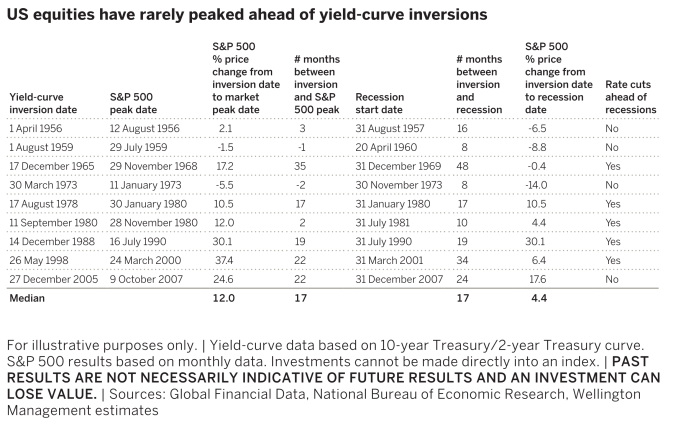
The following analysis undertaken by Wellington Management looks at the performance of the US sharemarket in relation to yield curves inversions.

The period of analysis is from the 1950s at which time the US Federal Reserve gained full, independent control over interest rates from the US Treasury. As Wellington note, “it was after this transition that the yield curve became an effective tool for gauging the impact of monetary policy on the economy and the prospect of a recession.”

Wellington present the following analysis and the Table below:

  • “As shown in the third column (of Table below), the S&P 500 peaked ahead of a yield-curve inversion only twice (1959 and 1973).
  • “The median time between inversion and peak equity returns was 17 months, and in several cases the market peaked almost two years or more after inversion.”
  • “Aggregate equity returns post-inversion have been partly dependent on the length of time between the initial inversion and the start of the recession.”
  • “Since returns tend to be negative right around the time a recession begins, the instances in which there was a shorter period between the initial inversion and the start of the recession were more likely to have a negative return.”


Just like there is a period of time between economic recession and an inverted yield curve, the sharemarket often peaks after the yield curves inverts.

Sharemarket returns and inverted yield curves.png


Back to the Capital article, for it also runs through a number of other recession related questions.

Of interest are:

What economic indicators can warn of a recession?

  • Capital outline some generally reliable signals worth watching closely, such as an inverted yield curve, corporate profits, unemployment, and leading economic indices.
  • Importantly it is appropriate to look at and consider several different economic indicators.


What Causes Recessions?

  • There are many reasons for a recession, chief amongst them are rising interest rates, particularly by Central Banks such as the US Federal Reserve and Reserve Bank of New Zealand, imbalances within an economy e.g. excess housing prices, high debt levels
  • Every economic cycle is unique, but anything that impacts on corporate profits or consumer spending, such as rising unemployment, are factors to consider.


Just remember is it notoriously difficult to predict economic recession and they are normally the result of a number of factors that have a cascading effect leading to an economic downturn.


The following Kiwi Investor Blog Posts maybe of interest to those wanting a better understanding of inverted yield curves, leading economic indicators, and historical performance of equity market corrections.

Recession predictability of inverted yield curves and other economic indicators to considered:


Analysis of Sharemarket corrections and market declines


Lastly the Capital article provides some suggestions as to how to position your portfolio for a recession. I think it is exceedingly difficult to finesse a portfolio in the expectations of a recession.

From my perspective, the following is most critical:

  • Maintain a long-term perspective;
  • Implement a balanced and broadly diversified portfolio. Portfolio diversification does not come from investing in more and more asset classes. This has diminishing diversification benefits. True portfolio diversification is achieved by investing in different risk factors that drive the asset classes e.g. duration (movements in interest rate), economic growth, low volatility, value, and growth. Investors are compensated for being exposed to a range of different risks;
  • Know you risk tolerance: what level of volatility in capital are you prepared to handle without changing your mind;
  • Understand your risk capacity: the amount of risk you need to take in order to reach your financial goals;
  • Implement a goals-based investment approach, where success is measured on how you are tracking relative to your investment goals, rather than market index performances; and
  • Always maintain a high quality portfolio, with plenty of liquidity, and limit the level of turnover across the portfolio e.g. amount of trading (buying and selling)


A good advisor should be able to help you with the above and see you through bouts of sharemarket volatility, including a recession environment.


Happy investing.


Please see my Disclosure Statement


Global Investment Ideas from New Zealand. Building more Robust Investment Portfolios.

cropped-title-picture-enhanced.jpg

Further growth expected for an Alternative future – Prequin

The outlook for Alternative investments continues to look bright according to the recent Prequin Global Alternatives Report.

Prequin note investor’s motivations for investing in alternatives are quite distinctive:

Private equity and venture capital, motives = high absolute and risk-adjusted returns

Infrastructure and real estate, motives = an inflation hedge and reliable income stream

Private debt, motives = high risk-adjusted returns and an income stream

Hedge Funds, motives = diversification and low correlation with other asset classes

Natural Resources, motives = diversification and low correlation with other asset classes

Prequin comment “Set against these objectives, it becomes clear why investors have not only consistently increased their allocations to alternative assets over the past decade, but also why they are planning to continue to do so in the years ahead (not to mention the growing number of investors that come into alternatives each year – i.e. growing ‘participation’).”

Interestingly, investors are expressing an increasing allocation not only to those alternatives that have exceeded expectations recently (Private equity and venture capital, private debt, infrastructure, real estate), but are also looking to increase allocations to areas where recent performance has disappointed – notably hedge funds and natural resources. As they note “the diversification and low correlation offered by these assets may be especially attractive in a challenging returns environment.”


Importantly, the Prequin survey is set against a backdrop where investors “see a challenging environment ahead for returns.”

They also note that continued growth is expected despite alternative assets having enjoyed a “tremendous decade of growth” and “becoming ever more vital in investors’ portfolios worldwide;”


With regards to expected growth, “Preqin is sticking with its forecast for further growth of alternative assets to 2023: from $8.8tn in assets under management in 2017 to $14.0tn in 2023.”


The full Prequin report is available and covers each of the Alternative strategies outlined above.

The Preqin-Alternatives-in-2019-Report, for example, provides some interesting facts and figures on Hedge Funds:

  • 59% of Surveyed investors believe we are the top of the equity cycle, 40% intend to position their portfolios defensively
  • 79% of surveyed investors intent to maintain or increase their level of allocation to hedge funds over the next 12 months


For further articles on Alternatives by Kiwi Investor Blog:

  1. An Alternative Future for Kiwisaver Funds
  2. Alternatives Investments will improve the investment outcomes of Target-Date Funds
  3. Future’s Hedge Funds
  4. Investment Fees and Investing like an Endowment – Part 2
  5. Perspective of the Hedge Fund Industry
  6. Adding Alternatives to and Investment Portfolio – Part 3 – Investing Like an Endowment Fund
  7. Adding Alternatives to and Investment Portfolio – Part 2
  8. Adding Alternatives to and Investment Portfolio


Happy investing.


Please see my Disclosure Statement

Global Investment Ideas from New Zealand. Building more Robust Investment Portfolios.


Best Portfolio Does Not Mean Optimal Portfolio

The best portfolio is not necessarily the optimal portfolio.

As this thought-provoking article by Joachim Klement, CFA, highlights, “In theory, the optimal portfolio is the best portfolio, but in reality, the optimal is often far from the best for any given investor. Or to recall a quote variously attributed to Albert Einstein, Yogi Berra, and Richard Feynman, among others: “In theory, there is no difference between theory and practice, while in practice there is.””

The article highlights the shortcomings of a portfolio optimisation approach. No surprises there!

Nevertheless, a key point made in the article is that many people in a Trustee or Fiduciary role see the portfolio optimisation process as a black-box exercise which is full of assumptions.

If true, this can be a challenge, particularly for those presenting the results and “the client never understands how these assumptions lead to the proposed allocation”.

I am sure this occurs to varying degrees and as a result there is a real risk that there is not a good understanding of the purpose of each investment allocation within the portfolio.

This often leads to the most pertinent point made in the article:

“But since clients do not grasp the purpose of each investment in the context of the overall portfolio, they are more likely to give up on the portfolio, or parts of it, in times of trouble. As a result, the best portfolio is not the optimal portfolio, but rather the one that the client can stick with through the market’s ups and downs. This means reframing the role of different asset classes or funds relative to the investor’s goals and sophistication rather than to volatility and return.”


Exactly. Reframing the role of the different asset classes can be achieved by taking the discussion away from the largely two-dimensional world of an optimal portfolio, market risk and return, and focusing instead on how the allocations will help meet a client’s investment goals over time.

Therefore, we can move beyond the Markowitz portfolio (the basis of Modern Portfolio and the “Optimal” Portfolio).  This is not to diminish the Markowitz optimal portfolio and the benefits of diversification, the closest thing to a free lunch in investing. Markowitz also placed a number on risk through the variance of returns.

Nevertheless, variance of return may not be an appropriate measure of risk. Other measures of volatility can be used, just as more sophisticated portfolio optimisation approaches can be implemented. Neither of which would address the key issues of the article as outlined above. In fact, they may compound the issues, particularly the black-box nature of the process.

Other measures of risk should be considered, the most important risk being failure to meet one’s investment objectives.

If your investment goal is to optimise risk and return the “optimal” portfolio is likely to be the “best” portfolio. Albeit, I am not sure this is the primary objective for most individuals and companies. For example, other investment objectives may include liquidity, income/cashflow generation, endowments. (I also don’t think the most optimal equities portfolio is the best portfolio, there are other risks to consider e.g. liquidity and concentration risk which would mean moving away from the optimal portfolio.)

There are personal and aspiration risks to take into consideration e.g. ability to weather large loses. There could be investment goals with different time periods – the optimal portfolio is generally for a single period, not multi-periods.

This is not to say don’t use an optimisation approach, it is a good starting point. Albeit, the portfolio allocation will likely need to be adjusted to take into consideration a wider set of investment objectives, risk tolerances, and behavioural factors. I would have thought this is standard practice.


Expanding the discussion with the client will help identify a more robust portfolio and increase the understanding of the role of each allocation within the Portfolio.

In effect, a more customising investment solution will be generated, rather than a mass-produced product.

As noted in the article, reframing the role of different asset classes within a portfolio relative to the investor’s goals and the sophistication of the client rather than to volatility and return will likely result in better outcomes for clients.

Such an approach is consistent with Liability Driven Investment (LDI), where the liabilities are matched with predictable cashflows and the excess capital is invested in a growth/return seeking portfolio, which would include the likes of equities.

Such an approach is also consistent with a Goal Based Investing approach for individuals.

It is also more consistent with a behavioural bias approach.


As the paper concludes:

“In my experience, such behavioral approaches to portfolio construction work much better in practice than black box “optimal portfolios.”

“Consultants, portfolio managers, and wealth managers who take their fiduciary duty seriously should seriously consider ditching their “optimal portfolios” in favor of these theoretically less optimal but practically more robust solutions.”

“Because you are not acting in the client’s best interest if you build them a portfolio that they won’t stick with over the long term.”


The above would resonate with most investment professionals I know, yet strangely it does not appear to be “conventional” wisdom. Perhaps ditch is to stronger a word, too provocative.

It would be hard to argue with implementing a more practical and robust solutions aligned with a wider set of investment objectives is not in the best interest of clients, particularly if they are able to stay with the investment strategy over the longer term.


Referenced in the article is the work undertaken by Ashvin Chhabra, Beyond Markowitz. This work is well worth reading. Essentially he frames the investor’s risks as being:

  • Personal Risk – e.g. the risk of not losing too much that would impact on life style, this supports the safety first type portfolio
  • Market Risk – e.g. risk within the investment
  • Aspirational risk – e.g. taking risks to achieve a higher standard of living


This would is a great framework for a Wealth Management / Financial Planning process. Of note, market risk is only one component.

Lastly, the concept of a single Optimal Portfolio is far from the likely solution under this framework.


Happy investing.


Please see my Disclosure Statement

Global Investment Ideas from New Zealand. Building more Robust Investment Portfolios.


2018 was a shocking Year

Well its official, 2018 was a shocking year in which to make money. Not for some time, 1972, has so many asset classes failed to deliver 5% or more in value.

In terms of absolute loses, e.g. Global Financial Crisis (GFC 2007/08), investors have incurred far worst returns than 2018, nevertheless, as far as breadth of asset classes failing to deliver upside returns, 2018 is historical.


Here is a run through the numbers:

International Equities were down around 7.4% in local currency terms in 2018:

  • The US was one of the “better” performing markets, yet despite reaching historical highs in January and then again in September, had its worst year since the GFC, December was is its worst December return outcome since the 1930s.
  • The US market entered 2018 on a record run, experiencing it longest period in history without incurring a 5% or more fall in value.  This was abruptly ended in February.
  • During the year the US market reached its longest period in history without incurring a Bear market, defined as a fall in value of more than 20%. Albeit, it has come very close to ending this record in recent months.
  • Elsewhere, many global equity markets are down over 20% from their 2018 peaks and almost all are down over 10%.
  • Markets across Europe and Japan fell by over 12% – 14% in 2018
  • The US outperformed the rest of the world given its better economic performance.
  • The New Zealand sharemarket outperformed, up 4.9%!

Commodities, as measured by the Bloomberg Index, fell over 2018. Oil had its first negative year since 2015, falling 20% in November from 4 year highs reached in October. Even Gold fell in value.

Hedge Fund indices delivered negative returns.

Global credit indices also delivered negative returns, as did High Yield

Emerging Market equities where negative, underperforming developed markets.

Global listed Property and Infrastructure indices also returned negative returns.

Fixed Interest was more mixed, Global Market Indices returned around 1.7%:

  • US fixed interest delivered negative returns for the year, as did US Inflation Protected fixed interest securities. US Longer-term securities underperformed shorter-term securities.
  • NZ fixed interest managed around +4.7% for the year.

The US dollar was stronger over 2018, this provided some relief for those investing outside of their home currency and maintained a low level of currency hedging.

The above analysis does not include the unlisted asset classes such as Private Equity, Unlisted Infrastructure, and Direct Property investments.


Two last points:

  • Balance Bear, under normal circumstances, fixed interest, particularly longer-term securities, would perform strongly when equity markets deliver such negative returns as experienced in 2018. This certainly occurred over the last quarter of 2018 when concerns over the outlook for global economic growth became a key driver of market performance. Nevertheless, over the year, fixed interest has failed to provide the usual diversification benefits to a Balanced Portfolio (60% Equities and 40% Fixed Income). Many Balanced Portfolios around the world delivered negative returns in 2018 and failed to beat Cash.
  • Volatility has increased. Research by Goldman Sachs highlights this. In 2018 the US S&P 500 Index experienced 110 days of 1%+ movements in value, this compares to only 10 days in 2017.


Happy investing.


Please see my Disclosure Statement

Global Investment Ideas from New Zealand. Building more Robust Investment Portfolios.