Private Equity characteristics – considerations for Portfolio inclusion

Portfolio analysis undertaken by Vanguard demonstrates that private equity (PE) can play a significant role in strategic, long-term, diversified portfolios.

Vanguard highlight:

  • Although private equity and public equity share some risk and return characteristics, there are key structural differences. (Both have a role to play in a well-diversified and robust portfolio.)
  • Private equity investments are illiquid and so must be actively managed, introducing both illiquidity and manager specific risk to the multi-asset portfolio.
  • Conventional asset allocation approaches such as mean-variance efficient frontiers omit illiquidity and active risk dimensions from the risk-return trade-off.
  • Asset allocation models that do not reflect the unique aspects of PE tend to over allocate to PE and therefore introduce unintended risks into a multi-asset portfolio.

In this Research Paper Vanguard introduce a new portfolio construction framework that accounts for private equity’s risk and return characteristics, Vanguard Asset Allocation Model (VAAM). 

They conclude that there is no single recommended allocation for all investors.  “Private equity allocations depend on each investor’s specific set of circumstances, such as the degree of risk tolerance, including active risk tolerance, and the ability to find and access high-quality managers.”

In allocating to PE investors must carefully consider their willingness and ability to handle a long-term lack of liquidity, constraints on rebalancing, and uncertainty around the timing and size of cash inflows and outflows.

Below is a summary of the Vanguard Research Paper, which also draws on this All About Alpha article by Vanguard.

The Vanguard paper addresses the following three main issues:

  • Complexity in the structure and mechanics of PE that lead to unique sources of risk and return versus public equity investments.
  • Data limitations due to lack of standardized publicly available marked-to-market performance reporting.
  • Lack of portfolio construction frameworks that can appropriately account for PE’s unique characteristics.

Why returns from Private Equity are different to those from Public Equities

For those new to PE the Vanguard paper provides an excellent introduction, including topics such as what is a PE investment, the growth in PE over the last two decades, and how to access PE.

Their discussions on identifying the drivers of PE returns is very good.

Vanguard outline four key reasons why the economic returns of private equity should be different than those of public equity benchmarks:

Liquidity premium.

“Investors in private equity have less ability to trade their investment and do not control the timing or size of cash flows if invested in funds; therefore, they should require compensation in the form of a liquidity premium.”  Returns from the “Liquidity Premium” vary over time.

An important point in relation to liquidity, is that most long-term investors do not need a 100% liquid portfolio.  Most investors over-estimate their liquidity needs (this is not to minimise the importance of portfolio liquidity).

Vanguard note there are two different but related forms of liquidity risk:

  • Market liquidity risk – the ease with which an investment can be traded.
  • Funding liquidity risk – investors must be flexible enough to make contributions quickly and to deal with potential material delays in distributions from the PE funds

Other risk factors

“The average characteristics of private equity companies may be different than those of public companies (for example, industry, size, financial leverage, geography, and valuation).”

There is a large body of research that attempts to estimate the common risk factors of PE, such as size and value.

Vanguard provides results from a sample of academic studies which suggests PE Funds tend to have above market risk (high betas) and a small size tilt.  The research also suggests that buyout funds have a value bias, whereas venture capital funds display a negative value bias.

These are important considerations to contemplate when evaluating the inclusion of PE into a diversified and robust portfolio to minimise unintended risk exposures.

Manager-specific alpha

“Investors accept idiosyncratic manager-specific risk in exchange for the opportunity to generate alpha.”

Vanguard outlined that PE managers look to add value in the following ways:

  • Company selection. In addition to their company selection skills, some managers may have access to certain deals or parts of the market that others may not because of their reputation or skill set.
  • Thematic bets. Managers can choose to focus on secular or structural changes (such as technological, regulatory, and consumer preference) that may not be fully reflected in company valuations today.
  • Governance. PE firms can provide the oversight to help portfolio companies with the likes of strategic planning, conflicts of interest, and remaining focused on competitive advantages.
  • Finance. PE firms provide guidance in optimising capital structures of portfolio companies.
  • Operations. PE firms may have specific sector or industry expertise that can help portfolio companies make key decisions, reduce costs, and identify growth opportunities.

Manager due diligence is always important, in relation to PE investors should understand how a manager seeks to add value, why the manager believes they will be successful, and what success will look like.

Always have a set of expectations as to a manager’s expected performance, these can be both quantitative and qualitative.  Undertake ongoing monitoring and review of the manager relative to these expectations.

As the Vanguard article highlights “David Swensen, the long-time chief investment officer of the Yale University endowment who may be the most well-known evaluator of private equity managers in the world, stresses that qualitative factors (such as people and process) play a central role in manager evaluations.”

All-in costs

Vanguard make the very significant point “Investors care most about performance net of all costs.”

The size and structure of PE fees/costs are materially different to investing into Public markets.  Investors will need to understand these and most importantly assess the likely performance outcome after all fees and charges.

Private Equity Portfolio modelling challenges

Most asset allocation models are built with liquid public assets in mind (e.g. public equities, fixed income, and cash) and assume the portfolio can be rebalanced periodically and with minimum cost.

However, with the introduction of illiquid asset classes, such as PE, there are some fundamental differences that need to be accounted for when undertaking portfolio modelling.

As outlined by Vanguard, these include:

  1. Smoothed (appraisal-based) private equity return estimates: Private equity historical return data have limited holdings transparency and are based on subjective appraisal-based valuations rather than observable, transaction-based prices on a public exchange. Relying solely on appraisal-based values to calculate returns can lead to significant underestimation of the volatility of returns.
  2. Illiquidity and frictionless rebalancing: Investors in private equity have less ability to trade their investment and rebalance their portfolio back to the intended target allocation. For this reason, they should require compensation in the form of a liquidity premium.
  3. Uncertainty in timing and magnitude of cash flows: Because private equity investors cannot control the timing or size of private equity fund cash flows, they incur an additional type of risk.
  4. Illiquidity and valuation adjustment: Private equity fund investments cannot easily be accessed and liquidated unless at a discount to NAV in most cases. This implies that liquid asset prices and private equity fund NAVs are not directly comparable.

Therefore, there are three distinct sources of risk when investing into PE:

  1. Market Risk (Systematic risk) which Public Equities also have, and is best measured via decomposition of risk factors (e.g. value and small cap) that are present in the public markets.  This risk is more accurately estimated after unsmoothing the returns from PE.
  2. Illiquidity factor risk that is unique to private equity and not observed in public markets.
  3. Manager (Idiosyncratic to the manager and unsystematic risk of individual companies) risk for the specific manager(s) selected. This is effectively active risk, with the potential to generate excess returns for the risk taken (which is alpha, a great portfolio diversifier).

Portfolio modelling with the inclusion of Private Equity

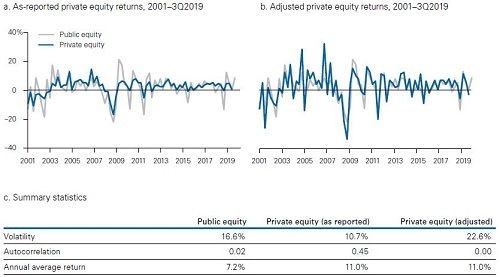
One of the key issues to consider when incorporating unlisted assets, such as PE, into a portfolio is the smoothed nature of the historical return data, which reflects appraisal-based valuations.

The use of smoothed historical returns results in an underestimation of return volatility.  The underestimation of volatility could lead to an overallocation to PE when undertaking portfolio modelling.

For portfolio modelling purposes, the true underlying risk profile of PE needs to be understood to make a better assessment when comparing and combining with public market assets.

As Vanguard highlight, several “statistical methods have been proposed in the academic literature over the last few decades to try to better understand historical performance. None of them are without shortcomings, which is why there remains no universally agreed-upon approach among academics or practitioners.”

Vanguard follow a time-series technique to “unsmooth” historically reported PE returns.  For a more in-depth discussion please see the Research Paper.

The adjustment to PE returns is presented in the Table below.  Note how Private Equity (adjusted) volatility is 22.6%, up from 10.7% calculated using reported historical PE returns.

The adjusted PE returns results in a more realistic return profile for PE which can be used for portfolio modelling purposes, resulting in more sensible volatility and covariance estimations.  Note historical PE returns have been preserved, only volatility measures have been adjusted.
In addition to estimating unbiased PE return estimates, as above, Vanguard also undertake the following adjustments to the standard portfolio modelling approach to address the issues identified above:

Account for the illiquidity of PE

Vanguard’s portfolio model, VAAM, drops the assumption of low cost and regular rebalancing assumed in standard portfolio modelling frameworks.  Therefore, they assume that PE can not be fully rebalanced.  As they note, “This illiquidity-constrained rebalance feature provides a more accurate representation of the risk-return trade-offs between liquidity premium and risks associated with private equity assessed within the portfolio optimization.”

Explicitly modelling private equity cash flows

Accounting for the uncertainty in timing and magnitude of PE cashflows Vanguard explicitly model cashflows in a multi-asset portfolio.  As noted above, cash needs to put aside for future committed investments (contributions) and timing of distributions (capital returned) also needs to be accounted for.

It is important to note, this nature of PE leads to additional decision making in the management of a multi-asset portfolio that includes PE i.e. where cash tagged for future PE investment should be invested in the interim and decisions around portfolio rebalancing.

Optional valuation adjustment of the illiquid wealth of the portfolio

Vanguard also make an adjustment for the disparity in market value of liquid and illiquid assets.  This reflects that illiquid assets, such as PE, can at times be sold in a secondary market, which more often than not trades at a discount (i.e. lower price) to asset values.

The discount function they implement “effectively converts illiquid wealth into its liquid equivalent.”

The Results

Compared to a multi-asset portfolio of 70% Equities and 30% Fixed Income (70/30) the key results include:

  • Portfolio modelling that ignores private equity’s illiquid characteristics as covered above leads to a higher allocation in PE compared with Vanguard’s enhanced framework (VAAM)
  • VAAM results in the PE allocation within “Equities” to fall from 50% to 30%
  • The sensitivity to key risk parameters include: expectations the manager will generate lower excess returns results in a lower allocation (12% vs 23%); a “lower risk” manager results in a higher PE allocation (36% vs. 23%)
  • For more conservative portfolios, such as a 30/70, although the total equity allocation decreases, the target PE share of total equity does not change materially relative to that of the 70/30 investor.

Please read my Disclosure Statement

Global Investment Ideas from New Zealand. Building more Robust Investment Portfolios.

Drivers of Unexpected Portfolio Return Outcomes – that should be controlled for.

Six reasons could largely explain manager underperformance or the delivery of investment return outcomes different from what is expected.

Conversely, controlling for these “risks” might be the reason why a Manager is consistently adding value.

How a manager controls for the following risks should be considered as part of the due diligence process and in the construction of a multi-manager portfolio:

  1. Levels of uncompensated vs compensated risk
  2. Incidence of underlying portfolio holdings cancelling each other out
  3. Hidden portfolio risks resulting in unintended outcomes
  4. Conventional style-box investing, which leads to index-like performance with higher fees
  5. Over-diversification
  6. Possible attempts to “time” manager changes may prove costly.

The above six risks where identified by Northern Trust following the analysis of $200 billion of assets on more than 200 equity portfolios from 64 institutional investors around the world.  The results surprised many of the institutions involved. 

Northern Trust expressed the above risks as “six common drivers of unexpected Portfolio Results.”

These risks largely explained manager underperformance in single manager portfolios and also multi-manager portfolios.

The analysis highlights, in my opinion, that implementation and portfolio construction are fundamental to capturing value and in delivering excess returns. Although the investment theory and development of investment strategy are important, implementation and portfolio construction are fundamental.  This is an important area to focus on in undertaking manager/strategy due diligence.

To the point, implementation is vital in capturing the desired investment outcomes of any proposed investment strategy.  This is where a lot of value is added, primarily by not detracted value in implementing the desired strategy!

As Northern Trust emphasis, finding a manager that consistently delivers on their investment objectives is certainly important, but it should not be the only area of focus.  Knowing how a manager, or strategy, interacts with the rest of your portfolio can have much more impact over time.

Institutions had nearly 2x more uncompensated vs compensated risk

Northern Trust found that portfolios which became “overcrowded” with uncompensated risks tended to underperform.

Risk needs to be taken to outperform.  Nevertheless, some risks are compensated for over the longer term and others are not.  Norther Trust outlines that some styles are not compensated for over the longer term, e.g. low quality.  They also include currency, and some countries and sectors have also not historically compensated for the risk taken.

From my own experience, managers who control for some of these risks, tend to outperform, primarily because intended risks, such as company specific risks or compensated styles, end up driving investment outcomes.

Norther Trust found a high level of uncompensated risk across all institutional investment segments, including Super Funds, Endowments, Insurance, Corporate Pensions, and Family Offices.

They conclude: “The result of uncompensated risks comprising nearly 50% of total portfolio active risk was generally benchmark-like returns or underperformance.  While sometimes these risks were taken intentionally, we found that many institutions were surprised when they saw the actual numbers.”

Underlying portfolio holdings cancelled each other out – and hurt performance

This risk particularly impacts multi-manager portfolios.

The cancellation effect occurs when managers within a portfolio take opposing positions that offsets each other e.g. one manager goes overweight a stock another manager is underweight, a manager might have a growth bias which offsets a manager with a value bias.

As Northern Trust note, on a standalone basis many managers individually offer high active risk, once combined with other managers a lot of this active risk is cancelled out.

This needs to be considered in the construction of a multi-manager portfolio. 

Northern Trust conclude: “Our analysis uncovered a shocking amount of this cancellation effect.  Nearly 50% of manager active risk was lost.  Capturing just 50% of targeted active risk, while paying 100% of the manager fees, effectively translates into paying 2x more for each realized basis point of active risk than originally thought.”

Hidden Portfolio risks cause unintended outcomes

Northern Trust found that style tilts contributed 29% of active risk on average.  However, other bets where often introduced into a portfolio unintentionally and led to “unpredictable portfolio outcomes.”

Although some styles are a consistent source of excess returns over time, it was unintended style risks that negatively impacted portfolio performance.

Often, these unintended style risks are included when trying to capture a known rewarded risk e.g. value comes with common unintended style risk exposures of low quality and low momentum.

This means meaningful style exposure is lost.

They conclude: “Our research uncovered that 55% of the portfolios had material style conflicts – caused by the cancellation effect – that introduced exposures different from the managers stated objective.  This introduction of conflicting and unintended style exposures left many portfolios with no material exposure to their intended style tilts.”

Conventional style investing led to index like performance with higher fees

This is probably self-evident to many, particularly given the above research conclusions.

Northern Trust found that those portfolios based on conventional style analysis, and those of a core-satellite approach, tended to suffer more from the cancellation effect.

The “style box” approach portfolio was more likely to have managers who took opposing views or two managers where hired to generate an exposure one manager alone could achieve.

As a result, “conventional style investing, whether intentional or not, created a mix of managers that closely mimicked the benchmark and left little chance to outperform.”

Over-diversification diluted performance

The Northern Trust research highlights than “hiring too many managers or building equity portfolios with thousand of securities took a significant toll on performance.”

Obviously, adding managers and combination of strategies can reduce overall portfolio risk, Northern Trust research showed that often the risks reduced where different to what was intended.

Norther Trust conclude: “While there are many approaches to generating excess returns, our research suggests that a greater focus on eliminating uncompensated risks is a critical first step toward potentially increasing a portfolio’s ability to outperform.”

Possible attempts to “time” manager changes may prove costly

Do not chase manager performance.  The Northern Trust research highlighted that historically poor active management performance had resulted in lower allocations to active managers in the following year.  When performance was better, a higher allocation to active managers resulted.

As they conclude: “Finding a manager that consistently delivers on their investment objectives is certainly important, but it should not be the only area of focus.  As evidenced through the preceding discoveries of this report, knowing how a manager will interact with the rest of your portfolio can ultimately be much more impactful over time.”

Access to the Northern Trust Risk Report can be found here.

Please read my Disclosure Statement

Global Investment Ideas from New Zealand. Building more Robust Investment Portfolios.

The benefits of behavioral finance in the investment planning process

Investment advisors who stay active across their client base in times of market volatility are more likely to add new clients from a variety of sources.

Clients and prospects want to know that their advisor is looking out for them, even when the advice they are delivering is to stay the course or focus on the long term.

Laying a foundation for communications based on behavioral finance allows advisors to better set expectations early on in client relationships, while also offering an opportunity to maintain an open dialogue when markets become turbulent.

When properly employed, behavioral finance allows advisors to pursue the twin goals of helping investors feel less financial stress while making better decisions in pursuit of their long-term goals.

A recent study found those advisors who employed behavioral finance in their approach:

  1. Gained a better understanding of clients’ risk appetite and kept them invested during the market turbulence in early 2020;
  2. Reported elevated client acquisition activity earlier in the year; and
  3. Developed deeper relations with clients.

As market volatility escalated, advisors increasingly turned to behavioral finance to help keep clients invested and focused on their long-term goals.

These are the key conclusions of a White Paper by Cerulli Associates, in partnership with Charles Schwab Investment Management, Inc., and the Investments & Wealth Institute: The Evolving Role of Behavioral Finance in 2020.    The Evolving Role of Behavioral Finance in 2020 | Schwab Funds

These findings will not be surprising to most investment advisors.  Nevertheless, the evidence supporting including elements of behavioral finance in the planning process is growing, and it is becoming more widely accepted.

It goes without saying, that advisors truly need to get to know their clients and use these insights to create personalised action plans to help them achieve their goals.  Clients prefer this too. 

Incorporating elements of behavioral finance in the planning process will help achieve this, benefiting both the client and advisor.

We all have behavioral biases and are prone to making poor decisions, investment related or otherwise. Therefore, it is important to understand our behavioral biases. From this perspective, behavioral finance can help us make better investment decisions.

For a further discussion on how investment decisions can be improved by employing behavior finance see this Kiwi Investor Blog Post, which includes access to a Behavioral Finance Toolkit.

Behavioral Biases

The following Table outlines the Top 5 behavioral biases identified by advisors in the Cerulli Associates study.

Recency biasBeing easily influenced by recent news events or experiences
Loss aversionOpting for less risk in portfolio than is recommended
Familiarity/home biasPreferring to invest in familiar (U.S. domiciled) companies
FramingMaking decisions based on the way the information is presented
Mental accountingSeparating wealth into different buckets based on financial goals

Not unexpectedly Recency bias was found by advisors to be the most common behavioral bias amongst clients this year.  This was also the most common behavioral bias in 2019, on both occasions 35% of Advisors indicated that Recency bias was a significant contributor to their clients’ decision making.

Loss aversion held the number two spot in both years.  The Paper provides a full list of Client behavioral biases identified, comparing 2020 results with those in 2019.

Clients are more than likely affected by several behavioral biases.

Source: Staib Financial Planning, LLC

Advisors can help clients improve their investment outcomes by influencing the behavioral bias in a positive way.  By way of example in the paper, Framing (easily influenced by recent events), “an advisor can emphasize how rebalancing a portfolio during an equity market decline allows investors to accumulate more shares of their favorite stock or funds at a reduced price.”

They conclude: “by embracing the principles of behavioral finance, advisors can nudge clients toward more constructive ways to think about their portfolios.”

Survey Results – the benefits of Behavioral Finance

The paper defines Behavioral finance as the study of the emotional and intellectual processes that combine to drive investors’ decision making, with the goal of helping clients optimize financial outcomes and emotional satisfaction.

As the White Paper outlines “Advisors must help investors create and maintain a mental framework to help ease their concerns about the fluctuations of the market. Behavioral finance can be a crucial element of advisors’ efforts to help investors overcome their emotional reactions in pursuit of their longterm financial goals.”

There has been an increase in advisors adopting the principles of behavioral finance in America, particularly in relation to client communications.

In 2020 81% of advisors indicated adopting the principles of behavioral finance, up from 71% in 2019.

The increase is likely in response by advisors to provide a “mental framework to deal with the adversity presented by increased uncertainty in the market and in life overall in 2020.”

Benefits of Behavioral Finance

Keeping clients invested was found to be a key benefit of incorporating behavioral finance in the advice process, 55% of advisors indicated this as a benefit, up from 30% in 2019.

The benefit of developing a better understanding of client’s comfort level with risk also grew in 2020, from 20% in 2019 to 44% in 2020 (probably not surprisingly given events in March and April of this year).

In 2019, the benefits of incorporating behavioral finance most cited by advisors was: strengthening relationships (50%), improving decisions (49%), and better managing client expectations (45%).  These benefits also scored highly in 2020. 

The paper provides a full list of the benefits of incorporating behavioral finance, comparing the results of 2020 with 2019.

To summarise, the results highlighted the dual role of behavioral finance in client relationships as:

  1. serving as a framework for deeper engagement to strengthen communications and prioritize goals during good times; and
  2. to help minimize clients’ instinctual adverse reactions during periods of acute volatility.

The paper then focused on two areas:

  • Growing the client base
  • Deepening client connections

Behavioral Finance Advisors experienced greater growth of their client base in 2020

In 2020 55% of advisor respondents indicated they had added new clients since the first quarter of 2020.  4% indicated they had experienced net client losses.

However, the results differed materially between advisors who adopted elements of behavioral finance compared to those who do not.

“Two-thirds (66%) of behavioral finance users reported adding to their client base, compared to just 36% of advisors who are not incorporating behavioral finance in their practices.”

The source of these new clients?:

  • “Approximately two-thirds of new clients were sourced from other advisors with whom clients had become dissatisfied, or as an outcome of investors seeking to consolidate their accounts and maintain fewer advisor relationships. This is frequently attributable to satisfied clients referring friends and family who are discontented with their current advisory relationship.”
  • “The other third of new client relationships was attributable to the conversion of formerly selfdirected investors who found the current conditions an opportune time to seek professional advice for the first time.“

Therefore, “behavioral finance adherents are more likely to not only educate clients regarding the potential for volatility, but also to urge clients to expect it. This scenario reinforces many of the key benefits of leveraging behavioral finance in advisory relationships, especially with regard to managing expectations and remaining invested during periods of volatility.”

Behavioral Finance Advisors develop deeper connections with their client base

Cerulli’s research has found that the level of an advisor’s proactive communication during periods of market volatility is the most reliable indicator of the degree to which the advisor will add new clients during the period.

In the study that they undertook, for example, they found that 72% of those advisors who employed elements of behavioral finance and increased their outgoing calls added new clients, compared to 42% of non-users of behavioral finance.

They conclude “The unifying element in these results is that proactive personal communication was valued by investors and was especially effective for advisors who have made behavioral finance a part of their client engagement strategy.“

A key point here, is that “Instead of having to pivot from touting their investment returns to focusing on explaining volatility, behavioral finance users were able to frame current conditions as expected developments within the context of the long-term plans they had previously developed and discussed.”

From this perspective, it is important to understand what type of communications clients and prospects prefer.

It goes without saying, that advisors truly need to get to know their clients and use these insights to create personalized action plans to help them achieve their goals.

Clients prefer this too. 

Incorporating elements of behavioral finance in the planning process will deliver this, benefiting both the client and advisor. 

Please read my Disclosure Statement

Global Investment Ideas from New Zealand. Building more Robust Investment Portfolios.

Behavioral Biases

Recency biasBeing easily influenced by recent news events or experiences
Loss aversionOpting for less risk in portfolio than is recommended
Familiarity/home biasPreferring to invest in familiar (U.S. domiciled) companies
FramingMaking decisions based on the way the information is presented
Mental accountingSeparating wealth into different buckets based on financial goals
Confirmation biasSeeking information that reinforces existing perceptions
AnchoringFocusing on a specific reference point when making decisions
HerdingFollowing the crowd or latest investment trends
Endowment effectAssigning a greater value to investments or assets already owned
Inertia/status quoFailing to take action or avoiding changes to a portfolio
Selective memoryRecalling only positive experiences or outcomes
Regret aversionFearing to take action due to previous mistakes or regret avoidance
Availability biasBasing decisions only on readily available information
OverconfidenceBeing overly confident in one’s own ability
Self-controlSpending excessively today at expense of the future

Sources: Cerulli Associates, in partnership with Charles Schwab Investment Management, Inc., and the Investments & Wealth Institute. Analyst Note: Advisors were asked, “To what degree do you believe the following biases may be affecting your clients’ investment decision making?”

Coronavirus – Financial Planning Challenges

For those near retirement this year’s global pandemic has thrown up new challenges for them and their Financial Advisor.

Early retirement due to losing a job, the running down of emergency funds, and a low interest rate environment are new challenges facing those about to retire.

Events this year are likely to have significant repercussions for how individuals conduct their financial planning.  Specifically, how they approach spending and saving goals.

The pandemic will likely have lasting implications for how people think about creating their financial and investment plans, and therefore raises new challenges for the Advisors who assist them.

These are the key issues and conclusions outlined by Christine Benz, director of personal finance for Morningstar, in her article, What the Coronavirus Means for the Future of Financial Planning.

In relation to the key issues identified above, Benz writes “All of these trends have implications for the way households—and the advisors who assist them—manage their finances. While the COVID-19 crisis has brought these topics to the forefront, their importance is likely to persist post-pandemic as well.”

Although the article is US centric, there are some key learnings, which are covered below.

How the Pandemic Has Impacted Financial Planning for Emergencies

The Pandemic has highlighted the importance of emergency funds as part of a sound financial plan and the difficulties that many individuals and households face in amassing these “rainy-day funds.”

Lower income families are more at-risk during times of financial emergencies.  Research in the US found that only 23% of lower-income households had emergency funds sufficient to see them through three months of unemployment.  This rises to 52% for middle income households.

It is advisable to have emergency funds outside of super.

The Morningstar article highlights “Withdrawing from retirement accounts is suboptimal because those withdrawn funds can’t benefit from market appreciation—imagine, for example, the worker who liquidated stocks from a retirement account in late March 2020, only to miss the subsequent recovery.”

An emergency fund helps boost peace of mind and provides a buffer and the confidence to maintain longer-term retirement goals.

Financial Advisors can assist clients in setting saving goals to amass an emergency fund, which is specific to their employment situation, and how best to invest these funds so they are there for a rainy day.

From an industry and Policymaker perspective, and reflecting many households struggle to accumulate emergency reserves, Morningstar raised the prospect of “sidecar” funds as potentially part of the solution.

Sidecars “would be for employees to contribute aftertax dollars automatically to an emergency fund. Once cash builds up to the employee’s own target, he could direct future pretax contributions to long-term retirement savings. Automating these contributions through payroll deductions may make it easier for individuals to save than when they’re saving on a purely discretionary basis.”

The concept of sidecar funds has recently been discussed in New Zealand.

Financial Planning for Early Retirement

The prospect of premature retirement will pose an urgent challenge for some clients. 

Although those newly unemployed will consider looking for a new job some may also consider whether early retirement is an option.

The US experience, to date, has been that those workers 55 and older have been one of groups most impacted by job losses.

Morningstar highlight that early retirement is not always in an individual’s best interest, actually, working a few years longer than age 65 can be “hugely beneficial to the health of a retirement plan,”….

They note the following challenges in early retirement:

  • Lost opportunity of additional retirement fund contributions and potential for further compound returns; and
  • Earlier withdrawals could result in a lower withdrawal rate or reduce the probability the funds lasting through the retirement period. 

Financial Advisors can help clients understand the trade-offs associated with early retirement and the impacts on their financial plans.  Often the decision to retire is about more than money.

Individual circumstances in relation to access to benefits, pensions, health insurance, and tax need to be taken into consideration.  Given this, a tailored financial plan, including the modelling of retirement cashflows on a year-to-year basis would be of considerable value.

Accommodating Low Yields in a Financial Plan

The low interest rate (yield) environment is a challenge for all investors. 

Nevertheless, for those in retirement or nearing retirement is it a more immediate challenge.

Return expectations from fixed income securities (longer dated (maturity) securities) are very low.  Amongst the best predictor of future returns from longer dated fixed income securities, such as a 10-year Government Bonds, is the current yield.

In the US, the current yield on the US Government 10-year Treasury Bond is not much over 1%, in New Zealand the 10-Year Government Bond yields less than 1%.  Expected returns on higher quality corporate bonds are not that much more enticing.

As Morningstar note, “These low yields constrain the return potential of portfolios that have an allocation to bonds and cash, at least for the next decade.“

The low yield and return environment have implications as to the sustainability of investment portfolios to support clients throughout their retirement.

The impact of low interest rates on “withdrawal rates” is highlighted in the graph below, which was provided by Morningstar in a separate article, The Math for Retirement Income Keeps Getting Worse, Revisiting the 4% withdrawal rule

The 4% withdrawal rate equals the amount of capital that can be safely and sustainably withdrawn from a portfolio over time to provide as much retirement income as possible without exhausting savings.

For illustrative purposes, the Morningstar article compares a 100% fixed income portfolio from 2013 and 2020 to reflect the impact of changes in interest rates on the sustainability of investment portfolios assuming a 4% withdrawal rate. 

As Morningstar note, since 2013 investment conditions have changed dramatically. When they published a study in 2013 the 30-year Treasury yield was 3.61% and expected inflation was 2.32%. Investors therefore received a real expected payout of 1.29%.

When they refreshed the study in 2020, those figures are 1.42% and 1.76%, respectively.  This implies a negative expected return after inflation.

The graph below tracks the projected value of $1 million dollars invested in 2013 and 2020.  The prevailing 30-year Treasury yields for July 2013 and October 2020, as outlined above, are used to estimate income for each portfolio, respectively, over time.  A “real” 4% withdrawal rate is assumed i.e. the first years $40k withdrawal grows with the inflation rates outlined above.

As can be seen, the 2013 Portfolio lasts up to 30 years, the 2020 Portfolio only 24 years, highlighting the impact of lower interest rates on the sustainability of an investment portfolio.

Financial Advisors can help in determining the appropriate withdrawal rates from an investment portfolio and the trade-offs involved.  They may also be able to suggest different investment strategies to maintain a higher withdrawal rate and the risks associated with this.

This may also include the purchase of annuities, to manage longevity risk (the risk of running out of money in retirement) rather than from the perspective of boosting current portfolio income.

Morningstar suggests that new retirees “should be conservative on the withdrawal rate front, especially because the much-cited “4% guideline” for portfolio withdrawal rates is based on market history that has never featured the current combination of low yields and not-inexpensive equity valuations.”

The 4% withdrawal rate is an industry “rule of thumb”.  Further discussion on the sustainability of the 4% withdrawal rate can be found here.

I have posted extensively about the low expected return environment and the challenges this creates for the Traditional Portfolio of 60% Equities and 40% Fixed Income.

The following Post on what investors should consider doing in the current market environment may be of interest. This Post outlines some investment strategies which may help in maintaining a higher withdrawal rate from an investment portfolio.

Likewise, this Post on how greater customisation of the client’s invest solution is required and who would benefit most from targeted investment advice may also be of interest.

Lastly, Wealth Management.com covers Benz’ article in Retirement Planning in a Pandemic.

Please read my Disclosure Statement

Global Investment Ideas from New Zealand. Building more Robust Investment Portfolios.

Who would benefit most from targeted investment advice?

Those in the Retirement Risk Zone would benefit most from targeted investment advice.

The Retirement Risk Zone is the 10-year period before and after retirement (assumed to retire at age 65 years).

It is the 20-year period when the greatest amount of retirement savings is in play, and subsequently, risk is at its highest.  It is a very important period for retirement planning.

The Retirement Risk Zone is the worst possible time to experience a large negative return.  How much you lose during a bear market (20% or more fall in value of sharemarkets) may not be anywhere near as important as the timing of that loss.

Therefore, the value of good advice and a well-constructed portfolio aligned with one’s investment objectives is of most value during the Retirement Risk Zone.

Impact on timing of market losses

If a large loss occurs during the Retirement Risk Zone it will result in less money in retirement and raise longevity risk (the risk of running out of money in retirement).

The risk that the order of investment returns is unfavourable is referred to as sequencing risk. 

Sequencing risk can be viewed as the interaction of market volatility and cashflows. The timing of returns and cashflows matters during both the accumulation of retirement savings and in retirement.

Once an investor needs to take capital or income from a portfolio volatility of equity markets can wreak havoc on a Portfolio’s value, and ultimately the ability of a portfolio to meet its investment objectives.

It is untrue to say that volatility does not matter for the long term when cashflows are involved.  For further discussion on this issue see this Post, Could Buffett be wrong?

Longevity Risk

The portfolio size effect and sequencing risk have a direct relationship to longevity risk.

For individuals, longevity risk is the risk of outliving ones’ assets, resulting in a lower standard of living, reduced care, or a return to employment.

One-way longevity risk manifests itself is when an investor’s superannuation savings is subject to a major negative market event within the Retirement Risk Zone.

Materiality of Market Volatility in Retirement Risk Zone

Research by Griffith University finds “that sequencing risk can deplete terminal wealth by almost a quarter, at the same time increasing the probability of portfolio ruin at age 85 from a probability of one-in three, to one-in-two.“

Based on their extensive modelling, investors have a 33.3% chance of not having enough money to last to aged 85, this raises to a 50% chance due to a large negative return during the Retirement Risk Zone.

They also note “It is our conjecture that, for someone in their 20s, the impact of sequencing risk is minimal: younger investors have small account balances, and plenty of time to recover …… However, for someone in their late 50s/early 60s, the interplay between portfolio size and sequencing risk can cause a potentially catastrophic financial loss that has serious consequences for individuals, families and broader society.”

This is consistent with other international studies.

Managing Sequencing Risk

Sequencing risk is largely a retirement planning issue. Albeit a robust portfolio and a suitably appropriate investment approach to investing will help mitigate the impact of sequencing risk.

Two key areas from an investment perspective to focus on in managing sequencing risk include:

The Retirement Goal is Income

The OECD’s Core Principles of Private Pension Regulation emphasis that the objective is to generate retirement income.  This is different to the focus on accumulated value.  A key learning from the Australian Superannuation industry is that there has been too greater focus on the size of the accumulated balance and that the purpose of superannuation should be about income in retirement.

An important point to consider, without a greater focus on generating income in retirement during the accumulation phase the variation of income in retirement will likely be higher.

Therefore, it is important to have coherency between the accumulation and pay-out phase of retirement as recommended by the OECD.

The OECD recommends the greater use of asset-liability matching (LDI) investment techniques.   

This is not just about increasing the cash and fixed income allocations within the portfolio but implementing more advanced funds management techniques to position the portfolio to deliver a more stable and secure level of income in retirement.

This is aligned with a Goals Based Investment approach.

A greater focus on reducing downside risk in a portfolio (Capital Preservation)

This is beyond just reducing the equity allocation within the retirement portfolio on approaching retirement, albeit this is fundamentally important in most cases.

A robust portfolio must display true portfolio diversification, that helps manage downside risk i.e. reduce degree of losses within a portfolio.

This may include the inclusion of alternative investments, tail risk hedging, and low volatility equities may also be option.

The current ultra-low interest rate environment presents a challenging environment for preserving portfolio capital, historically the role of Fixed Income.  Further discussion on this issue can be found in this Post, which includes a discussion on Tail Risk Hedging.

This article in smstrusteenews highlights the growing issue of capital preservation within the Australian Self-Managed Super Fund (SMSF) space given the current investment environment.

Meanwhile, this article from Forbes is on managing sequence of returns in retirement, and recommends amongst other things in having some flexibility around spending, maintaining reserve assets so you don’t have to sell assets after they fall in value, and the use of Annuities.

Many argue that sequencing risk can be managed by Product use alone. 

My preference is for a robust portfolio, truly diversified that is based on the principles of Goals-Based Investing.  Longevity annuities could be used to complement the Goals-Based approach, to manage longevity risk.

This is more aligned with a Robust Investment solution and the focus on generating retirement income as the essential investment goal.

Further Reading 

For a more technical read please see the following papers:

  1. Griffith University = The Retirement Risk Zone: A Baseline Study poorly-timed negative return event
  2. Retirement income and the sequence of-returns By: Moshe A. Milevsky, Ph.D., and Anna Abaimova, for MetLife

The case for a greater focus on generating retirement income is provided in this Post, summarising an article by Nobel Laureate Professor Robert Merton.  He argues strongly we should move away from the goal of amassing a lump sum at the time of retirement to one of achieving a retirement income for life.

The concepts in Merton’s article are consistent with the work by the EDHEC Risk Institute in building more robust retirement income solutions.

Lastly, a recent Kiwi Investor Blog Post, The Traditional Diversified Fund is outdated – greater customisation of the client’s investment solution is required, provides a framework for generating greater tailoring of investment solutions for clients.

Please read my Disclosure Statement

Global Investment Ideas from New Zealand. Building more Robust Investment Portfolios.

The value of Emerging Markets within a Robust Portfolio – The Attraction of Emerging Markets

Canada’s largest Pension Funds plan to increase their investments into emerging markets over the following years.  Asia, particularly India and China, are set to benefit.

The increased exposures are expected to be achieved by increasing portfolio target allocations to emerging markets, partnering on new deals, and boosting staff with expertise to the area.

The expected growth in the share of global economic activity in the years ahead and current attractive sharemarket valuations underpin the case for considering a higher weighting to emerging markets within portfolios.  Particularly considering the low interest rate environment and stretched valuation of the US sharemarket.  This dynamic is very evident in the market return forecasts provided below.

Additionally, emerging markets bring the benefits of diversification into different geographies and asset classes for investors, including both public and private markets.

Increasing allocations to Emerging Markets

As covered in this Pension & Investment ((P&I) online article emerging markets are set to become a large share of Canadian Pension Plan’s portfolios. 

As outlined in the P&I article, the Ontario Teachers’ Pension Plan (C$201.4 billion) is investing significantly into emerging markets, particularly Asia.  Their exposure to emerging markets fluctuates between 10% and 20% of the total Portfolio.

The Fund’s investments across the emerging markets includes fixed income, infrastructure, and public and private equities.  They plan to double the number of investment staff in Asia over the next few years, they already have an office in Hong Kong. 

The Canada Pension Plan Investment Board (CPPIB) (C$400.6 billion) anticipates up to one-third of their fund to be invested in emerging markets by 2025.

CPPIB sees opportunities in both equity and debt.  Investments in India are expected to grow, along with China.

The Attraction of Emerging Markets

The case for investing into emerging markets is well documented: rising share of global economic activity, under-representation in global market indices, and currently very attractive sharemarket valuations.

Although the current global economic and pandemic uncertainty provides pause for concern, the longer-term prospects for emerging market are encouraging.

From the P&I article “CPPIB estimates the share of global gross domestic product represented by emerging markets will reach 47% by 2025 and surpass the GDP of developed economies by 2029”.

Based on the expected growth outlook CPPIB “feel there are attractive returns available over the long term to those investors who take the time to study the characteristics and fundamentals of these markets and are able to identify trends and opportunities in those markets,”…..

CPPIB also highlight the benefit of diversification into different geographies and asset classes for the Fund.

Lastly, the valuations within emerging market sharemarkets are attractive. 

This is highlighted in the following Table from GMO, which provides their latest (Sept 2020) Forecasts Annual Real Returns over the next 7 years (after inflation).

As can be seen, emerging market is one of only two asset classes that provides a positive return forecast.  Emerging market value offers the prospect of the highest returns over the next 7 years.  As GMO highlight, the forecasts are subject to numerous assumptions, risks and uncertainties.  Actual results may differ from those forecasted.

Nevertheless, GMO provided the following brief commentary in this LinkedIn Post “From an absolute perspective, broad markets in the US are frighteningly bad; non-US developed markets, however, are not as bad, but that is faint praise, as our official forecast for this basket is also in negative territory. “Safe” bond forecasts are not much better. With yields this low, the very foundational justification for holding bonds — as providers of income and/or as anti-correlated money makers when equities decline — has been shaken to its core. The traditional 60/40 portfolio, consisting of heavy doses of US and International stocks and Government Bonds, is poised for a miserable and prolonged period.”

GMO Annual Real Returns over 7 years

In February 2020, GMO advised that it was time to move away from the Balanced Portfolio, as outlined in this Kiwi Investor Blog Post. GMO provide a historical performance of the traditional Balanced Portfolio (60% equities and 40% fixed income).  Overall, the Balanced Fund is riskier than people think.

In the LinkedIn Post mentioned above, GMO comment that “Our Asset Allocation team believes this is the best opportunity set we’ve seen since 1999 in terms of looking as different as possible from a traditional benchmarked portfolio.”  Where the traditional benchmarked portfolio is the Balanced Portfolio of 60% equities and 40% fixed income.

Why the Balanced Portfolio is expected to underperform and potential solutions to enhancing future portfolio returns is covered in this Post.

Please read my Disclosure Statement
Global Investment Ideas from New Zealand. Building more Robust Investment Portfolios.

Is a value bias part of the answer in navigating today’s low interest rates?

The Value Factor (value) offers the potential for additional returns relative to the broader sharemarket in the years ahead.

Exploring an array of different investment strategies and questioning the role of bonds in a portfolio are key to building a robust portfolio in the current low interest rate environment.

There will also be a need to be more dynamic and flexible to take advantage of market opportunities as they arise.

From this perspective, a value tilt within a portfolio is one investment strategy to consider in potentially boosting future investment returns.

The attraction of Value

Evidence supporting a value tilt within a robust portfolio is compelling, albeit opinion is split.

Nevertheless, longer-term, the “Rotating into Value stocks offers substantial upside in terms of return versus the broad market” according to GMO.

GMO presents the case for a value tilt to navigate today’s low interest rates in their Second Quarter 2020 Letter, which includes two insightful articles, one by Ben Inker and another by Matt Kadnar. 

Value is at cheapest relative to the broader market since 1999, based on GMO’s analysis.  Value is in the top decile of attractiveness around the world, as highlighted in the following figure.

Spread of Value for MSCI Regional Value Factors (GMO)

As of 6/30/2020 | Source: MSCI, Worldscope, GMO

Is Value Investing Dead

As mentioned, the opinion on value is split.

A research paper by AQR earlier in the year addressed the key criticisms of value, Is (Systematic) Value Investing Dead?

For a shorter read on the case for value Cliff Asness, of AQR, Blog Post of the same title is worth reading.

AQR’s analysis is consistent with GMO’s, as highlighted in the Graph and Table below.

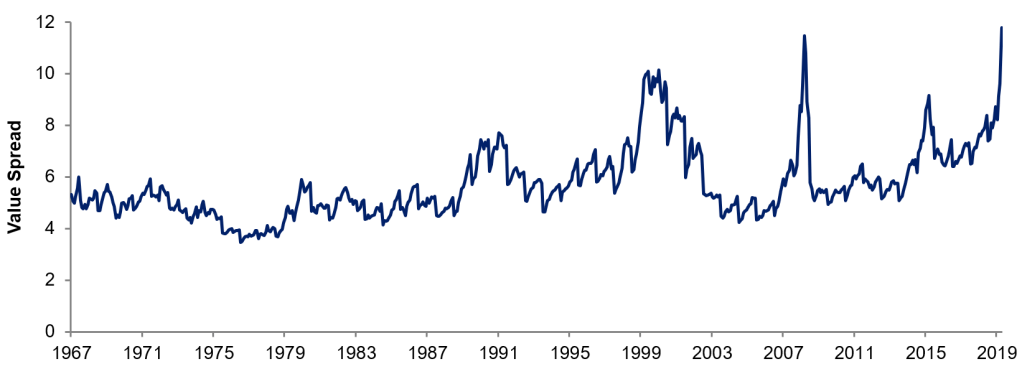
The Graph below measures the Price-to-Book spread of the whole US sharemarket from December 1967 to March 2020.

This spread was at the 100th percentile versus 50+ years of history on the 31 March 2020 i.e. value is at it cheapest based on 50 years of data.

Price-to-Book Spread (AQR)

Asness’s Blog Post highlights “expensive stocks are sometimes only <4x as expensive as the cheap stocks, the median is that they are 5.4x more expensive, but today they are almost 12x more expensive.” (March 2020).

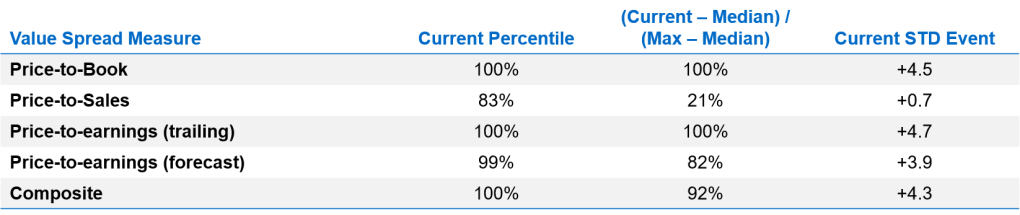
It is the same story when looking at different measures of value for the US sharemarket, as highlighted in the Table below.

Value is at its cheapest on many measures (AQR)

‘Don’t ask the barber whether you need a haircut’

This quote by Warren Buffett springs to mind when considering the analysis from GMO and AQR, both being value orientated investors.  As Asness states, AQR has a horse in the race.

However, as outlined in his Post, he undertakes the same analysis as above and controls for, just to name a few:

  • Excluding all Technology, Media, and Telcom Stocks
  • Excluding the largest stocks
  • Excluding the most expensive stocks
  • Industry bets
  • Industry neutrality
  • Quality of company

Analysis is also undertaken using other measures of value, Price-Sales, P/E, using trailing and forecast earnings (these are in addition to Price-Book).

The attraction of value remains based on different measures of value and when making the adjustments to market indices as outlined above.

Asness argues value is exceptionally cheap, probably the cheapest it has ever been in history (March 2020).

The AQR analysis shows this is not because of an outdated price-to-book nor because of the dominance of highly expensive mega-cap stocks.  Investors are paying more than usual for stocks they love versus the ones they hate.  There is a very large mispricing.

The AQR research paper mentioned above, looked at the common criticisms of value, such as:

  1. increased share repurchase activity;
  2. the changing nature of firm activities, the rise of ‘intangibles’ and the impact of conservative accounting systems;
  3. the changing nature of monetary policy and the potential impact of lower interest rates; and
  4. value measures are too simple to work.

 Across each criticism they find little evidence to support them.

Are we there yet?

We do not know when and how the valuation gap will be closed. 

Nevertheless, the evidence is compelling in favour of maintaining a value tilt within a portfolio, and certainly now is not the time to give up on value.

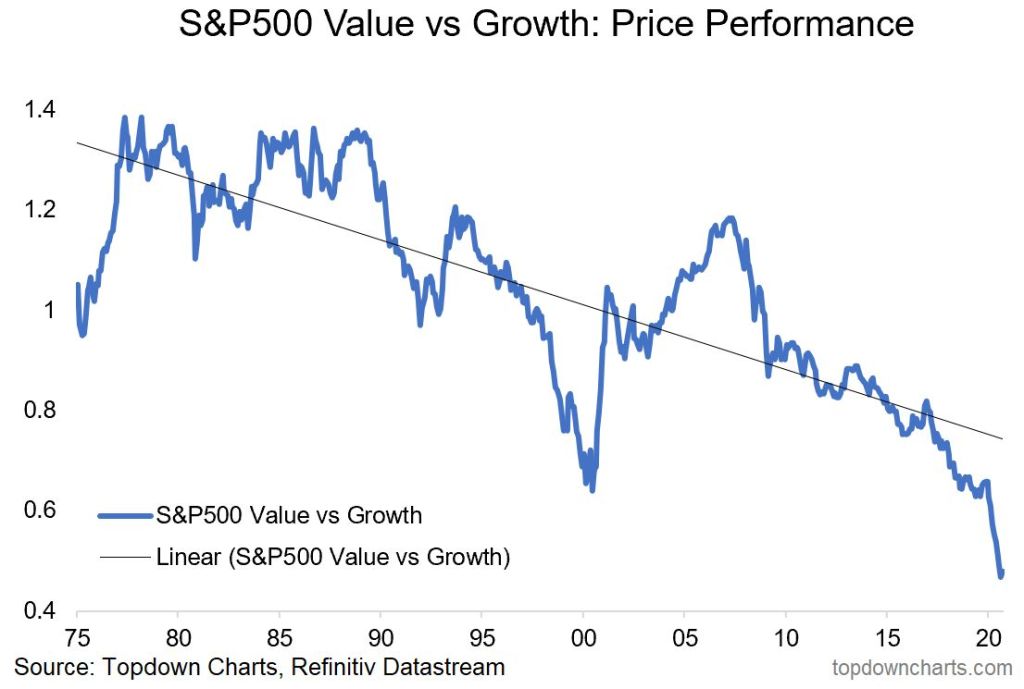
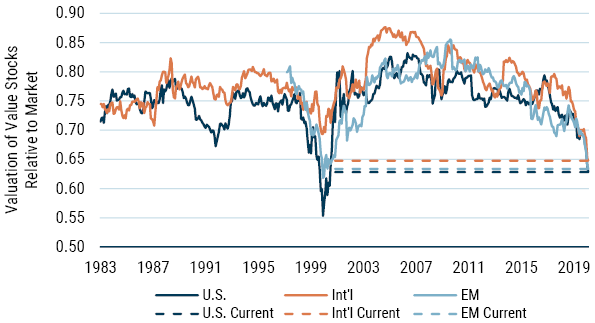
This is not a widely popular view, and quite likely a minority view, given the underperformance of value over the last ten years.  As clearly demonstrated in the Graph below provided by Top Down Charts.

However, from an investment management perspective, the longer-term odds are in favour of maintaining a value tilt and thereby providing a boost to future investment returns in what is likely to be a low return environment over the next ten years.

It is too early to give up on value, news of its death are greatly exaggerated, on this, Asness makes the following point, value is “a strategy that’s “worked” through the 1920s – when a lot of stocks were railroads, steel, and steamship companies – through the Great Depression, WWII, the 1950s – which included some small technological changes like rural electrification, the space race and all the technology that it spanned – the internet age (remember these same stories for why value was broken back in 1999-2000?)………. Value certainly doesn’t depend on technological advancement being stagnant! But in a time when it’s failed for quite a while (again, that just happens sometimes even if it’s as good as we realistically think it is), it’s natural and proper that all the old questions get asked again. Is now different?”

I don’t think so.

Please see my Disclosure Statement

Global Investment Ideas from New Zealand. Building more Robust Investment Portfolios.

The reality is that asset allocations can only do so much

It is estimated US public pension plans would need to leverage a Balance Portfolio of 60% equities and 40% fixed income by 47% to achieve their 7.25% actuarial return target in the years ahead. 

Such is the challenge facing all investors in the current low interest rate environment.

Investors face some very tough decisions in the future and may be forced to consider significant asset allocation shifts.  Increasing the tolerance for risk and illiquidity are likely actions required to boost future investment returns.

Investors are going to have consider something different, from a return perspective, buying bonds is not going to cut it.  Likely actions may include considering substitutes to fixed income to provide portfolio stability and some diversification during periods of equity market weakness.

The reality is that asset allocation decisions can only do so much.

These are the key conclusions from an article written by Rob Croce, PhD, of Mellon and Aaron Filbeck, that recently appeared in AllAboutAlpha.

The article covers three potential solutions for investors to consider in boosting future investment returns.

Meeting the Pension Fund Challenge

The above conclusions are determined in the context of the challenge facing US public pension plans.

On average US pension plans currently have target returns assumptions of 7.25% on average, this is down from 8% in 2000.

In the year 2000, US 10-year government bond interest rates were 6%.  Therefore there “was little headwind to meeting return objectives”….

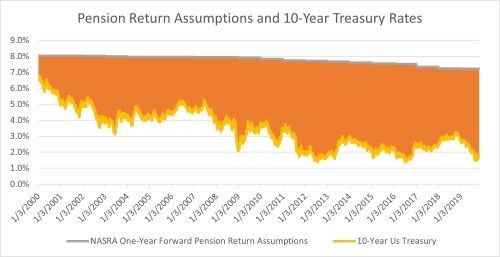
However, with the dramatic fall in interest rates over the last 20 years, the “gap” between long-term interest rates and return assumptions has widened materially.  This is highlighted in Figure 1 below, from the article. 

The gap is currently around 6%, compared to 2% in 2000!

Figure 1: Difference Between Average Plan Actuarial Return Assumption and 10-Year US Treasury Yield

Source: NASRA, Bloomberg, CAIA calculations

What have US pension plans done over the last 20 years as the return gap has widened:

  • Reduced their allocations to fixed income;
  • Allocated more to equities; and
  • Allocated more to alternatives.

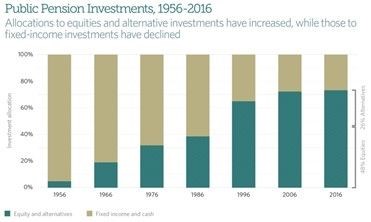
“ According to Public Plans Data, from 2001 to 2009, the average pension allocation to alternative investments increased from 8.7% to 15.7%, which only accelerated after the Global Financial Crisis (GFC). Over the next decade, allocations to alternatives nearly doubled, reaching nearly 27% by the end of 2019.”

The increased allocation to Equities and Alternatives at the expense of fixed income is highlighted in the following Figure also provided in the article.

Figure 2: Average Allocations for the 73 Largest State-Sponsored Pension Funds

Source: Pew Research. Data as of 2016

At the same time US pension plans remain underfunded. 

The challenge facing US pension plans has been known for some time, the article notes, “In general, pension trustees seem to be faced with two potential solutions – take on more (or differentiated) risks or improve funding statuses through higher taxation or slashing benefits.”

How big is the Pension Fund Return Challenge?

The article analyses potential solutions to “filling the gap” between current interest rates and the assumed target rate of return for US pension funds.

The first approach uses risk premia-based analysis, focusing on the amount of return that can be generated over and above holding just risk-free short-term US Government bonds.

Starting with a traditional Balanced Portfolio, 60% domestic stocks and 40% U.S. 10-year bonds, the analysis seeks to determine how much risk would need to be taken to reach the 7.25% return target. Assuming historical return premia, but with the current level of interest rates.

In relation to return assumptions, the Article notes “Since 1928, stocks have outperformed the risk free asset by 6.2% at 20% volatility and 10-year U.S. government bonds have outperformed the risk-free asset by 1.5%, for Sharpe ratios of 0.3 and 0.2, respectively. For cash, we have decided to use its current near-zero return, rather than its 3.3% average return during that period.”

The results, “there is effectively no unlevered portfolio of stocks and bonds that can reliably deliver many investors’ 7.25% target return over time. Because of the nature of the problem, the solution will likely force pension investors to consider taking on leverage.”

This reflects the low interest rate environment, returns on equities will be lower on an absolute return basis.  Although equities are still expected to earn a “premium” above cash, the absolute return will be lower given the cash rate is so low (0%). The 6% equity premium is earnt on 0%, not the average 3.3% cash rate since 1928. 

The article estimates, for the Balance Portfolio to achieve the 7.25% return objective it would need to be levered by 47%.  This would increase the Portfolio’s volatility to 17.75% from 12%.

As they note, this is not a sustainable solution.  Nevertheless, it provides an indication of how much more risk needs to be taken to achieve the 7.25% return target in the current low interest rate environment.

Therefore, the article highlights the return challenge all investors face.  The leveraging of portfolios is not going to be a viable option for most investors.

The Potential Role of Alternatives

The article looks at two “hypothetical alternative allocations as potential solutions for U.S. pension funds to hit their 7.25% return, one illiquid and the other liquid.”

  1. Private Equity (illiquid).
  2. Hedge Funds or Diversified Assets (liquid)

Their analysis seeks to achieve the return outcome of 7.25% with less volatility than the levered Balance Portfolio above of 17.75% with an allocation to Private Equity and Liquid Alternatives separately.

Based on their analysis, and assumptions, they conclude the inclusion of Private Equity and Liquid Alterative strategies could help in reaching the 7.25% return assumption.

They note that Private Equity and Liquid Alternatives are “two examples provide different solutions for the same problem”.

The article also notes that there are many strategies that do not make sense e.g. anything that takes them further from their return target for the sake of diversification or anything illiquid with an expected return below their target portfolio return.

Key insights

The article wraps up with some key insights, including “buying bonds isn’t going to cut it from a return target perspective today,”…..

They also demonstrated that to meet return targets US pension plans are going to have consider something different.  “And while each pension fund is different, risk tolerance and liquidity needs will need to be managed.”

“We think that the current, low yield environment could potentially open institutions up to the idea of using low-risk liquid absolute return strategies as substitutes for fixed income investments. We believe they will increasingly look for investments that provide portfolio stability values and some diversification during risk-off environments, similar to that of traditional fixed income, but potentially provide the return of fixed income two decades ago.”

Reading this article made me think of the following John Maynard Keynes quotes:

“The difficulty lies not so much in developing new ideas as in escaping from old ones.”

“When my information changes, I alter my conclusions. What do you do, sir?”

“It is better to be roughly right than precisely wrong.”

Please see my Disclosure Statement

Global Investment Ideas from New Zealand. Building more Robust Investment Portfolios.

Kiwi Investor Blog has published 150 Posts….. so far

Kiwi Investor Blog has published over 150 Posts, so far! 

Thank you to those who have provided support, encouragement, and feedback. It has been greatly appreciated. Kiwi Investor Blog achieved 100 Posts in October 2019.

Consistent with the current investment environment and the outlook for future investment returns, the key themes of the Kiwi Investor Blog Posts over the last twelve months have been:

  1. Future returns are unlikely to be as strong as those experienced over the last decade
  2. Investment strategies for the next decade likely to include real assets, tail risk hedging, and a greater allocation to alternatives e.g. Private Equity
  3. What portfolio diversification is, and looks like
  4. Positioning portfolios for the likelihood of higher levels of inflation in the future
  5. Time to move away from the traditional Diversified Balanced Portfolio
  6. Occasions when active Management is appropriate and where to find the more consistently performing managers – who outperform
  7. Investing for Endowments, Charities, and Foundations
  8. Navigating a Bear market, including the benefits of disciplined portfolio rebalancing

Links to the key Posts to each of these themes is provided below.

Kiwi Investor Blog’s primary objective is to make available insights into Institutional investment strategies, practices, and processes to a wider audience in simple language.

The Posts are written in the spirit of encouraging industry debate, challenging the status quo and “conventional wisdoms”, and striving to improve investment outcomes for clients.

Future returns are unlikely to be as strong as those experienced over the last decade

The year started with a sobering outlook for long-term investment returns as outlined in this article by AQR.  The long-term outlook for investment markets has been a dominant theme this year, where the strong returns experienced over the Past Decade are unlikely to be repeated in the next 10 years.  Also see a related Bloomberg article here.

Interestingly, even after the strong declines in March and April of this year, Forecasted investment returns remain disappointing, given the nature of longer-term market returns.

If anything, the outlook for fixed income returns has deteriorated over the course of 2020.

Investment strategies for the next decade likely to include real assets, tail risk hedging, and a greater allocation to Alternatives

The challenging return environment led to a series of Posts on potential investment strategies to protect your Portfolio from different market environments in the future.

This includes the potential benefits of Tail Risk Hedging and an allocation to Real Assets.

A primary focus of many investment professions currently is what to do with the fixed income allocations of portfolios, as outlined in this article.

This series of Posts also included the case against investing in US equities and the case for investing in US equities (based on 10 reasons by Goldman Sachs that the current US Bull market has further to run).

The investment case for a continued allocation to Government Bonds was also provided.

Theses Post are consistent with the global trend toward the increasing allocations toward alternatives within investment portfolios.  This survey by CAIA highlights the attraction of alternatives to investors and likely future trends of this growing investment universe, including greater allocations to Private Equity and Venture Capital.

One of the most read Post this year has been a comparison between Hedge Funds and Liquid Alternatives by Vanguard, with their paper concluded both bring diversification benefits to a traditional portfolio.

What Portfolio Diversification is, and looks like

Reflecting the current investment environment and outlook for investment returns, recent Posts have focused on the topic of Portfolio Diversification. These Posts have complemented the Posts above on particular investment strategies.

A different perspective was provided with a look at the psychology of Portfolio Diversification.  Diversification is hard in practice, easy in theory, it often involves the introduction of new risks into a Portfolio and there is always something “underperforming” in a truly diversified portfolio.  This was one of the most read Posts over the last six months.

A Post covered what does portfolio diversification look like.  A beginner’s guide to Portfolio diversification and why portfolios fail was also provided.

On a lighter note, the diversification of the New Zealand Super Fund was compared to the Australian Future Fund (both nation’s Sovereign Wealth Funds).

A short history of portfolio diversification was also provided, and was read widely.

The final Post in this series provided an understanding of the impact of market volatility on a Portfolio.

Positioning Portfolios for the likelihood of higher levels of inflation in the future

Investors face the prospects of higher inflation in the future.  Although inflation may not be an immediate threat, this article by Man strongly suggests investors should start preparing their Portfolio for a period of higher inflation.

The challenge of the current environment is also covered in this Post, which provides suggestions for Asset Allocations decisions for the conundrum of inflation or deflation.

Time to move away from the traditional Diversified Portfolio

A key theme underpinning some of the Posts above is the move away from the traditional Diversified Portfolio (the 60/40 Portfolio, being 60% Equities and 40% Fixed Income, referred to as the Balance Portfolio).

Posts of interest include why the Balanced Portfolio is expected to underperform and why it is time to move away from the Balanced Portfolio.  They are likely riskier than you think.

There has been a growing theme over the last nine months of the Reported death of the 60/40 Portfolio.

My most recent Post (#152) highlights that the Traditional Diversified Fund is outdated as it lacks the ability to customise to the client’s individual needs.  Modern day investment solutions need to be more customised, particularly for those near and in retirement.

Occasions when active Management is appropriate and where to find the more consistently performing managers

Recent Posts have also covered the role of active management.

They started with a Post with my “colour” on the active vs passive debate (50 shades of Grey), after Kiwi Wealth got caught up in an active storm.

RBC Global Active Management provided a strong case for the opportunities of active management and its role within a truly diversified portfolio.

While this Post covered several situations when passive management is not appropriate and different approaches should be considered.

Another popular Post was on where investment managers who consistently outperform can be found.

Investing for Endowments, Charities, and Foundations

I have written several Posts on investing for Endowments, Charities, and Foundations.

This included a Post on the key learnings from the successful management of the Yale Endowment.

How smaller Foundations and Charities are increasingly investing like larger endowments.  See here and here.

Navigating a Bear market, including the benefits of disciplined Portfolio rebalancing

Not surprisingly, there have been several Posts on navigating the Bear Market experienced in March and April of this year.

Posts on navigating the event driven Bear Market can be found here and here.

The following Post outlined what works best in minimising loses, market timing or diversification at the time of sharemarket crashes.

This Post highlighted the benefits of remaining disciplined during periods of market volatility, even as extreme as experienced this year, particularly the benefits of Rebalancing Portfolios.

Please see my Disclosure Statement

Global Investment Ideas from New Zealand. Building more Robust Investment Portfolios.

The Traditional Diversified Fund is outdated – greater customisation of the client’s investment solution is required

Although it has been evident for several years, the current investment environment highlights the shortcomings of the one size fits all multi-asset portfolio (commonly known as Diversified Funds such as Conservative, Balanced, and Growth Funds, which maintain static Strategic Asset Allocations, arising to the reference of the “Policy Portfolio”).

The mass-produced Diversified Funds downplay the importance of customisation by assuming investment problems can be portrayed within a simple risk and return framework.

However, saving for retirement is an individual experience requiring tailoring of the investment solution.   Different investors have different goals and circumstances.  This cannot be easily achieved within a one size fits all Diversified Fund.

Modern-day investment solutions involve greater customisation.  This is particularly true for those near or in retirement.

A massive step toward offering increased customisation of the Wealth Management investment solution is the framework of two distinctive “reference” portfolios: A Return Seeking Portfolio; and Liability-Hedging (Capital Protected) Portfolio.

Details and implementation of this framework are provided in the next section.  The benefits of the framework include:

  • A better assessment of the risks needed to be taken to reach a client’s essential goals and how much more risk is involved in potentially attaining aspirational goals;
  • An approach that will help facilitate more meaningful dialogue between the investor and his/her Advisor. Discussions can be had on how the individual’s portfolios are tracking relative to their retirement goals and if there are any expected shortfalls. If there are expected shortfalls, the framework helps in assessing what is the best course of action and trade-offs involved; and
  • A more efficient use of invested capital.  This is a very attractive attribute in the current low interest rate environment.  The framework will be more responsive to changing interest rates in the future.

These benefits cannot be efficiently and effectively achieved within the traditional Diversified Fund one size fits all framework; greater customisation of the investment solution is required.

With modern-day technology greater customisation of the investment solution can easily be achieved.

The technology solution is enhanced with an appropriate investment framework also in place.

Implementation of the Modern-Day Wealth Management Investment Solution

The reasons for the death of the Policy Portfolio (Diversified Fund) and rationale for the modern-day Wealth Management investment solution are provided below.

Modern-day investment solutions have two specific investment portfolios:  

  • Return seeking Portfolio that is a truly diversified growth portfolio, owning a wide array of different return seeking investment strategies; and
  • Capital Protected (Liability) Portfolio, is more complex, particularly in the current investment environment.  See comments below.

The allocations between the Return Seeking portfolio and Capital Protected portfolio would be different depending on the client’s individual circumstances.  Importantly, consideration is given to a greater array of client specific factors than just risk appetite and risk and return outcomes e.g. other sources of income, assets outside super.

Although the return seeking portfolio can be the same for all clients, the Capital Protected (Liability) portfolio should be tailored to the client’s needs and objectives, being very responsive to their future cashflow/income needs, it needs to be more “custom-made”.

The solution also involves a dynamic approach to allocate between the two portfolios depending on market conditions and the client’s situation in relation to the likelihood of them meeting their investment objectives.  This is a more practical and customer centric approach relative to undertaking tactical allocations in relation to a Policy Portfolio.

The framework easily allows for the inclusion of a diverse range of individual investment strategies.  Ideally a menu offering an array of investment strategies can be accessed allowing the customisation of the investment solution for the client by the investment adviser.

Implementation is key, which involves identifying and combining different investment strategies to build customised robust investment solutions for clients.

The death of the Policy Portfolio

Modern Portfolio Theory (MPT), the bedrock of most current portfolios, including the Policy Portfolio, was developed in the 1950s.

Although key learnings can be taken from MPT, particularly the benefits of diversification, enhancements have been made based on the ongoing academic and practitioner research into building more robust investment solutions.  See here for a background discussion.

The Policy Portfolio is the strategic asset allocation (SAA) of a portfolio to several different asset classes deemed to be most appropriate for the investor e.g. Diversified Funds

It is a single Portfolio solution.

A key industry development, and the main driver of the move away from the old paradigm, is the realisation that investment solutions should not be framed in terms of one all-encompassing Policy Portfolio but instead should be framed in terms of two distinct reference Portfolios.

A very good example of the two portfolios framework is provided by EDHEC-Risk Institute and is explained in the context of a Wealth Management solution.  They describe the two reference portfolios framework involving:

  1. Liability-hedging portfolio, this is a portfolio that seeks to match future income requirements of the individual in retirement, and
  2. Performance Seeking Portfolio, this is a portfolio that seeks growth in asset value.

The concept of two separate portfolios is not new, it dates to finance studies from the 1950s on fund separation theorems (which is an area of research separate to the MPT).

The concept of two portfolios has also been endorsed by Daniel Kahneman, Nobel Memorial Prize-winning behavioural economist, a “regret-proof” investment solution would involve having two portfolios: a risky portfolio and a safer portfolio.  Kahneman discusses the idea of a “regret-proof policy” here.

The death of the Policy Portfolio was first raised by Peter Bernstein in 2003.

Reasons for the death of Policy Portfolio include:

  • there is no such thing as a meaningful Policy Portfolio. Individual circumstances are different.
  • Investors should be dynamic; they need to react to changing market conditions and the likelihood of meeting their investment goals – a portfolio should not be held constant for a long period of time.

Many institutional investors have moved toward liability driven investment (LDI) solutions, separating out the hedging of future liabilities and building another portfolio component that is return seeking.  More can be found on LDI here.

These “institutional” investment approaches, LDI, portfolio separation, and being more dynamic are finding their way into Wealth Management solutions around the world.

Evolution of Wealth Management – Implementation of the new Paradigm

In relation to Wealth Management, the new paradigm has led to Goal-Based investing (GBI) for individuals. GBI focuses is on meeting investor’s goals along similar lines that LDI does for institutional investors.

As explained by EDHEC Risk Goal-Based Investing involves:

  1. Disaggregation of investor preferences into a hierarchical list of goals, with a key distinction between essential and aspirational goals, and the mapping of these groups to hedging portfolios possessing corresponding risk characteristics (Liability Hedging Portfolio).
  2. On the other hand, it involves an efficient dynamic allocation to these dedicated hedging portfolios and a common performance seeking portfolio.

GBI is consistent with the two portfolios approach, fund separation, LDI, and undertaking a dynamic investment approach.

The first portfolio is the Liability Hedging Portfolio to meet future income requirements, encompassing all essential goals.

The objective of this Portfolio is to secure with some certainty future retirement income requirements. It is typically dominated by longer dated high quality fixed income securities, including inflation linked securities.  It does not have a high exposure to cash. In the context of meeting future cashflow requirements in retirement Cash is the riskiest asset, unless the cashflows need are to be met in the immediate future.  For further discussion on the riskiness of cash in the context of retirement portfolios see here.

The second portfolio is the return seeking portfolio or growth portfolio. This is used to attain aspirational goals, objectives above essential goals. It is also required if the investor needs to take on more risk to achieve their essential goals in retirement i.e. a younger investor would have a higher allocation to the Return Seeking Portfolio.

The Growth Portfolio would be exposed to a diversified array of risk exposures, including equities, developed and emerging markets, factor exposures, and unlisted assets e.g. unlisted infrastructure, direct property, and Private Equity.

Allocations between the Hedging Portfolio and the Growth Portfolio would depend on an individual’s circumstances e.g. how far away they are from reaching their desired standard of living in retirement.

This provides a fantastic framework for determining the level of risk to take in meeting essential goals and how much risk is involved in potentially attaining aspirational goals.

This will will lead to a more efficient use of invested capital and a better assessment of the investment risks involved.

Importantly, the framework will help facilitate a more meaningful dialogue between the investor and his/her Advisor. Discussions can be had on how the individual’s portfolios are tracking relative to their retirement goals and if there are any expected shortfalls. If there are expected shortfalls, the framework also helps in assessing what is the best course of action and trade-offs involved.

For those wanting a greater appreciation of EDHEC’s framework please see their short paper: Mass Customization versus Mass Production – How An Industrial Revolution is about to Take Place in Money Management and Why it Involves a Shift from Investment Products to Investment Solutions  (see: EDHEC-Whitepaper-JOIM)

A more technical review of these issues has also been undertaken by EDHEC.

Please see my Disclosure Statement

Global Investment Ideas from New Zealand. Building more Robust Investment Portfolios.